
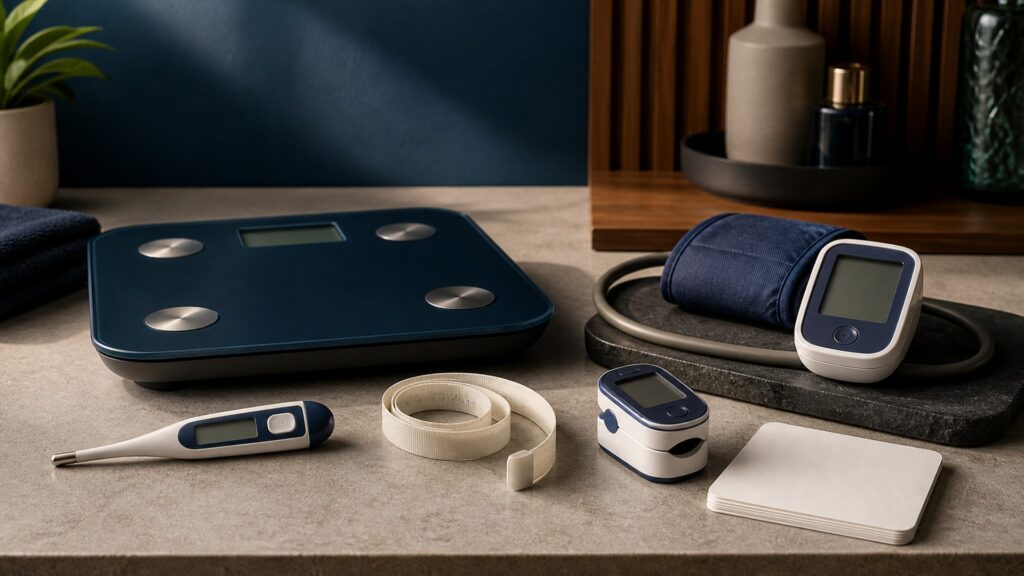
What Makes Body Measurement Devices Different from Heart Health Devices

Body measurement spans several physical properties, while heart health devices target cardiovascular variables and bring measurement-position, rhythm, cuff, or symptom-specific interpretation.

The deciding issue is different mechanisms. For body measurement devices, examine target variable and resolution; for heart health devices, examine cuff fit and rest period. Feature counts are meaningful once the task has been defined.

By: Review Streets Research Lab
Updated: August 18, 2026
Explainer · 8-12 min read
People-free editorial still life illustrating broad measurement category versus cardiovascular focus
What You'll Learn

Choose Between Body Measurement Devices and Heart Health Devices by Purpose

Use the sequence of target variable, calibration, conditions surrounding use, places where reliability can slip, and what should happen next without allowing a label to substitute for analysis.

  • How target variable defines the first decision
  • Why resolution changes the working pathway
  • Where calibration may introduce uncertainty
  • Which conditions alter placement protocol
  • What repeatability contributes to maintenance planning
  • When measurement trend signals a limit or next action

Tip: Read the concept as part of a system, then connect it back to the use case.

Definitions

Six Concepts That Shape This Decision

These definitions connect the main idea to the variables, limits, and practical signals readers need to compare options.

Target Variable

Physical property the device is intended to measure.

  • Role: In the present context, target variable defines part of body measurement devices.
  • Check: For target variable, locate this concept in the manufacturer's stated use.
  • Boundary: It cannot correct a category mismatch.

Resolution

Smallest displayed change.

  • Role: During preparation, resolution shows how the first pathway is prepared.
  • Check: For resolution, observe it under stable conditions before comparing categories.
  • Boundary: One supportive factor does not secure the final outcome.

Calibration

Comparison or adjustment against a reference.

  • Role: During the direct task, calibration marks a difference in mechanism.
  • Check: For calibration, record any technique or condition that changes its behavior.
  • Boundary: Its value must be read alongside the surrounding steps.

Placement Protocol

Standard location and position for use.

  • Role: While assessing what happened, placement protocol names an output that affects the choice.
  • Check: For placement protocol, relate it to the outcome the product directly creates rather than a sweeping conclusion.
  • Boundary: The individual situation can alter its practical importance.

Repeatability

Closeness of repeated readings under similar conditions.

  • Role: When conditions are imperfect, repeatability changes practical individual suitability.
  • Check: For repeatability, inspect it when an abnormal result or failure occurs.
  • Boundary: A normal-looking result may coexist with failure.

Measurement Trend

Pattern across multiple observations.

  • Role: At the choice stage, measurement trend adds to the ownership burden.
  • Check: For measurement trend, include it in the maintenance and follow-up plan.
  • Boundary: It cannot make warning signs irrelevant.

Tip: Keep the definitions connected; the strongest answer usually comes from the whole system, not one term.

Purpose

Separate the Two Primary Jobs

The first pathway emphasizes target variable, resolution, and calibration; the alternative emphasizes cuff fit, rest period, and lead contact. That difference should come first; cost and convenience follow.

  • Clarify environmental conditions
  • Document user technique
  • Check whether a trend exceeds normal variation
  • Define current intended use

Target Variable is useful only when it answers the stated purpose.

Mechanism

Trace Target Variable, Resolution, and Calibration

Target Variable means physical property the device is intended to measure. Resolution affects the next part of the process: smallest displayed change. The pathway then reaches calibration, meaning comparison or adjustment against a reference.

  • Locate target variable in the instructions
  • Observe how resolution changes operation
  • Treat calibration as a defined step
  • Relate placement protocol to the outcome the product directly creates

Mechanism analysis makes clear where placement protocol can change the result.

Conditions

Compare the Factors Behind Placement Protocol

A careful comparison tracks the following factors: verify target variable; device resolution; calibration status; placement; and posture. If several change together, it becomes difficult to identify whether placement protocol or other conditions produced the observed difference.

  • Hold timing steady
  • Label units
  • Recheck repeatability
  • Preserve context for repeatability

Comparable conditions make the selection between categories easier to interpret without pretending uncertainty disappears.

Limits

Plan for Problems Involving Repeatability

Build the safety plan around these requirements: inspect before operation; use the least intensive suitable setting; stop if the user responds unexpectedly; protect children and private information; and maintain a working alternative. If the step associated with repeatability breaks down or the user's condition changes, a seemingly normal output should not delay an action matched to the case at hand.

  • Avoid unsupervised treatment changes
  • Avoid treating one consumer reading as a diagnosis
  • Follow cleaning and weight limits
  • Follow the backup procedure when problems involve measurement trend

The safety boundary for the selection between categories includes failure, misuse, and warning signs.

Routine

Make Measurement Trend Part of a Sustainable Process

Routine use should account for these actions: use consistent timing and placement; repeat only when justified; record units and context; clean it; review trends rather than reacting to isolated fluctuations; and check condition before use. The workflow continues with: prepare compatible supplies; and confirm settings and power. Keep any required caregiver or professional review in the process.

  • Perform the task the product performs directly in sequence
  • Observe the first-order result
  • Choose one measurement protocol
  • Prepare the device

The best routine for the selection between categories is a low-burden process that remains dependable.

Quick Reality Check

A Practical Boundary for the selection between categories

Use target variable and placement protocol to separate what the evidence supports versus a broader claim ordinary operation cannot establish independently.

Reasonable Findings

A suitable application can demonstrate how target variable affects resolution under this product's documented conditions.

Repeated attention to calibration and placement protocol can reveal whether the first-order function remains practical over time.

What Still Requires Caution

Consumer use cannot convert repeatability into proof of an underlying condition or cancel person-specific limits.

A failure involving measurement trend needs the response established for the user rather than another unsupported attempt.

Common Myths

Misconceptions That Distort the Decision

Common shortcuts and misunderstandings can make the topic seem simpler than it is.

Resolution makes body measurement devices equivalent to heart health devices

Resolution contributes one input to this choice of category. That definition is too narrow to support the claim. The conclusion must also account for user technique. A safe-use plan should also use the least intensive suitable setting.

Calibration proves the option with more features is superior

Calibration describes a control within the category choice. The description does not justify that conclusion. The conclusion cannot omit whether a trend exceeds normal variation. The user may also need to stop when the response differs from expectations.

Placement Protocol lets one option replace both categories

Placement Protocol marks an intermediate step in the product-category choice. Its role in the pathway is more limited than the myth suggests. The conclusion must also account for current intended use. The applicable precaution is to protect children and private information.

Repeatability decides the choice while ignoring upkeep

Repeatability sets one boundary around the decision between product types. A correct setup still cannot control every variable. The finding also turns on verify target variable. Responsible follow-through should maintain a working alternative.

Tip: Treat strong claims as starting points for comparison, not final answers.

FAQ

Questions to Ask Before Choosing

Concise answers to common questions readers may have after the main explanation.

What should be checked first for placement protocol?

Placement Protocol enters at the start of the product-category choice. Start by reviewing device resolution. The daily routine should also repeat only when justified. The applicable precaution is to maintain a working alternative.

How can the result be interpreted for repeatability?

Repeatability changes a control point in the product-category choice. Interpret the observation alongside calibration status. The daily routine should also record units and context. The backup procedure should also avoid unsupervised treatment changes.

Which condition commonly changes performance for measurement trend?

Measurement Trend affects the observable output from the category choice. Compare performance only after recording placement. The daily routine should also clean it. Before continuing, remember to avoid treating one consumer reading as a diagnosis.

When should use stop or receive review for target variable?

Target Variable helps define the stopping point for the category selection. Before continuing use, confirm posture. The daily routine should also review trends rather than reacting to isolated fluctuations. This boundary requires users to follow cleaning and weight limits.

Bottom Line

Judge the two-category choice through target variable, calibration, and the real conditions surrounding repeatability.

A sound decision keeps resolution visible, builds placement protocol into the workflow, and responds promptly when measurement trend or another defined warning condition appears.

Next Steps

Go Deeper or Compare Your Options

Use these Review Streets paths to connect the explainer to related categories, comparisons, and next decisions.

Quick Summary

Practical Takeaways

  • Target Variable frames the first practical question.
  • Resolution helps explain the working mechanism.
  • Measurement context includes environmental conditions.
  • Safety planning includes this rule: inspect before operation.
  • Reliable follow-through includes this action: use consistent timing and placement.