
Outward Expansion
The drum-brake action where shoes move away from the center and into the drum.
- Drum role: Creates internal friction
- Check: Shoe movement and return springs
- Limit: Hidden inside the drum
Brake drums and brake calipers both create friction, but their architecture is almost opposite. A drum brake pushes shoes outward inside a rotating shell; a caliper clamps pads inward against an exposed rotor.
That design split affects cooling, inspection, parking-brake packaging, hardware complexity, and the way wear shows up. The point is not that one label is always better, but that each system solves the braking problem through a different mechanical path.
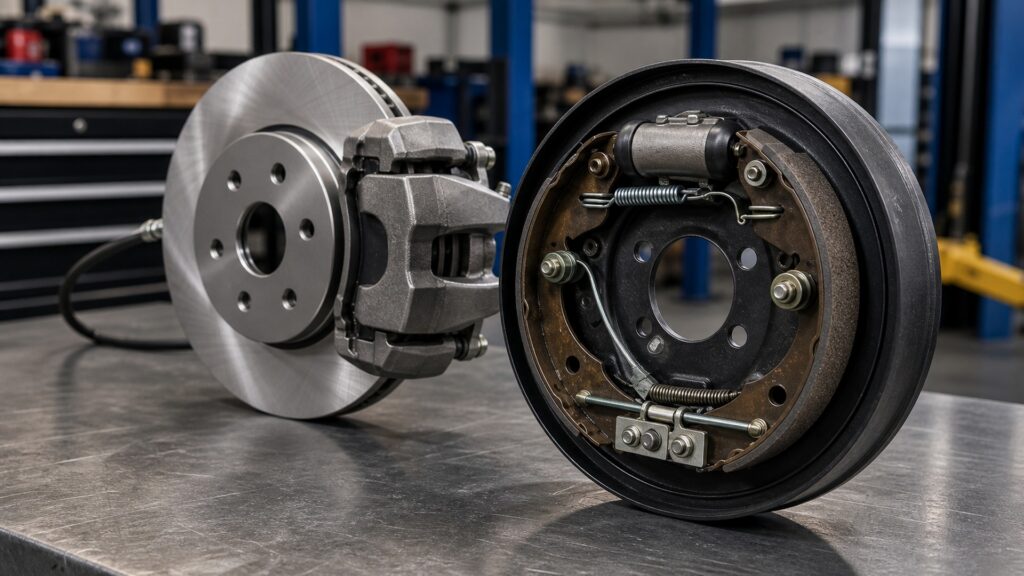
A clear explanation of brake drums vs brake calipers, focused on role, mechanism, fit, service limits, and repair decisions.
Tip: Read the concept as part of a system, then connect it back to the use case.
These definitions connect the main idea to the variables, limits, and practical signals readers need to compare options.
The drum-brake action where shoes move away from the center and into the drum.
The caliper action where pads squeeze the rotor from outside.
The drum's internal contact area.
The disc-brake surface clamped by pads.
Springs and adjusters that manage drum shoe position.
Pistons and slides that manage pad application.
Tip: Keep the definitions connected; the strongest answer usually comes from the whole system, not one term.
The force path is the defining difference. Drums expand shoes outward; calipers squeeze pads inward.
Same goal, different mechanical direction.
A rotor sits in open air, while a drum encloses more of the friction surface. That difference affects repeated-stop behavior.
Heat behavior depends on design and workload.
Disc brakes are usually easier to inspect quickly. Drum brakes hide springs, shoes, leaks, and dust until the shell comes off.
Access changes diagnosis speed.
Drums can integrate parking brake hardware efficiently and may be cost-effective on some rear axles.
Drums remain a packaging answer in some vehicles.
The comparison should be tied to the vehicle and use case, not to a universal ranking.
The better system is the one matched to the vehicle and condition.
The comparison is useful when it focuses on mechanical direction, heat, access, and packaging.
It shows why drum brakes hide more service parts inside the assembly.
It explains why disc brakes are often favored where repeated heat and quick inspection matter.
It cannot say every disc system is better than every drum system.
Maintenance quality and vehicle design can matter more than the label.
Common shortcuts and misunderstandings can make the topic seem simpler than it is.
Drums are rotating shells with shoes inside; calipers are clamps around rotors.
They do shed heat, but their enclosed layout usually manages heat differently from exposed rotors.
Slides, clips, pins, seals, and brackets still affect caliper behavior.
Some vehicles use rear drums for cost, parking-brake packaging, and lower rear braking load.
Tip: Treat strong claims as starting points for comparison, not final answers.
Concise answers to common questions readers may have after the main explanation.
Drums use outward shoe expansion; calipers use inward pad clamping.
Pads, rotors, and caliper hardware are more exposed than the internal parts of a drum brake.
They can package parking brake hardware simply and work well in some rear-brake applications.
Many disc systems shed repeated heat better, but size, materials, airflow, and use still matter.
Yes. Front discs with rear drums have been common on many vehicles.
Brake drums and brake calipers solve the same braking goal through opposite mechanical layouts.
The practical takeaway is to compare enclosure, heat, access, and parking-brake needs instead of treating one label as universally superior.
Use these Review Streets paths to connect the explainer to related categories, comparisons, and next decisions.
Use the Automotive Replacement Parts path for related brake component explainers and comparisons.
Use the Brake Components path for related brake component explainers and comparisons.
Use the Brake Drums path for related brake component explainers and comparisons.
Choose a retailer
Prices checked regularly. We may earn a commission at no cost to you.