
Hydraulic Clamp
The caliper function that turns fluid pressure into pad force.
- Caliper role: Applies pressure
- Kit role: Supports movement
- Limit: Hardware cannot seal fluid
Brake hardware kits and brake calipers occupy different levels of the brake system. A caliper is the hydraulic clamp assembly for a disc brake; a hardware kit is a collection of smaller support parts that guide, retain, protect, or quiet the friction components.
The difference matters when diagnosing drag or uneven pad wear. A caliper may be blamed because it is large and visible, but corroded clips, dry pins, torn boots, or missing anti-rattle parts can create similar symptoms without the caliper body being the root failure.
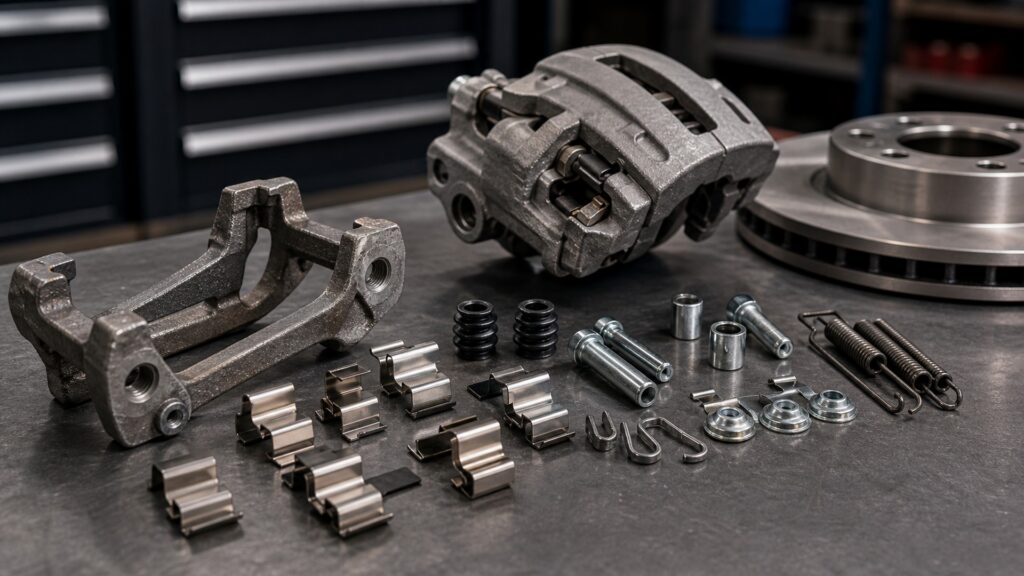
A practical explanation of brake hardware kits vs brake calipers for brake-component comparison and service decisions.
Tip: Read the concept as part of a system, then connect it back to the use case.
These definitions connect the main idea to the variables, limits, and practical signals readers need to compare options.
The caliper function that turns fluid pressure into pad force.
Clips, boots, pins, springs, and retainers around the friction parts.
A sliding part associated with floating calipers.
A replaceable pad contact surface in the bracket.
A hydraulic sealing part inside the caliper.
Small hardware's role in managing rattle and vibration.
Tip: Keep the definitions connected; the strongest answer usually comes from the whole system, not one term.
The caliper creates clamp force; the hardware kit manages how surrounding parts sit and move.
One part applies force; the other supports controlled motion.
Binding hardware can make a healthy caliper look guilty.
Small hardware can create large symptoms.
Hardware is not a cure for hydraulic or structural caliper faults.
The failed function sets the scope.
Pad wear patterns can point toward hardware or caliper problems.
Wear is evidence, not a verdict.
Compare what the kit includes with what the diagnosis found.
Do not buy the larger part just because the symptom is annoying.
The comparison keeps repair scope tied to the failed function.
It separates hydraulic clamp problems from support hardware problems.
It helps avoid replacing a caliper for a clip or pin issue.
Some caliper assemblies include partial hardware.
Hoses, pads, rotors, and brackets can complicate diagnosis.
Common shortcuts and misunderstandings can make the topic seem simpler than it is.
It usually renews support parts, not the hydraulic caliper assembly.
Many calipers do not include all pad hardware or bracket parts.
Binding clips, pins, or hoses can create drag too.
New clamp parts still need correct pad support hardware.
Tip: Treat strong claims as starting points for comparison, not final answers.
Concise answers to common questions readers may have after the main explanation.
A caliper applies hydraulic clamp force; a hardware kit renews support and retention parts.
It can fix binding slides or clips, but not a seized piston or leaking seal.
Some include brackets or pins, but many do not include all pad hardware.
Neither by default. Diagnose whether the failure is hydraulic, structural, sliding, or support-related.
It can contribute to heat and corrosion around caliper movement parts.
Brake hardware kits are not miniature calipers; they are support systems around the friction parts.
The practical takeaway is to separate hydraulic clamp failure from clip, pin, boot, spring, and retention failure.
Use these Review Streets paths to connect the explainer to related categories, comparisons, and next decisions.
Explore related Review Streets coverage in Automotive Replacement Parts.
Explore related Review Streets coverage in Brake Components.
Explore related Review Streets coverage in Brake Hardware Kits.
Compare brake caliper fitment and operating context.
Choose a retailer
Prices checked regularly. We may earn a commission at no cost to you.