
Brake Rotor
The disc attached to the hub that rotates with the wheel.
- Role: Provides pad contact and heat absorption
- Check: Scoring, cracks, thickness, and runout
- Limit: Does not create clamp force
Brake rotors and brake calipers are often discussed together because both sit at the wheel, but they do very different jobs. The rotor is the rotating friction surface; the caliper is the hydraulic clamp that squeezes pads against it.
This explainer separates surface wear from clamp failure. That distinction helps readers understand why a scored rotor, leaking caliper, worn pad, or seized slide points to a different repair path.
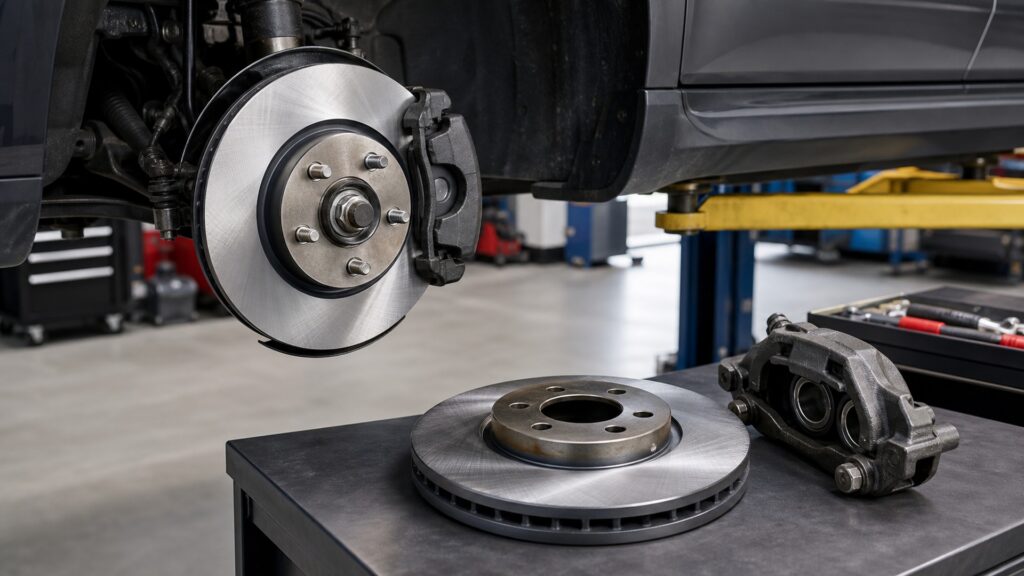
A practical comparison of the rotating disc that absorbs heat and the hydraulic assembly that applies pad force.
Tip: Read the concept as part of a system, then connect it back to the use case.
These definitions connect the main idea to the variables, limits, and practical signals readers need to compare options.
The disc attached to the hub that rotates with the wheel.
The clamp assembly that uses hydraulic pressure to press pads into the rotor.
The friction material between the caliper and rotor.
The caliper component pushed outward by brake fluid pressure.
The rotor material that absorbs heat from pad contact.
The caliper and pad movement that lets the rotor spin freely after braking.
Tip: Keep the definitions connected; the strongest answer usually comes from the whole system, not one term.
The caliper creates squeeze; the rotor receives that squeeze through the pads while spinning with the wheel. The pad is the contact bridge between hydraulic force and rotating friction surface.
The parts cooperate, but each one fails according to its own job.
Rotor problems usually appear as surface, thickness, heat, or mounting issues. Scoring, cracks, heavy rust, uneven deposits, or runout point toward the rotating disc rather than the hydraulic clamp.
Rotor evidence is about the rotating surface and its position.
Caliper problems usually involve pressure, movement, sealing, or release. A leaking piston seal, seized slide, torn boot, or dragging pad points toward the clamp assembly instead of the rotor alone.
Caliper evidence is about force control and release.
The confusing part is that one failed component can damage the other. A dragging caliper can overheat a rotor, while a damaged rotor can wear pads and make the caliper area seem noisy.
Shared symptoms need role-based inspection instead of guessing.
A practical check separates friction-surface evidence from hydraulic-clamp evidence. Inspect the rotor, pads, caliper movement, fluid condition, and heat pattern before choosing parts.
The right replacement is the one tied to the failed function.
Separating the two roles helps avoid wrong parts, but brake symptoms can still involve several components at once.
It explains why a worn friction surface and a failed hydraulic clamp call for different inspections and different parts.
It also helps readers understand why replacing only the visible damaged part may not fix the cause.
A dragging caliper can damage rotors and pads, so the final symptom may involve all three components.
A complete decision still needs measurement, movement checks, leak inspection, and vehicle-specific fitment.
Common shortcuts and misunderstandings can make the topic seem simpler than it is.
They work together, but their roles are separate. The rotor provides the rotating friction surface and heat sink, while the caliper supplies hydraulic clamp force and release movement through pads and slides.
A scored or rusty rotor may come from age, pad wear, contamination, or mounting issues. The caliper becomes suspect only when there is evidence of leaks, sticking, poor release, or uneven clamp behavior.
A caliper can fix vibration only if drag or uneven clamp force caused the issue. Rotor runout, thickness variation, uneven deposits, dirty hub seating, or wheel torque problems may remain after caliper replacement.
Rotors may be simpler surface parts, but replacing them alone is not enough when a caliper is leaking, seized, or dragging. The cheaper part does not fix a failed hydraulic function.
Tip: Treat strong claims as starting points for comparison, not final answers.
Concise answers to common questions readers may have after the main explanation.
The rotor is the spinning disc that pads grip and heat up. The caliper is the hydraulic clamp that pushes the pads into the rotor and releases them after braking pressure drops.
Rotor problems often show as scoring, cracks, heavy rust, thickness variation, heat spots, runout, or vibration during braking. Those clues relate to the disc surface, its heat history, or its mounting position.
Caliper problems often show as fluid leaks, seized pistons, stuck slide pins, torn boots, pulling, dragging, or uneven inner and outer pad wear. Those clues involve clamp force or release movement.
Yes. A caliper that drags or clamps unevenly can overheat the rotor, create deposits, accelerate pad wear, and cause scoring. That is why rotor replacement should include caliper movement checks.
Not automatically. Replace rotors for surface, heat, thickness, or runout problems, and replace calipers for hydraulic or movement failures. Replace both only when inspection clearly shows both roles have failed.
Brake rotors are rotating friction and heat surfaces; brake calipers are hydraulic clamp assemblies.
The practical takeaway is to identify whether the complaint comes from surface condition, heat management, clamp force, leakage, or release movement before choosing parts.
Use these Review Streets paths to connect the explainer to related categories, comparisons, and next decisions.
Explore related Review Streets coverage in Automotive Replacement Parts.
Explore related Review Streets coverage in Brake Components.
Explore related Review Streets coverage in Brake Rotors.
Compare related Brake Calipers brake component context.
Choose a retailer
Prices checked regularly. We may earn a commission at no cost to you.