What Makes Compact SUVs Different from Hybrid SUVs

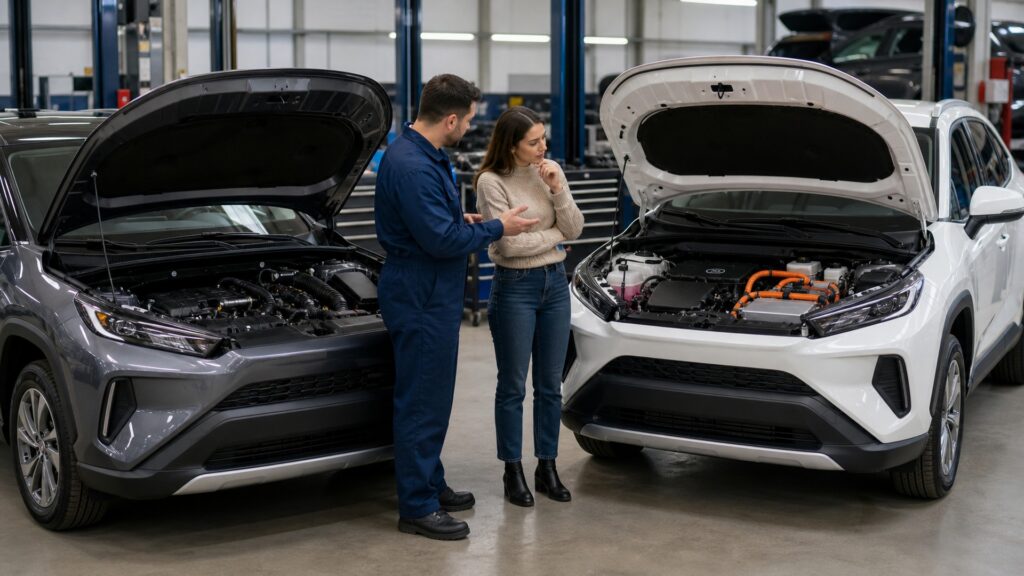
Compact SUVs and hybrid SUVs are not separate, competing classes. Compact describes vehicle size, while hybrid describes a powertrain that combines an engine with electrical equipment. A compact hybrid SUV belongs to both groups. The meaningful comparison is between specific compact models with different powertrains, or between different body sizes while keeping propulsion differences explicit.

A compact body affects parking, access, and usable passenger-and-cargo space. Hybrid propulsion affects energy flow, engine operation, fuel use, and some service considerations. Neither label guarantees the other’s benefits, and the hybrid category itself includes conventional and plug-in arrangements with different ownership routines.

By: Review Streets Research Lab
Updated: September 30, 2026
Explainer · 8-12 min read
compact suvs explainer hero image for Review Streets
What You'll Learn

Compare the Body and the Energy System Separately

Clear categories make a purchase comparison easier to interpret.

  • Recognize compact hybrids as part of both groups.
  • Match required seating and cargo before comparing powertrains.
  • Distinguish conventional hybrids from plug-in hybrids.
  • Evaluate fuel use for the actual driving pattern.
  • Compare equipment, price, and service on equivalent terms.

Tip: A larger hybrid’s extra passenger space comes from its design and dimensions, not simply from having a hybrid system.

Definitions

The Concepts Behind This Overlapping Comparison

Each term describes a different aspect of the vehicle.

Compact size class

A broad category describing a comparatively small SUV body and packaging.

  • Example: A compact fits a parking area that is awkward for a larger model.
  • Check: Check actual exterior and interior dimensions.
  • Limit: The size class does not specify propulsion.

Hybrid powertrain

An engine and electrical equipment coordinated to propel the vehicle according to its design.

  • Example: The motor assists engine output during part of a journey.
  • Check: Identify the exact system and its capabilities.
  • Limit: Hybrid designs do not all operate identically.

Conventional hybrid

A hybrid that normally uses fuel as its external energy source without plug-in charging.

  • Example: The driver refuels while the vehicle manages battery use internally.
  • Check: Confirm that the model is not a plug-in version.
  • Limit: Electric-only capability varies by hybrid type.

Plug-in hybrid

A hybrid that can also receive external electrical energy through charging.

  • Example: Regular charging supports a portion of driving using stored electricity.
  • Check: Check electric capability and conditions for engine operation.
  • Limit: A charged battery does not guarantee the engine always stays off.

Braking energy recovery

Capture of some vehicle motion as electricity during deceleration.

  • Example: The motor returns energy to the battery while helping slow the SUV.
  • Check: Understand the contribution and its operating limits.
  • Limit: It does not supply unlimited energy or eliminate fuel or charging needs.

Equivalent configuration

A comparison that accounts for body, equipment, and capability differences.

  • Example: Gasoline and hybrid trims are compared with the same required features.
  • Check: Identify differences before attributing cost or space changes to propulsion.
  • Limit: A shared model name does not guarantee identical equipment.

Tip: Use the full description—such as compact conventional hybrid—when a single label leaves the comparison unclear.

The physical vehicle

Compact Dimensions Address Space and Access

A compact SUV may reduce the amount of vehicle that must be parked and maneuvered, but usable interior space still depends on the design. Check occupants, restraints, luggage, and opening clearances in the actual candidate. Hybrid propulsion does not automatically make the body larger or the cabin more useful.

  • Measure the normal parking and access requirements.
  • Try required passengers with their usual seat positions.
  • Check luggage space with needed seats retained.

A compact hybrid that fits the household can preserve the same parking advantages as a compact gasoline alternative. A larger hybrid may provide more room while introducing a separate size tradeoff.

Energy management

The Hybrid System Changes How Propulsion Is Supplied

Hybrid systems coordinate engine and electrical operation in ways that differ by architecture. Some can propel the vehicle electrically in particular conditions; other systems mainly assist the engine. Battery charging within a conventional hybrid comes from engine operation and recovered motion rather than an external plug.

  • Read the specific system’s description.
  • Avoid assuming every hybrid offers sustained electric-only driving.
  • Assess normal response and engine transitions on a test drive.

An engine starting at a stop or during acceleration can be a normal control decision. The vehicle’s requirements for power, temperature, or battery management determine behavior, not the compact body classification.

Refueling and charging

Separate Conventional and Plug-In Ownership

A conventional hybrid maintains a fuel-stop routine. A plug-in hybrid adds a charging opportunity and can use externally supplied electricity for part of its travel. Its practical value depends in part on whether charging is convenient and regularly used, while the engine remains part of the vehicle and its service plan.

  • Confirm the hybrid type before comparing energy costs.
  • For a plug-in, verify charging access and capability.
  • Read the conditions under which engine operation may occur.

Two compact hybrids can require different planning if one plugs in and the other does not. Treating them as one identical ownership arrangement can hide a charging dependency or an unrealistic fuel-use assumption.

Efficiency and expense

Compare the Same Driving Pattern and Equipment

Hybrids can reduce fuel consumption in suitable use, but the benefit varies by model and route. Use vehicle-specific efficiency information, realistic annual distance, and current energy prices. Then compare purchase terms, insurance, tires, and maintenance rather than assuming fuel savings settle total cost.

  • Compare similar equipment and required capability.
  • Use city and highway information relevant to the routine.
  • For a plug-in, estimate the actual share of charged driving.

A driver covering mostly short local trips can have a different result from someone doing long highway runs. The appropriate comparison describes those trips instead of applying one generic savings percentage.

Packaging and service

Verify the Version Instead of Assuming Everything Matches

Hybrid components can change storage arrangements, spare-wheel provision, weight allowances, or accessory applications within a model family. Engine maintenance remains relevant, and electrical systems have their own instructions. Inspect the specific version and use its ratings and schedule.

  • Compare usable cargo shape and any underfloor storage.
  • Verify payload, towing, and accessory compatibility.
  • Review engine and hybrid-specific service requirements.

A cargo tray or towing figure from a gasoline version may not apply to the hybrid variant. Shared styling makes the vehicles easy to associate, but it does not establish identical specifications.

Quick Reality Check

Which Label Answers Which Question?

Use both labels when both characteristics matter.

Compact helps describe…

Exterior scale and the space available for passengers and cargo.

The parking and access demands of the body.

Hybrid helps describe…

Engine-and-electric cooperation and energy-recovery capability.

The fueling or charging arrangement and relevant service considerations.

Common Myths

Misconceptions About Compact and Hybrid SUVs

Avoid giving either label more meaning than it carries.

Must I choose between compact size and a hybrid?

No. Compact hybrid SUVs combine both characteristics.

Does hybrid always mean plug-in?

No. Conventional hybrids normally do not accept external charging; plug-in hybrids do.

Is every hybrid able to drive with its engine off?

No. Electric-only capability depends on the type and design.

Will a hybrid version have identical cargo and towing specifications?

Not necessarily. Verify the exact variant’s layout, ratings, and equipment.

Tip: Compare actual configurations when a decision depends on a specific amount of room or capability.

FAQ

Questions for Comparing Compact Powertrains

Use a common household task to make the differences meaningful.

What is a fair starting comparison?

Compare compact gasoline, conventional-hybrid, and plug-in-hybrid candidates that meet the same passenger, cargo, and equipment requirements.

Do I need a charger for every hybrid?

No. Conventional hybrids use fuel-based replenishment; plug-in hybrids can also charge externally.

How should I judge a price premium?

Compare the actual purchase difference and expected ownership costs over the same mileage and period, including realistic energy use.

What should I inspect beyond the test drive?

Check storage, restraint fit, ratings, accessory applications, and the correct service schedule for the variant.

Bottom Line

Compact describes the body; hybrid describes the propulsion system.

Choose the space you need, then compare conventional, hybrid, and plug-in arrangements on real efficiency, access, cost, and service requirements.

Next Steps

Go Deeper or Compare Your Options

Use these Review Streets paths to compare related categories and practical next decisions.

Vehicles

Compare related vehicle choices against the same carrying needs and driving routine.

SUVs

Compare related vehicle choices against the same carrying needs and driving routine.

Compact SUVs

Explore Compact SUVs with your passenger, cargo, and ownership requirements in mind.

Further reading: DOE hybrid configurations; Plug-in hybrid operation; Electrified-vehicle maintenance; Vehicle efficiency comparison. Use the owner’s manual for the exact vehicle’s instructions and limits.