
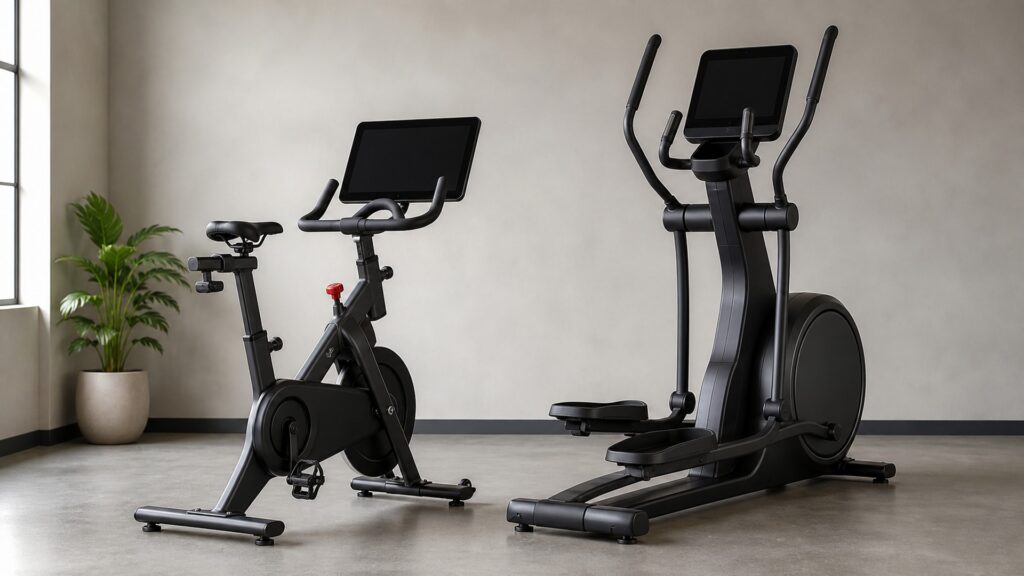
What Makes Connected Exercise Bikes Different from Rear Drive Ellipticals

Connected Exercise Bikes and Rear Drive Ellipticals are not interchangeable tools with different labels. Connected Exercise Bikes is organized around rider fit, flywheel inertia, electronic resistance, cadence and power sensing, display content, connectivity, user profiles, software control, subscriptions, and maintenance, whereas Rear Drive Ellipticals is organized around rear-drive geometry, pedal path, stride length, resistance, ramp angle, hand support, cadence, user setup, frame stability, and maintenance.

For Connected Exercise Bikes, the useful difference is the task each option serves, the input it asks from the user, and the tradeoffs created by its setup—not which name sounds more advanced.

By: Review Streets Research Lab
Updated: August 19, 2026
Explainer · 8-12 min read
connected exercise bikes explainer hero image for Review Streets
What You'll Learn

Connected Exercise Bikes Versus Rear Drive Ellipticals: The Decision Map

Compare purpose, movement or operating method, setup, feedback, and limits before choosing between connected exercise bikes and rear drive ellipticals.

  • The primary job performed by Connected Exercise Bikes
  • The different job performed by Rear Drive Ellipticals
  • How user input differs between the two options
  • Which setup demands matter in the intended location
  • What each option measures or communicates
  • Which tradeoffs appear during repeated use
  • A scenario-based rule for making the final choice

Tip: Read the concept as part of a system, then connect it back to the use case.

Definitions

Key Concepts That Define Connected Exercise Bikes

These definitions connect the main idea to the variables, limits, and practical signals readers need to compare options.

Frame and adjustable contact points

On the Connected Exercise Bikes side of this comparison with Rear Drive Ellipticals, the function of frame and adjustable contact points is to hold the working parts in alignment and manage load against the floor at the input or starting-condition stage.

  • Role: This comparison treats frame and adjustable contact points as the input or starting-condition stage checkpoint for connected exercise bikes.
  • Compare: For frame and adjustable contact points, look for movement, flex, and clearance during the full task; for rear drive ellipticals, inspect rear flywheel housing, whose function is to create, transfer, or regulate the working resistance at the input or starting-condition stage.
  • Limit: A comparison based only on frame and adjustable contact points is incomplete because insufficient stability or space can undermine otherwise capable hardware.

Flywheel and resistance system

On the Connected Exercise Bikes side of this comparison with Rear Drive Ellipticals, the function of flywheel and resistance system is to create, transfer, or regulate the working resistance at the transfer and stabilization stage.

  • Role: This comparison treats flywheel and resistance system as the transfer and stabilization stage checkpoint for connected exercise bikes.
  • Compare: For flywheel and resistance system, test whether changes feel smooth and predictable at realistic effort; for rear drive ellipticals, inspect pedals and rails, whose function is to hold the working parts in alignment and manage load against the floor at the transfer and stabilization stage.
  • Limit: A comparison based only on flywheel and resistance system is incomplete because headline resistance levels do not reveal control, noise, or usable range.

Crank and pedals

On the Connected Exercise Bikes side of this comparison with Rear Drive Ellipticals, the function of crank and pedals is to determine leverage and the position from which force enters the movement at the adjustment and user-control stage.

  • Role: This comparison treats crank and pedals as the adjustment and user-control stage checkpoint for connected exercise bikes.
  • Compare: For crank and pedals, align the contact point with a repeatable joint position and range; for rear drive ellipticals, inspect linkage arms, whose function is to coordinate the component's contribution at stage 3 of the rear drive ellipticals system.
  • Limit: In connected exercise bikes, a comparison based only on crank and pedals is incomplete because a mismatched position can shift stress or shorten usable motion.

Display or device mount

On the Connected Exercise Bikes side of this comparison with Rear Drive Ellipticals, the function of display or device mount is to turn operating data into controls, prompts, or feedback at the contact or feedback stage.

  • Role: This comparison treats display or device mount as the contact or feedback stage checkpoint for connected exercise bikes.
  • Compare: For display or device mount, check whether the displayed metric changes a real decision; for rear drive ellipticals, inspect moving handlebars, whose function is to form the main contact point where pressure and control pass between user and product at the contact or feedback stage.
  • Limit: In connected exercise bikes, a comparison based only on display or device mount is incomplete because a polished interface can still present estimates or distracting features.

Sensors and connectivity

On the Connected Exercise Bikes side of this comparison with Rear Drive Ellipticals, the function of sensors and connectivity is to capture or translate a signal into usable feedback at the repeatability and durability stage.

  • Role: This comparison treats sensors and connectivity as the repeatability and durability stage checkpoint for connected exercise bikes.
  • Compare: In connected exercise bikes, for sensors and connectivity, compare readings under the same placement and conditions; for rear drive ellipticals, inspect resistance system, whose function is to create, transfer, or regulate the working resistance at the repeatability and durability stage.
  • Limit: In connected exercise bikes, a comparison based only on sensors and connectivity is incomplete because poor contact, motion, or calibration can distort the reading.

Power supply and software account

On the Connected Exercise Bikes side of this comparison with Rear Drive Ellipticals, the function of power supply and software account is to turn operating data into controls, prompts, or feedback at the maintenance, storage, or release stage.

  • Role: This comparison treats power supply and software account as the maintenance, storage, or release stage checkpoint for connected exercise bikes.
  • Compare: For power supply and software account, check whether the displayed metric changes a real decision; for rear drive ellipticals, inspect frame, console, and stabilizers, whose function is to turn operating data into controls, prompts, or feedback at the maintenance, storage, or release stage.
  • Limit: A comparison based only on power supply and software account is incomplete because a polished interface can still present estimates or distracting features.

Tip: Keep the definitions connected; the strongest answer usually comes from the whole system, not one term.

Decisive distinction

The Core Difference Between Connected Exercise Bikes and Rear Drive Ellipticals

Connected Exercise Bikes centers on rider fit, flywheel inertia, electronic resistance, cadence and power sensing, display content, connectivity, user profiles, software control, subscriptions, and maintenance. For Connected Exercise Bikes, by contrast, Rear Drive Ellipticals centers on rear-drive geometry, pedal path, stride length, resistance, ramp angle, hand support, cadence, user setup, frame stability, and maintenance. For Connected Exercise Bikes, that structural difference determines which comparison criteria are meaningful.

  • Name the task assigned to Connected Exercise Bikes
  • Name the task assigned to Rear Drive Ellipticals
  • Compare the user input each option requires
  • Discard features unrelated to that task

For Connected Exercise Bikes, the clearest difference begins with purpose and operating method.

User experience

How the Two Options Ask the User to Work

With Connected Exercise Bikes, control passes through frame and adjustable contact points, flywheel and resistance system, and crank and pedals. For Connected Exercise Bikes, rear Drive Ellipticals creates a different interaction because its system relies on rear-drive geometry, pedal path, stride length, resistance, ramp angle, hand support, cadence, user setup, frame stability, and maintenance.

  • Rehearse the full task with Connected Exercise Bikes
  • Estimate the learning and setup demand for Rear Drive Ellipticals
  • Compare comfort only under equivalent conditions
  • Check whether feedback leads to a useful action

For Connected Exercise Bikes, a fair comparison uses the same goal and realistic conditions for both options.

Best-fit situations

When Connected Exercise Bikes Is the Better Fit—and When It Is Not

Favor Connected Exercise Bikes when this benefit answers the real need: a well-matched connected exercise bike can combine repeatable indoor cycling, guided sessions, automatic resistance, and performance feedback in one platform. For Connected Exercise Bikes, favor Rear Drive Ellipticals when its own use case is the closer match: rear-drive ellipticals can provide a smooth guided stride and adjustable resistance for repeatable low-impact cardio sessions.

  • Choose Connected Exercise Bikes for its relevant operating advantage
  • Choose Rear Drive Ellipticals when its different method better serves the task
  • Account for available space, time, and maintenance
  • Prefer the option the user can operate consistently

The better choice between connected exercise bikes and rear drive ellipticals changes with the scenario.

Tradeoffs

Costs Hidden by a Feature Checklist

The limits of Connected Exercise Bikes include this boundary: connected exercise bikes cannot guarantee accurate metrics, correct fit or technique, lasting software access, or results when setup, progression, connectivity, subscriptions, and maintenance are ignored. For Connected Exercise Bikes, rear Drive Ellipticals brings a separate set of constraints, so counting features without examining failure modes can reverse the apparent winner.

  • Inspect wear around sensors and connectivity
  • Consider upkeep for power supply and software account
  • Include storage, noise, cleanup, or subscription friction where relevant
  • Do not convert a convenience advantage into a safety claim

Tradeoffs explain why neither connected exercise bikes nor rear drive ellipticals wins every comparison.

Decision rule

Choose Between Connected Exercise Bikes and Rear Drive Ellipticals in Four Questions

For Connected Exercise Bikes, ask what outcome is needed, what input the user can provide, what conditions the setup must tolerate, and which limitations are acceptable. For Connected Exercise Bikes, the answers are more durable than a generic ranking.

  • Define one primary outcome
  • Describe the real environment of use
  • Test the most important contact or control point
  • Choose the tolerable tradeoff rather than the longest feature list

For Connected Exercise Bikes, a scenario-specific choice resolves this difference more honestly than a universal verdict.

Quick Reality Check

What This Answer Supports—and What It Cannot Promise

Keep the conclusion about Connected Exercise Bikes and Rear Drive Ellipticals tied to the operating facts and the user's actual conditions.

A Defensible Benefit for Connected Exercise Bikes

For this question, the supported benefit is that a well-matched connected exercise bike can combine repeatable indoor cycling, guided sessions, automatic resistance, and performance feedback in one platform

That benefit is credible when the components are fitted, used, and maintained for the stated task in what makes connected exercise bikes different from rear drive ellipticals.

The Boundary That Still Applies

The central limitation in this answer is that connected exercise bikes cannot guarantee accurate metrics, correct fit or technique, lasting software access, or results when setup, progression, connectivity, subscriptions, and maintenance are ignored

If pain, alarming symptoms, unstable equipment, or a health condition changes the situation, this connected exercise bikes explainer is not a substitute for qualified assessment.

Common Myths

Misconceptions About Connected Exercise Bikes

Common shortcuts and misunderstandings can make the topic seem simpler than it is.

One specification settles the question about Connected Exercise Bikes

No single number captures the interaction among frame and adjustable contact points, flywheel and resistance system, user setup, and the conditions addressed by what makes connected exercise bikes different from rear drive ellipticals.

A feature automatically creates the advertised result

A connected exercise bikes feature provides a capability; the outcome still depends on suitable use, repeatable conditions, and whether the capability serves the stated goal.

More support, resistance, data, or complexity is always better

For Connected Exercise Bikes, additional capability can add friction, fatigue, cost, or new failure points. For connected exercise bikes and rear drive ellipticals, the useful amount is the amount that solves the defined problem.

Owning Connected Exercise Bikes removes the need for technique or maintenance

The condition of sensors and connectivity, the handling of power supply and software account, and the user's decisions remain part of the outcome after purchase.

Tip: Treat strong claims as starting points for comparison, not final answers.

FAQ

Frequently Asked Questions About Connected Exercise Bikes

Concise answers to common questions readers may have after the main explanation.

What is the short answer to “What Makes Connected Exercise Bikes Different from Rear Drive Ellipticals”?

The short answer begins with the operating facts in this specific question: rider fit, flywheel inertia, electronic resistance, cadence and power sensing, display content, connectivity, user profiles, software control, subscriptions, and maintenance. For Connected Exercise Bikes, use that mechanism to judge the stated task rather than relying on the product label alone.

Which part of Connected Exercise Bikes should be checked first?

Start with frame and adjustable contact points because it is an early link in this article's operating or decision chain, then confirm how flywheel and resistance system changes the response.

How can someone test this connected exercise bikes claim?

Use one representative task, keep the setup consistent, observe the response involving crank and pedals, and retest after changing only one relevant variable.

What limitation matters most for Connected Exercise Bikes?

The practical boundary is that connected exercise bikes cannot guarantee accurate metrics, correct fit or technique, lasting software access, or results when setup, progression, connectivity, subscriptions, and maintenance are ignored; a feature should not be interpreted as a guarantee beyond that boundary.

What is the final selection rule for this question?

Choose the setup whose operating method, fit, feedback, upkeep, and limits match the exact task posed by what makes connected exercise bikes different from rear drive ellipticals.

Bottom Line

The answer to what makes connected exercise bikes different from rear drive ellipticals comes from matching the operating chain to a defined task, then checking the components under realistic conditions.

Use frame and adjustable contact points and flywheel and resistance system as starting checks, but make the final judgment from the complete connected exercise bikes system and its stated limits.

Next Steps

Go Deeper or Compare Your Options

Use these Review Streets paths to connect the explainer to related categories, comparisons, and next decisions.

Fitness

Explore the Fitness category for related Review Streets explainers, comparisons, and buying context.

Fitness Technology

Explore the Fitness Technology category for related Review Streets explainers, comparisons, and buying context.

Connected Gym Equipment

Explore the Connected Gym Equipment category for related Review Streets explainers, comparisons, and buying context.

Quick Summary

Connected Exercise Bikes Explained

  • This page answers what makes connected exercise bikes different from rear drive ellipticals directly.
  • Frame and adjustable contact points is the first concrete checkpoint.
  • Flywheel and resistance system changes control or consistency.
  • The relevant benefit is conditional, not guaranteed.
  • The final choice depends on task, setup, evidence, and limits.