
Guided stride
The machine-controlled path followed by the feet.
- It reduces free movement.
- It makes fit important.
- It differs from outdoor gait.
Ellipticals and exercise bikes both provide indoor cardio, but they organize the body differently. An elliptical puts the user in a standing guided stride with pedals moving through an oval path. A bike puts the user in a seated pedaling pattern around a crank.
That difference changes posture, balance, fit, joint motion, muscle involvement, and how the user interacts with resistance. The better comparison is not which machine is more serious. It is which movement pattern fits the session.
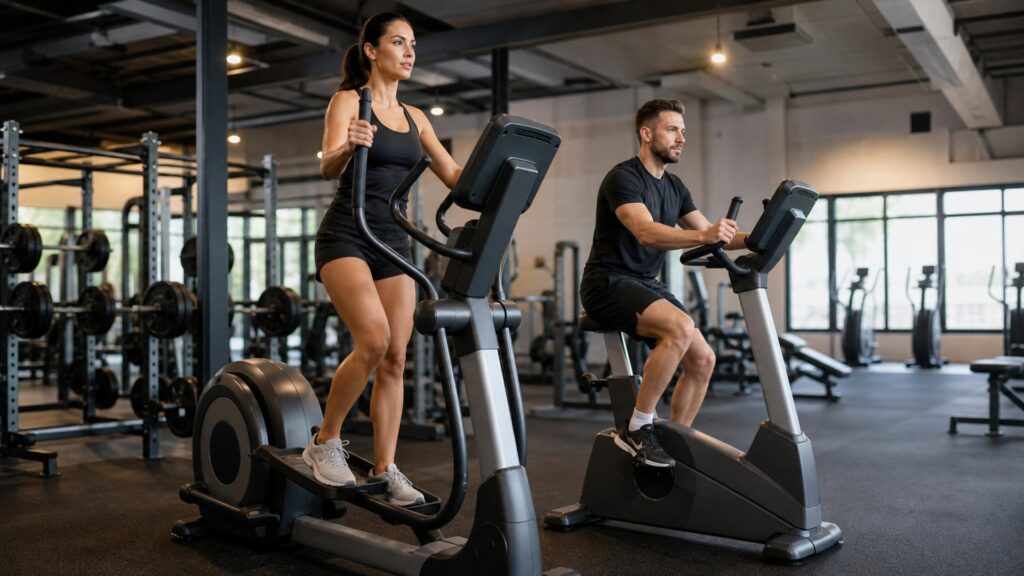
This explainer compares the machine by movement pattern, posture, resistance feel, fit, and workout role.
Tip: Compare the machine's movement first, then compare features.
These definitions connect the main idea to the variables, limits, and practical signals readers need to compare options.
The machine-controlled path followed by the feet.
The shape and length of each pedal loop.
The selected difficulty against the drive system.
The rate of repeated strides or strokes.
How the machine positions the body during work.
The job the machine has in the session.
Tip: A cardio machine's label matters less than the path it asks the body to repeat.
The core difference is the path. An elliptical moves each foot through a guided oval stride while the user stands. An exercise bike rotates the feet around a crank while the user sits on a saddle. That changes how the hips, knees, ankles, and torso participate in the session.
The comparison starts with the repeated path each machine asks the body to follow.
A bike saddle supports the user and can reduce balance demand, but it also makes saddle height, fore-aft position, and handle reach central to comfort. An elliptical removes the saddle and shifts the issue toward stance, upright posture, and pedal path fit.
Posture decides which fit details matter most.
Both categories can use magnetic resistance and flywheels, but the body feels that resistance through different mechanics. On a bike, resistance pushes back against pedaling around a crank. On an elliptical, resistance pushes back against a guided standing stride.
Resistance numbers are not directly comparable across machine types.
Exercise bikes may use fixed handles or sometimes moving arms on specialty models, while ellipticals often include moving handlebars tied to the stride. Those arms can add coordination and perceived effort, but they do not turn the elliptical into a strength machine.
Handle design changes rhythm more than it changes the machine category.
If seated pedaling feels better, an exercise bike may fit the session. If a standing low-impact stride feels more natural, the elliptical may fit better. The useful choice comes from posture, fit, cadence, and workout role, not from declaring one machine more serious.
The better machine is the one whose posture and movement can be repeated comfortably.
The comparison explains movement differences without turning them into universal rankings.
It explains why similar cardio goals can feel different on machines with different posture and movement paths.
It helps readers compare fit and session role before chasing feature lists.
It does not prove one machine is safer, better, or more effective for every user.
Comfort, medical history, training goals, space, and model design can change the answer.
Common shortcuts and misunderstandings can make the topic seem simpler than it is.
They can both support indoor cardio, but one uses a standing guided stride and the other uses seated crank rotation.
Seated support can reduce balance demand, but bike fit, saddle pressure, and hip angle can still make the session demanding.
Moving handles add rhythm and coordination, but they should not be treated as a full strength-training substitute.
A level number on an elliptical does not mean the same mechanical feel as the same number on a bike.
Calorie estimates vary and should not replace fit, comfort, consistency, and session purpose.
Tip: Treat strong claims as starting points for comparison, not final answers.
Concise answers to common questions readers may have after the main explanation.
The elliptical uses a standing guided stride; the bike uses seated pedaling around a crank.
A traditional exercise bike usually has less balance demand because the user is seated, though fit still matters.
Moving handlebars can involve the arms rhythmically, but the motion is still tied to the stride and should not be overstated.
The seated position may suit some users better, especially when the saddle, handle reach, and pedal position are set well.
The standing stride may suit users who prefer no saddle contact and a guided low-impact pattern.
Elliptical Machines vs Exercise Bikes matters because machine categories create different movement constraints.
The practical takeaway is to compare posture, path, resistance feel, fit, and session role before deciding which cardio machine belongs in the workout.
Use these Review Streets paths to connect the explainer to related categories, comparisons, and next decisions.
Use this hub to compare elliptical types, stride designs, resistance systems, and console features in one place.
Use this path when the comparison turns on seated cycling, flywheel resistance, bike fit, and lower-body cardio.
Use this path when the next decision involves drive sequence, handle pull, damper feel, and full-body rhythm.
Choose a retailer
Prices checked regularly. We may earn a commission at no cost to you.