
Foil
Thin perforated screen separating reciprocating cutters from skin.
- Use: identify linear capture
- Variable: opening pattern and flex
- Tradeoff: A damaged foil can expose cutters
Foil and rotary razors both cut hair behind a protective metal guard, but they present hair to the cutters differently. A foil shaver uses one or more perforated screens over fast reciprocating blades. It usually works best with straight, overlapping strokes. A rotary shaver uses circular slotted guards over spinning cutters and is normally guided in small circles across changing contours.
The useful difference is capture geometry, not motor mythology. Foils can give precise edges and an even finish on relatively flat areas and regular stubble. Floating rotary heads may maintain contact around a jaw, chin, neck, or scalp and approach multidirectional growth from several angles. Flat-lying hairs, long stubble, pressure, worn parts, and individual skin response can reverse those expectations.
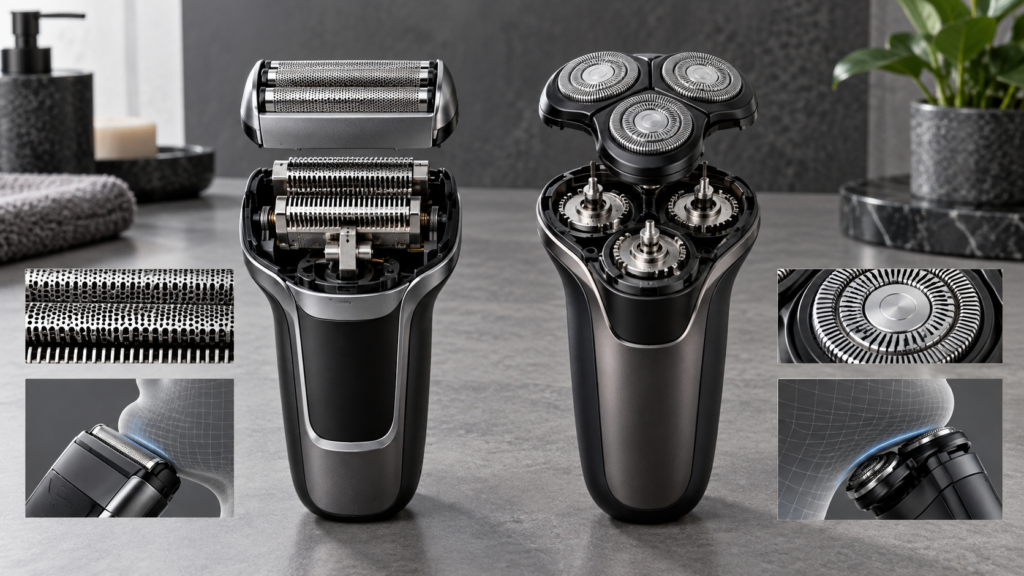
Compare reciprocating cutters beneath linear foils with rotating cutters beneath circular guards by capture geometry, stroke pattern, contours, hair direction, stubble length, closeness, comfort, cleaning, wear, and ownership—not by declaring one architecture universally superior.
Tip: Precision comes from controlled placement, not extra pressure.
These foil razors vs rotary razors concepts separate mechanism, application, limits, and purchasing consequences.
Thin perforated screen separating reciprocating cutters from skin.
Blade moving rapidly back and forth beneath a foil.
Slotted circular surface above a spinning cutter.
Spring-mounted unit that pivots or compresses over contours.
Direction at which hair enters a foil hole or rotary slot.
Matched guard and cutter assembly intended to wear together.
Tip: Use these terms to test foil razors vs rotary razors instead of relying on a front-label promise.
Foil systems often suit users who shave short stubble regularly, like straight strokes, and want deliberate edging around a beard or sideburn.
Precision comes from controlled placement, not extra pressure.
Articulating rotary heads can simplify curved faces or scalps and growth that changes direction, provided small circular passes actually feed hair into the slots.
Contour contact is useful only when hair enters the guard.
Both systems can struggle when hair is too long, flat, oily, or matted. Use the approved trimmer and follow wet or dry preparation instructions for the model.
Preparation changes capture before power changes it.
Hair dust, sebum, mineral residue, damaged foil, dull cutters, and incorrect reassembly can increase heat, pulling, and repeat passes.
A neglected head changes the comparison.
Price compatible heads, cleaning cartridges, lubricant, local parts, warranty, battery service, travel lock, noise, grip, and storage over several years.
The cheaper handle may own the costlier head.
Architecture changes technique and fit; it does not determine comfort or closeness without the exact head, hair, skin, and maintenance state.
The shaving motion matches the cutter system rather than imitating a manual blade.
The head reaches contours without repeated pressure or excessive passes.
Long hairs are pre-trimmed when the guard cannot capture them efficiently.
Replacement foils, cutters, heads, and cleaning supplies are available at a tolerable cost.
These claims flatten the variables that determine how foil razors vs rotary razors performs in a real routine.
Some foil designs cut very close, but exact head, skin, stubble, direction, and technique determine the result.
A rotary head can follow contours, yet pressure, repeated circles, worn cutters, or poor fit can still irritate.
Additional tracks may increase coverage, but head articulation, slot design, access, and motor behavior also matter.
Hair diameter is one variable; length, angle, density, opening geometry, and cutter condition can matter more.
Worn cutters can pull, heat, miss hair, and require more passes before they visibly fail.
Tip: Test the exact foil razors vs rotary razors tool, setting, and routine before generalizing from its category.
The remaining decisions about foil razors vs rotary razors concern technique, compatibility, safety, upkeep, and value.
The answer depends on contour and growth direction. Rotary may follow curves; foil may offer controlled cross-grain strokes. Test without chasing maximum closeness.
Many foils open quickly, while rotary assemblies have more pieces; model-specific rinse and dock systems can reverse that generalization.
Only when the exact model is labeled for wet use, and never while connected to power unless instructions explicitly permit it.
Stubble may be too long, cutters clogged or worn, battery low, movement too fast, or strokes misaligned with growth.
Personal use is preferable because guards contact skin and collect hair and skin material; casual wiping is not validated reprocessing.
Visible dents, holes, rough edges, sudden scratching, or exposed cutter contact require immediate replacement.
Foil razors use linear perforated guards over reciprocating cutters; rotary razors use circular slotted guards over spinning cutters. That changes stroke pattern, contour contact, capture angle, maintenance, and feel.
Choose by growth direction, stubble length, face or scalp contour, edging needs, skin response, cleaning effort, and replacement cost. Technique and head condition often matter more than architecture alone.
These Review Streets paths narrow the next foil razors vs rotary razors decision by format, goal, and routine fit.
Browse shaving, epilation, and light-based hair-removal categories.
Compare at-home beauty devices, including light-based hair-removal systems.
Choose a retailer
Prices checked regularly. We may earn a commission at no cost to you.