
Rinse-off cleanser
A product that washes the skin and comes off with water.
- Job: Cleansing can include the skin on the feet.
- Finish: Dove’s Deep Moisture wash ends with a rinse.
- Other claims: A wash can also be marketed as moisturizing.
Foot care can narrow where a familiar job happens. A heel balm can focus on a dry heel, and some general body moisturizers already include feet. The format can make a different kind of distinction. A foot file can work directly on the sole, while a foot mask can wrap around the foot.
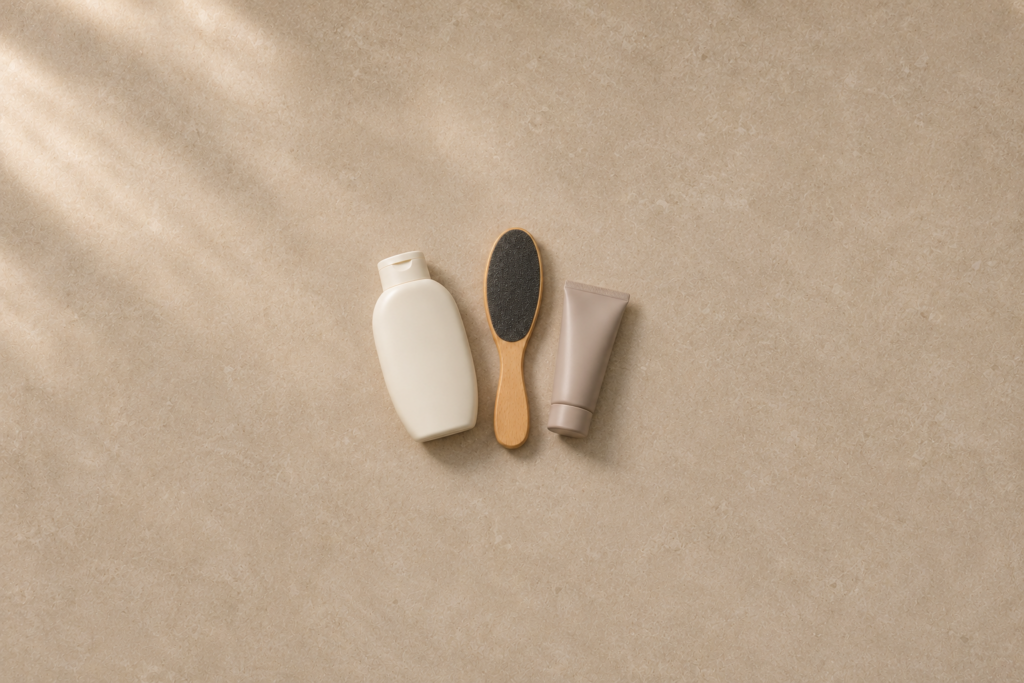
The name on the front can give you the broad task. Directions can narrow it to the parts of the feet that need attention.
Tip: Read the area and the job together. A product can say body lotion and still direct you to apply it just where the skin is rough or bumpy.
A cleanser names a job and Drug Facts names a panel. The definitions here give each term a place in the comparison.
A product that washes the skin and comes off with water.
A moisturizer applied to the skin with no wash-off step in its directions.
A scrub or tool that removes dead skin from the surface through rubbing or filing.
In these examples, a moisturizing product for a smaller area of the foot.
A product worn on the feet for a set period. A bootie is the packet that slips over the foot.
The standard information panel on U.S. over-the-counter medicine labels.
Tip: Read the finish as a separate clue. A leave-on lotion and a wash can both mention moisture while asking you to do different things at the end.
The area a label names can be broad, like the body, or as specific as rough patches on the feet. That difference gives a familiar job a more precise place to happen.
Coverage is part of what makes a product specialized. A foot cream can direct attention to a patch that feels rough even when moisturizing is a familiar job.
A cream can be sold for the look or feel of the skin. Another cream can carry a specific drug use under U.S. labeling rules.
For the U.S. drug example, the Uses entry gives the specific condition. That’s the practical difference that the word cream leaves open.
Dr. Scholl’s sells both a hydrating and an exfoliating mask in booties. The label for each job gives its own wear time and finish.
The brand advises staying seated or lying down in its masks because the booties can be slippery. A format you wear can determine what else you can do during that time.
A familiar function can cross the aisle. A body moisturizer’s intended area can include foot skin.
The scrubs share a rinse step. The area they tell you to focus on is one way their directions differ.
Both AmLactin products highlight the same acid. The stated skin concern and the place each product names tell you which one is presented as foot care.
The stated target tells you which one is presented as foot care. How the two products would perform on the same heel remains open.
The first example shows what a label note can miss on a shared shelf. The second compares moisture language on a wash and a wearable mask.
Imagine jotting down which products on a shared shelf explicitly name feet. A label alone gives you one kind of entry. CeraVe’s general body moisturizer guidance gives you another, because it names feet among the places body moisturizers can be used.
A note that says ‘rinse off’ would group Dove’s broad body scrub and Freeman’s foot scrub together. Both direct you to rinse. To capture the specific foot-care role, you’d add that the Freeman directions name the feet and single out rough areas.
Imagine a guest sees Dove’s Deep Moisture Body Wash beside Dr. Scholl’s hydrating bootie mask. Both names refer to moisture. The words ‘body wash’ identify a cleansing product, while the booties tell you how the mask is worn on the feet.
Dove’s instructions call for rinsing off the wash. The mask’s directions call for taking off the booties and using a towel to remove excess. The shared moisture wording tells you what both are marketed to offer. The finish is specific to each product.
A product marketed as a wash can have another job alongside cleansing.
Dove’s Gentle Exfoliate Body Wash gives a counterexample. It is marketed to cleanse and exfoliate in the same rinse-off product.
AmLactin highlights lactic acid in its Foot Repair Cream and in its Intensive Healing Lotion. The lotion shows how a featured ingredient from the foot aisle can also appear in a broader body product.
Exfoliation can be mechanical or chemical. Baby Foot’s Original Exfoliation Foot Peel uses a formula in a bootie for contact without scrubbing.
Overnight tells you when the product stays on. Olive and June describes its balm as a weekly overnight product, while O’Keeffe’s directions for its Healthy Feet Night Treatment say nightly.
The Body Shop uses cooling language for both a refreshing mist and a pumice foot scrub. One is a spray. The other is sold to exfoliate.
Tip: Read descriptions of how a product feels alongside the job on the label. Two products can be described as cooling and have different purposes.
The finer distinctions show up in where directions send a product and what happens at the end of contact.
Yes. The Body Shop’s Peppermint Invigorating Foot & Leg Mist explicitly names both the feet and the legs.
For Dr. Scholl’s Odor-X Ultra Odor-Fighting Foot Powder, yes. The directions name both shoes and socks as places for the powder, in addition to the feet.
Baby Foot gives an hour as the wear time for its Original Exfoliation Foot Peel, followed by a rinse. The brand describes the exfoliation process as continuing over the following days.
The textured glass surface of Dr. Scholl’s Nano Glass Foot File does the filing. In The Body Shop’s pumice scrub, the abrasive is part of the mixture that goes on the feet.
Yes. CeraVe markets its SA Lotion for Rough & Bumpy Skin for areas such as the legs, elbows and knees. Its directions say to apply it only to affected skin.
Uses names the symptom or condition the product is labeled to address. The FDA puts application instructions under Directions.
Olive and June includes socks in the directions for its Heel Balm. O’Keeffe’s describes socks as optional after applying its Healthy Feet Night Treatment.
It describes a benefit the wash is marketed to offer. Dove’s Deep Moisture Body Wash still calls for a rinse, and Dove describes applying a body lotion as a separate step.
Tip: Product-specific details can sit outside the main directions. In the O’Keeffe’s example, the optional sock detail is in the maker’s FAQ.
Start by naming the job and the area together. Moisturizing body skin can include the feet. A heel balm can give that familiar job a more local target.
A foot-specific product’s difference should be easy to name. For a file, it’s the solid working surface against the sole. For a powder with footwear directions, it’s the extra place the product is meant to go. Those are concrete differences you can read from the description and directions.
Browse the Foot Care archives for lists, comparisons and buying guides.
Browse collections of foot care products.
See foot care options side by side.
Explore what to look for when choosing foot care products.
Choose a retailer
Prices checked regularly. We may earn a commission at no cost to you.