What Makes Guided Meditation Devices Different from Mindfulness Audio Devices

Guided meditation gives you directions for a practice. Mindfulness audio describes material you hear. The same device can play a guided session and offer other sound selections. To see how those labels apply, start with one track and ask whether it gives you anything to do during the practice.

By: Review Streets Research Lab
Updated: November 25, 2026
Explainer · 8–9 min read
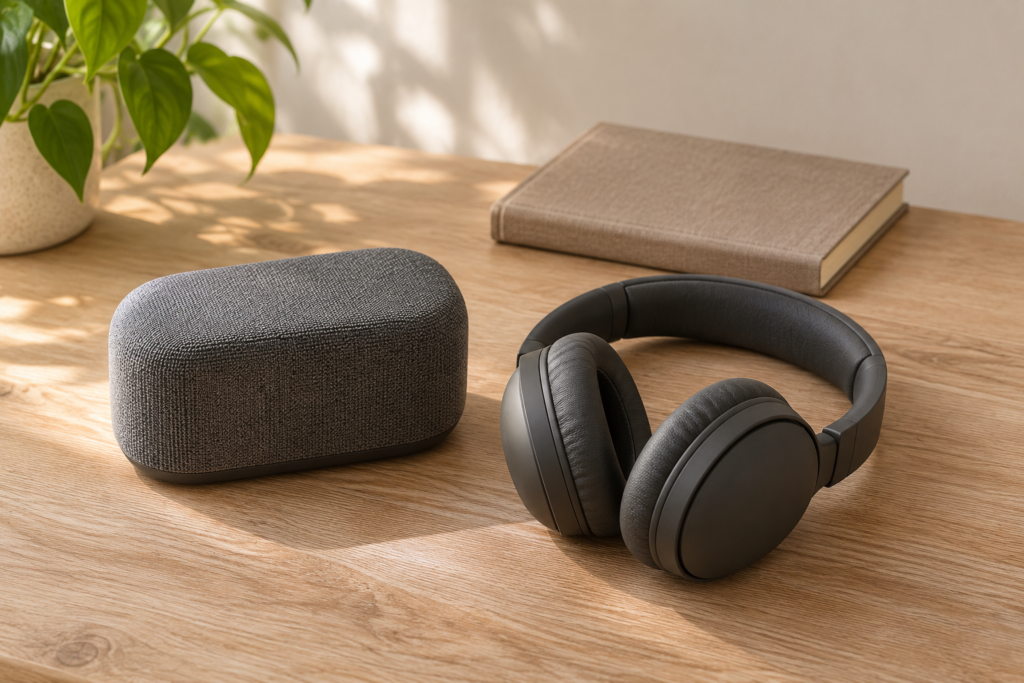
A gray fabric-covered speaker and black over-ear headphones on a wooden table beside a closed notebook.
Getting oriented

What you’ll learn

Start with a single selection. Keep its title at the top of your notes.

  • Mark any instruction you find.
  • Match a recording with its transcript.
  • Trace one change in the body scan.
  • Recognize what a playlist category says about a selection.
  • Interpret a bell set for a particular moment.
  • Locate the signed example.
  • Tell a preview from a playback command.

Tip: Keep the words you copied from a selection on a separate line. In your own notes, say what those words let you conclude.

Vocabulary

Terms to know before you listen

Use these terms to describe the same session from different angles.

Guidance

Directions for taking part in a practice.

  • Focus: Imagine a guide asking you to picture the outline of a familiar object.
  • Sequence: If two directions apply at different times, their order is part of what you follow.
  • Participation: If a session asks you to do something, you’re the one who decides whether to follow it.

Content

What a recording or session contains.

  • Words: A greeting and a direction have different jobs, even if they come from the same person.
  • Sound: Hatch lists ocean waves for the Sleep Clock. Check the name before you try to describe the track.
  • Layers: Music can accompany guidance within one track.

Delivery format

The form in which the session reaches you.

  • Audio: Audio reaches you through sound. Ask which sounds belong to the clip.
  • Transcript: The transcript gives you the words. Mark a sentence you want to revisit.
  • Signed video: Watch for a direction in the signs.

Spoken instruction

A direction given in words you hear.

  • Action: A listener could put the instruction in their own words to show they understood it.
  • Transition: Imagine a voice asking you to switch from listening to the sound nearby to listening for one farther away.
  • Recording: Recorded directions travel with the track. Mark the words you’d use to describe them.

Prompt

A cue to act at a particular moment.

  • Wording: In an imagined exercise, the word “switch” might be a prompt if you know what to switch to.
  • Timing: A scheduled bell can mark a moment.
  • Meaning: The same chime could mean begin or finish, depending on what you intend it to signal.

Playback

The player’s presentation of a recording.

  • Selection: In Hatch’s app, select an item before previewing it.
  • Start: The Hatch Sleep Clock’s top button starts its Bedtime playlist. During playlist playback, one press skips a step.
  • Pause: Hatch’s app lets you interrupt playback with pause.

Tip: Use the terms to label your notes. Put each observation under the term that helps you explain it.

The distinction

What job is this selection doing?

A friend asks whether a clip is guided or audio. Give each word its own place in your reply.

  • Write the title of the selection you’re describing, so someone else knows which item you mean.
  • Identify the practice, if the item supplies one. Mindfulness practice can emphasize paying attention to the present moment without judging what you notice.
  • Write the format next to the title. Give that note its own line so it’s easy to find later.
  • Underline words that tell you about the practice. Circle words that tell you about the format.
  • A guided track can be audio. Give the selection both labels when the evidence supports them.

Set aside any label you can’t back up. You can leave that part of your description blank.

An example of guidance

What the body-scan directions do

Take UCLA Mindful’s Short Body Scan.

  • One direction names a sensation.
  • Later, the practice shifts to the whole body.
  • The transcript presents both.

The guide shifts the focus.

A player in practice

What the Hatch Sleep Clock plays and controls

Hatch lists guided meditation and rain for its Bedtime playlist.

  • Sample a selection on the phone or clock before adding it in the app.
  • Hold the top button to stop the playlist.
  • The app separates pause and stop.

The button starts this playlist. Look to each selection for its instructions.

The overlap

Where directions and sound meet

Read these examples for what the guide contributes and how the people following it receive that guidance.

  • Hatch identifies Meditations on Color for the Sleep Clock. Its Listening Room describes a guided practice centered on color and light.
  • Apple gave another example in 2024. It described the Fitness+ Sound theme as combining sparse trainer instruction with instrument tones such as gongs.
  • UCLA Mindful also lists a body scan in American Sign Language.

Both descriptions fit Apple’s example because its audio carries guidance. The tones are also part of what reaches the listener.

Reading the clues

What a preview can establish

A listing summarizes an item. A preview covers only the portion you receive.

  • Imagine a clip that ends after a greeting. Describe that opening and leave the exercise itself open.
  • Read a catalog description at the level of detail it gives. A theme such as “color” leaves room for different exercises.
  • Insight Timer lets creators indicate that a talk includes guided meditation. The form option leaves the exercise itself unspecified.

A good description of the session can be narrow. Say what you heard or read about, and leave open what happens beyond that.

Reality check

Two things you might hear

Imagine starting two recordings. In each case, the useful detail is what the listener would need to supply.

A recording leads a short exercise

Imagine a recording that asks you to picture an empty shelf and then to picture setting a cup on it. You can describe the selection as recorded guidance because the clip takes the listener through those two steps.

The shelf and cup belong to one exercise. The guide tells you which to picture first.

An instrumental track sets the scene

Suppose you open a separate recording that consists entirely of guitar music. You might decide to listen for the moment a tune returns. Your listening exercise comes from that decision.

Now imagine a teacher asks the group to recall that same tune later. The teacher supplies the instruction in this example.

Myths

Common mix-ups about guidance and audio

These questions test what you can infer from a label, a format or one shared feature.

Is every audio selection in a meditation device a guided practice?

In the guitar example, the choice to follow the tune comes from you.

Does a label tell me what happens throughout a session?

Read exactly what the label says. Add details only when you have support for them.

Does guidance have to be spoken?

Sign language can give directions for a practice.

If two devices play guided sessions, will they behave the same way?

Look up each player separately if you need to know what its buttons do.

Does the delivery format tell me which practice works better?

To compare outcomes, look for evidence that measures the outcome you care about.

Tip: If two people use the same label for different experiences, ask what each one actually heard or read during the session.

FAQ

Questions about sessions and controls

Start with the question you want answered, whether it’s about a practice or a player setting.

Does a longer recording necessarily have more guidance?

VA Portland lists two 30-minute Choiceless Attention recordings and labels one as having less guidance. The matching lengths leave open how much of each recording is spent giving directions.

Can I read the directions before listening?

Yes. UCLA Mindful provides an English transcript for its Short Body Scan.

What does a timed bell tell me during a practice?

Insight Timer lets you schedule a bell for a point in the session. Hearing that bell tells you the chosen point has arrived. What you do then depends on the meaning you gave it or the directions you were following.

Can a talk also contain a guided exercise?

Yes. Insight Timer lets creators flag a guided meditation within a talk.

Is music part of the guidance when I hear both together?

Insight Timer leaves background music optional for creators. To understand its role in a particular exercise, listen for whether the directions ask you to do anything with the music you hear.

Can a light and an audio selection play together?

Hatch documents audio paired with light on the Sleep Clock. Whether looking at the light is part of the exercise depends on the directions in that selection.

What changes when I rearrange a playlist?

Hatch lets you reorder Sleep Clock playlist steps. A step’s position changes. The directions in the recording are a separate question.

Do pause and stop tell me whether I can reopen at the same point?

Hatch’s control instructions distinguish those actions and leave reopening at a saved position unspecified.

Tip: If your question starts with “Can I…,” decide whether it’s about the recording or the player. That tells you where to look for the answer.

Bottom line

Start with the session. Guidance gives the practice its directions. Audio can carry them.

Use both labels where both fit. If you’re writing a note for someone else, leave a blank beside any label you haven’t established.

Related reading

Guided meditation device archives

Browse the category by article format.