
What Makes HEPA Air Purifiers Different from Ionic Air Purifiers

A HEPA purifier pulls air through dense fibrous media that mechanically captures particles. An ionic purifier releases or uses charged ions so particles become charged and attach to a collector plate, another surface, or each other. The two technologies move particles through fundamentally different paths.

Those paths change what to inspect. HEPA performance depends heavily on airflow, sealing, and filter loading. Ionic performance depends on charging, collection efficiency, plate cleaning, and whether particles settle outside the device. Electronic designs also deserve scrutiny for intentional or incidental ozone production.

By: Review Streets Research Lab
Updated: August 13, 2026
Explainer · 8-12 min read
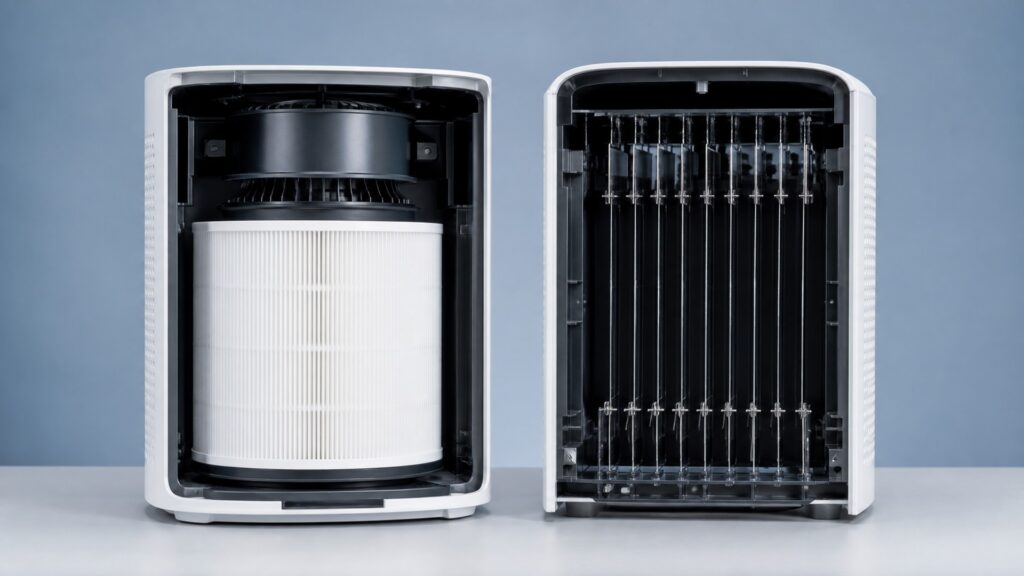
Opened HEPA purifier with pleated filter beside an ionic purifier with collector plates and emitter wires
What You'll Learn

Mechanical Capture Versus Electrical Charging

Compare how particles move, where they end up, which metrics matter, and how maintenance preserves performance.

  • The defining purpose and boundary of HEPA and Ionic Air Purifiers
  • The physical or biological pathway involved
  • The variable that most changes the output
  • How conditions and maintenance affect results
  • Which HEPA and Ionic Air Purifiers claims exceed the mechanism
  • How to apply the distinction in practice

Tip: Read the concept as part of a system, then connect it back to the use case.

Definitions

Key Concepts That Define HEPA and Ionic Air Purifiers

These definitions connect the main idea to the variables, limits, and practical signals readers need to compare options.

HEPA Media

High-efficiency fibrous material that captures particles carried through it

  • Role of HEPA Media: Provides mechanical collection
  • Decision for HEPA Media: compare conditions only when this hepa media is relevant
  • Boundary for HEPA Media: other mechanisms and outcomes require separate evidence beyond this definition

Ionization

Creation of charged ions that transfer charge to airborne material

  • Role of Ionization: Changes particle electrical behavior
  • Decision for Ionization: compare conditions only when this ionization is relevant
  • Boundary for Ionization: other mechanisms and outcomes require separate evidence beyond this definition

Collector Plate

A surface designed to attract and hold charged particles

  • Role of Collector Plate: Keeps captured material inside some ionic units
  • Decision for Collector Plate: compare conditions only when this collector plate is relevant
  • Boundary for Collector Plate: other mechanisms and outcomes require separate evidence beyond this definition

Deposition

Settling or attachment of particles onto room surfaces

  • Role of Deposition: Can move rather than contain contamination
  • Decision for Deposition: compare conditions only when this deposition is relevant
  • Boundary for Deposition: other mechanisms and outcomes require separate evidence beyond this definition

Ozone

A reactive gas that can be produced by some electrical air-cleaning processes

  • Role of Ozone: Requires careful avoidance and verification
  • Decision for Ozone: compare conditions only when this ozone is relevant
  • Boundary for Ozone: other mechanisms and outcomes require separate evidence beyond this definition

Bypass

Air traveling around rather than through the intended collection stage

  • Role of Bypass: Reduces effective cleaning
  • Decision for Bypass: compare conditions only when this bypass is relevant
  • Boundary for Bypass: other mechanisms and outcomes require separate evidence beyond this definition

Tip: Keep the definitions connected; the strongest answer usually comes from the whole system, not one term.

Operating Path

How the System Produces Its Result

HEPA devices route airflow through media; ionic devices charge particles and rely on collection plates or deposition.

  • Trace where particles finish
  • Check whether a fan is present
  • Inspect containment

Removal from air and containment inside the device are different outcomes.

Core Mechanism

What Performs the Main Work

Fibers capture through physical contact mechanisms, while electric fields change particle charge and attraction.

  • Mechanical media adds resistance
  • Electrical fields need clean collectors
  • Neither pathway removes all gases

Technology names should lead to mechanism-specific evidence.

Control Variable

What Changes Performance

Clean-air delivery, room size, fan speed, collector area, charging rate, and runtime affect real reduction.

  • Compare tested delivery
  • Check ozone data
  • Account for quiet-mode airflow

Low noise can reflect low air movement rather than superior engineering.

Failure Modes

Where Results Become Misleading

HEPA filters load and need replacement; ionic plates soil and need cleaning, while uncollected particles may deposit on walls and furnishings.

  • Follow power-off cleaning instructions
  • Inspect seals
  • Clean surrounding surfaces appropriately

Maintenance determines whether capture continues.

Use Case

How to Match the Tool to the Need

Choose a sealed HEPA system for predictable particle containment; evaluate ionic designs only with credible performance and ozone information.

  • Avoid ozone generators
  • Separate particle and gas claims
  • Consider replacement and cleaning burden

A specific tested product matters more than a broad technology label.

Quick Reality Check

Two Particle-Control Pathways

A buyer-first boundary for HEPA and Ionic Air Purifiers between direct performance and claims requiring more context or evidence.

Where It Works

HEPA systems can provide predictable mechanical particle capture when airflow and sealing are adequate.

An electronic collector can remove charged particles from air when its field, airflow, plate area, and cleaning state support effective collection.

Where It Stops

Neither technology automatically controls gases, carbon monoxide, radon, or moisture.

Ion generation that merely deposits particles on room surfaces does not equal secure collection, and ozone production is an important concern.

Common Myths

Misconceptions About HEPA and Ionic Air Purifiers

Common shortcuts and misunderstandings can make the topic seem simpler than it is.

Ionic purifiers and ozone generators are the same thing

Ionization and intentional ozone generation are distinct concepts, but some electronic cleaners can produce ozone as a byproduct. Buyers should verify emissions and avoid devices whose cleaning method depends on producing ozone.

HEPA filters cannot capture particles smaller than their rating

Fibrous filtration is not a simple mesh. Diffusion, interception, and impaction operate across sizes, so particles smaller than the most penetrating range can still be captured efficiently when they pass through intact media.

A filterless ionic purifier requires no maintenance

Collector plates accumulate particles and lose performance when dirty, while deposited material may soil nearby surfaces. Cleaning frequency, safe power isolation, emitter condition, and any washable components remain central to operation.

Silent operation proves an ionic purifier cleans more efficiently

Silence may reflect little or no fan airflow. Particle removal depends on how much room air reaches the charging and collection system, its efficiency, runtime, room mixing, and whether particles remain contained.

Tip: Treat strong claims as starting points for comparison, not final answers.

FAQ

Frequently Asked Questions About HEPA and Ionic Air Purifiers

Concise answers to common questions readers may have after the main explanation.

Which type is easier to verify before purchase?

HEPA appliances often provide filter and clean-air-delivery information, though whole-unit testing still matters. Ionic devices need credible particle-removal, airflow, collector, and ozone-emission data because technology descriptions alone reveal little about room performance.

Do ionic purifiers remove particles or just move them?

Designs with effective collection plates can retain charged particles, while some ionizers mainly encourage deposition on walls, floors, furnishings, or occupants. Determine where particles end up and how the collection surface is maintained.

Can HEPA and ionization be combined in one unit?

Yes, some appliances combine mechanical filters with electronic charging. Evaluate the complete device for clean-air delivery, sealing, noise, replacement cost, maintenance, and ozone emissions rather than assuming the added stage improves performance.

Which technology is better for smoke particles?

A well-sized, sealed HEPA purifier with adequate clean-air delivery offers a clear mechanical pathway for smoke particles. It does not remove every smoke gas, so source reduction and clean-air guidance still matter.

Bottom Line

HEPA purifiers mechanically contain particles in fibrous media; ionic purifiers electrically charge particles for collection or deposition.

Compare whole-device delivery, containment, maintenance, noise, and ozone emissions. For predictable particle control, a well-sealed HEPA pathway is generally easier to evaluate.

Next Steps

Go Deeper or Compare Your Options

Use these Review Streets paths to connect the explainer to related categories, comparisons, and next decisions.

Why HEPA Filtration Matters

HEPA media captures a very high share of particles passing through it, but room performance also depends on how much air reaches the filter, whether air bypasses it, how long the unit runs, and whether its capacity fits the space.