What Makes Hybrid SUVs Different from Compact SUVs

Hybrid and compact describe different attributes of an SUV. Hybrid identifies a powertrain that combines an engine with electric-drive components; compact identifies a relatively small body category. A compact SUV can therefore be either hybrid or conventional gasoline, and a hybrid SUV can be compact or larger.

When comparing a hybrid compact with a gasoline compact, the meaningful differences are energy management, power delivery, braking behavior, and some ownership requirements. Body space, towing capability, and equipment may also differ between the actual versions, but those differences need to be checked rather than assumed from the powertrain label.

By: Review Streets Research Lab
Updated: September 30, 2026
Explainer · 8-12 min read
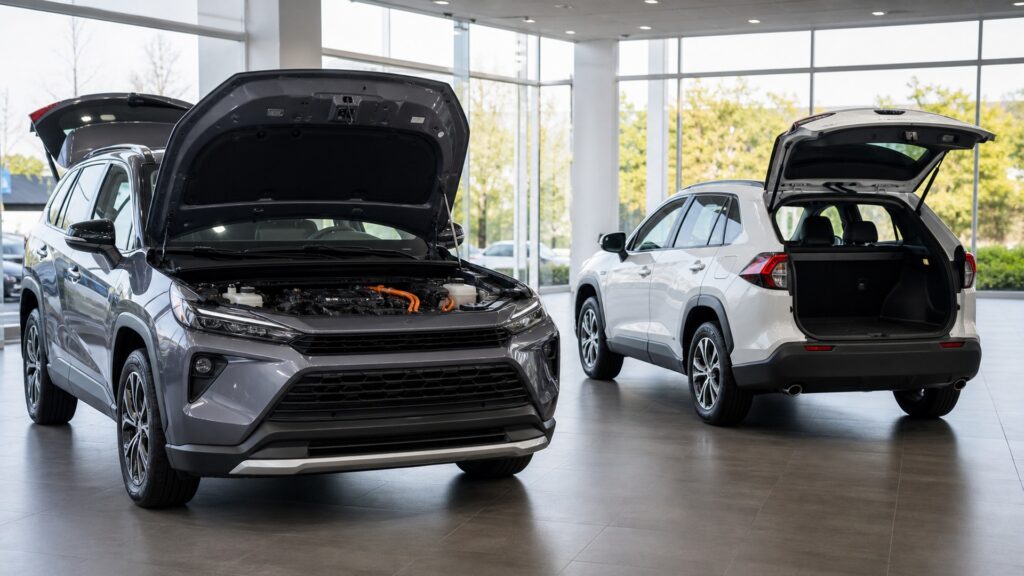
hybrid suvs explainer hero image for Review Streets
What You'll Learn

What Hybrid Power Changes in a Compact SUV

Separate the mechanical differences from the dimensions both vehicles may share.

  • Understand the engine, motor, and battery roles.
  • Recognize how hybrid energy recovery differs from ordinary braking.
  • Compare actual response rather than engine specifications alone.
  • Check packaging and capability for the exact versions.
  • Distinguish conventional and plug-in hybrid ownership.

Tip: A fair comparison starts with two vehicles that satisfy the same space requirement.

Definitions

The Terms That Separate Size from Propulsion

These definitions explain the differences without creating a false either-or category.

Compact body category

A description of the SUV’s general size and packaging, rather than its energy source.

  • Example: A compact SUV has two rows within a relatively manageable exterior footprint.
  • Check: Compare the actual dimensions and layout.
  • Limit: Compact does not mean gasoline-only.

Electric-drive contribution

Propulsion assistance or drive supplied by an electric motor in the hybrid system.

  • Example: Motor torque supports a normal acceleration request.
  • Check: Check the capability of the specific hybrid architecture.
  • Limit: Not all hybrids provide the same electric-only operation.

Traction battery

The energy store used by the electric propulsion system.

  • Example: Recovered energy can be stored for later motor assistance.
  • Check: Identify the model’s hybrid type and battery-care guidance.
  • Limit: The battery does not create energy or eliminate fuel use in a conventional hybrid.

Energy recovery during braking

Conversion of some vehicle motion energy into electrical energy rather than dissipating all of it as brake heat.

  • Example: The drivetrain recovers energy during suitable slowing.
  • Check: Understand normal brake feel and the limits of recovery.
  • Limit: Friction brakes remain necessary.

Engine operating strategy

The way the control system starts, stops, and uses the engine for propulsion and other needs.

  • Example: The engine stops in some conditions and restarts when required.
  • Check: Assess the transitions during a representative drive.
  • Limit: Engine silence at one moment does not prove that the vehicle is off.

Version-specific packaging

The arrangement of components, cabin space, and equipment in the particular model variant.

  • Example: A hybrid version has a different underfloor storage arrangement.
  • Check: Check cargo space, spare-tire provision, and seating directly.
  • Limit: Hybrid components do not cause the same packaging change in every vehicle.

Tip: Use the body label to discuss space and the powertrain label to discuss energy and operation.

Energy path

A Hybrid Adds Controlled Electrical Storage and Drive

A conventional gasoline SUV relies on its engine for propulsion. A hybrid adds electric-drive capability and storage that allow different power flows, depending on design. It can recover some braking energy and use electric assistance while managing engine operation.

  • Identify whether the vehicle uses an assisting, full-hybrid, or plug-in arrangement.
  • Compare the complete powertrain rather than the engine alone.
  • Use the manufacturer’s explanation for the exact design.

This is why engine displacement or engine-only output can be misleading in a hybrid comparison. The vehicle’s response comes from coordinated systems, not just one engine specification.

Traffic behavior

The Difference Can Be Noticeable at Low Speeds

Some hybrids can move using electric drive in suitable conditions and start their engines as demand changes. Others primarily assist the engine. A gasoline compact may have its own engine stop-start function, but that feature alone does not establish the same electrical propulsion capability.

  • Try gentle starts and ordinary stop-start traffic.
  • Notice engine transitions and cabin noise.
  • Check whether the response feels predictable to the driver.

Two versions of the same compact may feel different without looking different from outside. Compare the way they handle the same normal maneuver rather than expecting one universal hybrid feel.

Braking and efficiency

Recovered Energy Changes the Balance, Not the Need for Brakes

During slowing, a hybrid can recover a portion of motion energy electrically. The system still uses friction braking where needed, and the available recovery depends on design and conditions. This can help reduce fuel use, particularly in some repeated slowing-and-acceleration patterns.

  • Compare city and highway economy estimates for the exact candidates.
  • Evaluate normal brake response during the test drive.
  • Keep friction-brake inspection requirements in the ownership plan.

The hybrid cannot recover all the energy used to accelerate, and unnecessary acceleration still wastes energy. Recovery is one efficiency tool within the vehicle, not a source of free propulsion.

Space and capability

Shared Body Size Does Not Guarantee Identical Specifications

Hybrid equipment can affect component placement, weight, storage, or configuration choices, but the effect is model-specific. A hybrid compact may retain the same useful cabin layout as its gasoline counterpart, or it may have differences worth inspecting.

  • Check seats-up luggage space and underfloor storage.
  • Verify the vehicle’s load label and any towing rating.
  • Confirm the driven-wheel system and fitted equipment.

Do not assume a hybrid sacrifices cargo room or gains all-wheel drive. Both claims need confirmation on the actual vehicle being compared.

Ownership routine

Hybrid Type Determines Whether Charging Enters the Picture

A conventional hybrid is refueled like a gasoline vehicle and does not require routine external charging. A plug-in hybrid accepts electricity from outside the vehicle and can make charging part of daily ownership. Both retain engine-related maintenance requirements.

  • Identify the hybrid type before comparing energy costs.
  • Read the exact service schedule and warranty terms.
  • Compare purchase quotes, insurance, and expected energy use over the same period.

The compact body may remain familiar while the energy routine changes. Decide whether the specific powertrain’s benefits are useful for your travel, rather than treating hybrid ownership as one fixed package.

Quick Reality Check

Which Differences Come from Which Label?

Keep body characteristics and propulsion characteristics in separate columns mentally.

Hybrid can change…

Power flow, engine use, energy recovery, and the driving response.

Charging needs for a plug-in and model-specific service or packaging details.

Compact describes…

A general body-size category whose actual cabin must still be evaluated.

A possible home for conventional, hybrid, or other powertrain choices.

Common Myths

Misconceptions About Hybrid and Compact SUVs

The two labels can belong on the same vehicle.

Hybrid SUVs are a size above compacts

Hybrid is a powertrain description. A hybrid SUV can be compact.

A smaller hybrid engine necessarily means weaker performance

Electric contribution and the complete design matter. Compare vehicle-level performance and response.

A conventional hybrid makes its own free energy

It manages fuel-derived energy and recovers some motion energy. Losses still occur, and it still needs fuel.

Hybrid versions always lose cargo space

Packaging varies. Inspect the dimensions, storage, and seating for the actual variants.

Tip: Replace a broad assumption with the specification or trial that directly answers it.

FAQ

Questions About the Difference Between Hybrid and Compact SUVs

Answers that keep the comparison technically clear.

Can I buy an SUV that is both compact and hybrid?

Yes. Compact describes its body category and hybrid describes its propulsion system.

Does every hybrid need charging?

No. Conventional hybrids do not plug in; plug-in hybrids accept external electricity and should be evaluated with that routine in mind.

Is a hybrid always more efficient on my route?

Compare the actual ratings and likely operating conditions. The size label by itself gives no answer, and results vary across designs and use.

What should I compare besides fuel economy?

Driving response, brake feel, space, rated capability, purchase cost, and the required service or charging routine.

Bottom Line

The real difference is between a powertrain description and a body-size description: an SUV can be both hybrid and compact.

Compare equally suitable vehicles to see what the engine-and-motor system changes, then verify space and capability independently.

Next Steps

Go Deeper or Compare Your Options

Use these Review Streets paths to compare related categories and practical next decisions.

Vehicles

Compare related vehicle choices against the same carrying needs and driving routine.

SUVs

Compare related vehicle choices against the same carrying needs and driving routine.

Hybrid SUVs

Explore Hybrid SUVs with your passenger, cargo, and ownership requirements in mind.

Further reading: DOE: hybrid vehicle components; DOE: hybrid braking energy recovery; FuelEconomy.gov: hybrid technology; DOE: maintenance comparison. Use the owner’s manual for the exact vehicle’s instructions and limits.