
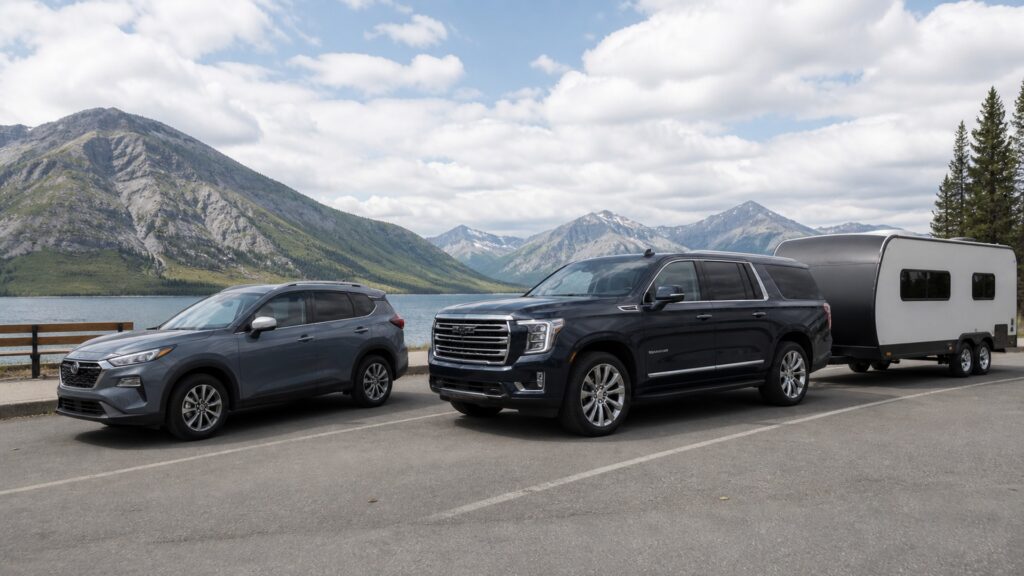
What Makes Hybrid SUVs Different from Full Size SUVs

Hybrid SUVs differ from conventional SUVs in how they produce and manage propulsion, while full-size SUVs are distinguished by their body size and packaging. Those labels can overlap: a full-size SUV can use a hybrid powertrain. A useful comparison therefore separates the space and carrying job from the engine-and-motor system that performs it.

If the real choice is a smaller hybrid versus a conventional full-size SUV, two things change at once. The hybrid may reduce fuel use for your routine, while the larger vehicle may provide more usable seating or luggage room. Neither advantage follows from the badge alone; compare the exact vehicles with the same people and load aboard.

By: Review Streets Research Lab
Updated: September 30, 2026
Explainer · 8-12 min read
hybrid suvs explainer hero image for Review Streets
What You'll Learn

Separate SUV Size from Hybrid Propulsion

Understand what changes mechanically and what changes because the vehicles are different sizes.

  • Recognize that full-size and hybrid can describe one vehicle.
  • Identify the role of electric assistance and energy recovery.
  • Compare occupied-seat cargo space independently of fuel economy.
  • Verify load and towing limits for the exact configuration.
  • Evaluate ownership costs without assuming every hybrid has the same benefit.

Tip: First choose the space and capability you need; then compare suitable powertrains.

Definitions

Two Different Ways to Describe an SUV

Use each term for the question it actually answers.

Hybrid powertrain

A propulsion system combining an internal-combustion engine with electric-drive components. Designs differ in how much assistance they provide.

  • Example: An electric motor assists an engine during acceleration.
  • Check: Identify the hybrid type and the model’s actual operating characteristics.
  • Limit: The word hybrid does not specify body size or electric-only capability.

Full-size body

A large SUV package that can provide substantial passenger and cargo space, depending on layout.

  • Example: A large three-row vehicle retains luggage room behind its occupied back row.
  • Check: Check seating, dimensions, and cargo shape directly.
  • Limit: Size does not establish the engine type or guarantee a particular capacity.

Conventional hybrid

A hybrid that manages its propulsion battery without routine external charging.

  • Example: The owner refuels with gasoline while the vehicle manages electrical assistance.
  • Check: Distinguish it from a plug-in hybrid.
  • Limit: Fuel remains an energy source; stored electricity is not free energy.

Load allowance

The permitted weight of occupants and carried items under the vehicle’s instructions.

  • Example: A full passenger group reduces the weight available for luggage and other loads.
  • Check: Read the label on the actual vehicle.
  • Limit: A roomy interior is not proof of unlimited carrying weight.

Cargo with seats occupied

The storage space left after preserving every seating position required for the trip.

  • Example: Holiday bags fit behind a third row carrying passengers.
  • Check: Use the same passenger arrangement for both candidates.
  • Limit: A seats-folded figure does not describe a fully occupied trip.

Configuration-specific capability

The limits and features attached to the exact powertrain, equipment, and body version.

  • Example: A towing package changes the applicable equipment or rating for one version.
  • Check: Use manufacturer information for the vehicle being offered.
  • Limit: The highest advertised rating may describe another configuration.

Tip: Do not let a powertrain label answer a cabin-space question, or a size label answer an energy-use question.

Mechanical difference

Hybrid Assistance Changes Energy Use, Not the Meaning of Size

A hybrid can use electric assistance, engine management, and recovery of some braking energy to change how it uses fuel. The implementation varies. Some systems emphasize efficiency, others also support performance, and the owner should not assume identical electric-driving behavior from every hybrid badge.

  • Check whether the system is conventional or plug-in.
  • Compare fuel-economy estimates for the specific vehicle.
  • Try engine transitions and low-speed response during ordinary driving.

A large hybrid remains a large vehicle. Its electric components do not make its parking footprint, passenger layout, or weight identical to a smaller SUV.

Passenger requirement

Let the Full Passenger Group Determine the Space Needed

A full-size SUV may be useful when adults regularly occupy the third row or when many people must travel with luggage. A smaller hybrid can be entirely sufficient for another household. Try the whole seating arrangement rather than evaluating empty seats one at a time.

  • Adjust the front seats for their regular occupants.
  • Have rear passengers check access, foot space, and comfort.
  • Leave every required row upright while loading luggage.

For a household carrying six people every week, the last row and the bags behind it can decide the comparison. For two commuters, that same extra space may rarely be used.

Towing and load

Do Not Substitute Hybrid Torque or Vehicle Bulk for Ratings

Strong acceleration and a large body do not establish towing suitability. The loaded trailer, people, luggage, hitch load, and equipment all have to fit the relevant limits. A hybrid can be a capable tow vehicle when its manufacturer permits the intended combination, but that capability must be verified.

  • Confirm the exact vehicle’s required towing equipment.
  • Check the loaded combination against all applicable ratings.
  • Account for the people and gear carried at the same time.

Compare a complete trip rather than a headline trailer number. Moving to either a hybrid or a full-size model does not excuse a mismatch elsewhere in the combination.

Daily burden

Compare the Whole Vehicle in Your Ordinary Week

A conventional full-size SUV may ask more of a narrow garage or parking bay than a smaller hybrid. A full-size hybrid may have much the same spatial burden as its conventional counterpart. Fuel use and physical convenience are separate parts of the ownership decision.

  • Measure actual exterior dimensions and opening clearances.
  • Compare the powertrain versions on routes you normally use.
  • Obtain relevant insurance, tire, and service quotes.

If both candidates carry your normal load comfortably, the easier vehicle to park and operate deserves weight in the decision. Unused maximum capacity is not automatically a benefit.

Fair comparison

Use Two Comparisons When Both Size and Powertrain Change

To understand the purchase clearly, compare suitable sizes first, then consider hybrid versus conventional propulsion within the viable choices. You may discover that the right answer is a full-size hybrid, a smaller hybrid, or a conventional vehicle that already meets the need.

  • Write down required seats, cargo, and any towing task.
  • Eliminate configurations that do not meet those requirements.
  • Compare purchase and running costs among the remaining candidates.

This prevents an efficient but unsuitable vehicle from winning on fuel economy alone, or a spacious but unnecessary vehicle from winning on capacity you never use.

Quick Reality Check

Where the Real Tradeoff Lies

A powertrain decision and a size decision can point in different directions.

Hybrid propulsion is relevant when…

Its fuel use and driving behavior improve the ownership case for a suitable vehicle.

The type of hybrid matches your charging or refueling routine.

A full-size body is relevant when…

Regular passengers and luggage need its actual layout and space.

The exact configuration meets a capability requirement smaller candidates cannot.

Common Myths

Misconceptions About Hybrid and Full-Size SUVs

The labels are not opposing mechanical categories.

A full-size SUV cannot be a hybrid

Full-size describes size. Hybrid describes propulsion, so a vehicle can be both.

Every hybrid is more efficient than every full-size SUV

Compare specific vehicles and powertrains. Size, mass, equipment, and driving conditions affect energy use.

Electric assistance proves towing suitability

It is only one part of the vehicle. The manufacturer’s configuration-specific limits control the complete task.

More seats mean enough room for all the luggage

Check cargo space with those seats occupied, not folded.

Tip: State the carrying job first, then ask which vehicle and powertrain perform it best.

FAQ

Questions About Comparing Hybrid and Full-Size SUVs

Answers that separate the two decisions.

Should I choose a hybrid to avoid buying full-size?

Only if the hybrid candidate actually meets the space and load requirement. Hybrid propulsion does not replace missing room.

Does a full-size hybrid always save enough fuel to justify its price?

No universal result applies. Compare actual prices, energy use, mileage, and the expected ownership period.

Is the third row the main difference?

It can be important, but passenger comfort, luggage space, overall dimensions, and configuration-specific capability also matter.

What is a fair starting point?

Compare vehicles that can carry the same people and load, then examine propulsion, cost, and everyday usability.

Bottom Line

Hybrid SUVs and full-size SUVs describe different characteristics: propulsion and body size.

Choose the space and capability required for the trip, then compare suitable hybrid and conventional configurations on their actual merits.

Next Steps

Go Deeper or Compare Your Options

Use these Review Streets paths to compare related categories and practical next decisions.

Vehicles

Compare related vehicle choices against the same carrying needs and driving routine.

SUVs

Compare related vehicle choices against the same carrying needs and driving routine.

Hybrid SUVs

Explore Hybrid SUVs with your passenger, cargo, and ownership requirements in mind.

Further reading: DOE: hybrid powertrain operation; Ford: towing equipment and ratings; EPA: fuel-economy comparisons. Use the owner’s manual for the exact vehicle’s instructions and limits.