
IPL
Filtered broad-spectrum pulses from a flashlamp.
- Use: identify one light source
- Variable: filter and pulse profile
- Tradeoff: Not a laser
IPL hair removal uses a flashlamp to emit a broad range of wavelengths, then filters that light for the treatment purpose. Laser hair removal uses a laser source with a much narrower principal wavelength, such as alexandrite, diode, or Nd:YAG systems. Both aim to heat pigment in hair structures enough to impair future growth while limiting injury to surrounding skin.
The label does not determine the result by itself. Wavelength or spectrum, fluence, pulse duration, spot size, repetition rate, cooling, skin pigment, hair pigment and diameter, recent tanning, operator skill, and treatment schedule all matter. Clinic IPL and home IPL also differ substantially in output and controls; a home device should not be treated as a miniature version of every professional platform.
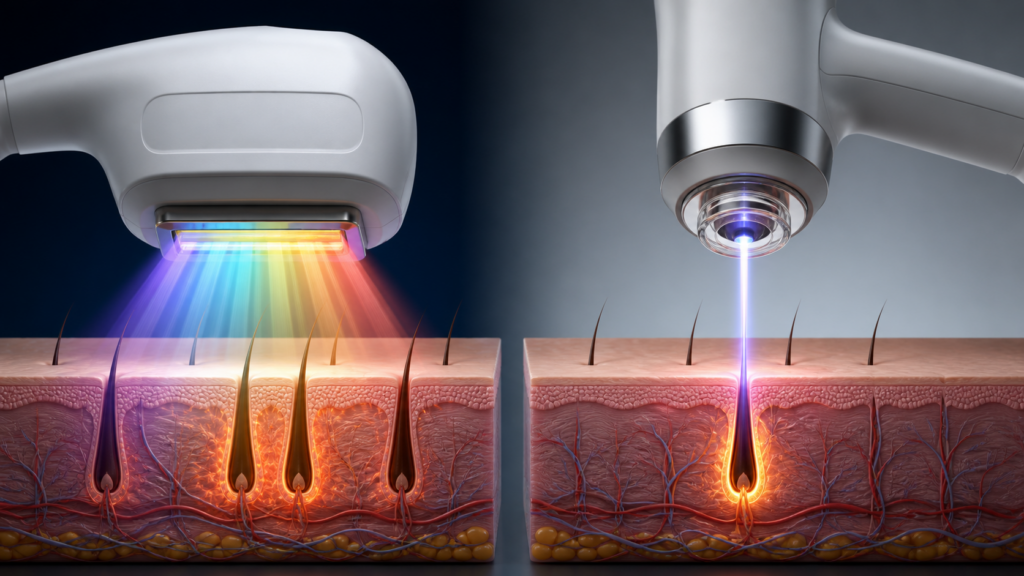
Compare broad-spectrum filtered intense pulsed light with laser's narrower wavelength by optical design, melanin targeting, professional and home formats, skin-hair compatibility, parameters, cooling, speed, evidence, schedule, safety, and total cost—without declaring a universal winner.
Tip: IPL is a technology family, not one standardized treatment.
These ipl vs laser hair removal concepts separate mechanism, application, limits, and purchasing consequences.
Filtered broad-spectrum pulses from a flashlamp.
Narrow principal wavelength produced by a laser system.
Energy delivered per unit area, commonly expressed as joules per square centimeter.
Time over which a light pulse delivers its energy.
Area covered by one treatment pulse.
Protection of the skin surface before, during, or after a pulse.
Tip: Use these terms to test ipl vs laser hair removal instead of relying on a front-label promise.
IPL platforms can cover areas efficiently and may offer filters for different uses. Their performance depends on the exact system, settings, contact, and operator—not the letters IPL alone.
IPL is a technology family, not one standardized treatment.
Laser systems concentrate output around a narrower wavelength. Different lasers have different absorption and skin-use profiles, but no wavelength removes the need for screening and skilled settings.
Laser specificity still requires whole-system judgment.
Home IPL typically limits output and guides eligibility for unsupervised use; clinic systems may offer more parameter control, cooling, speed, and trained monitoring at greater cost.
The operator and setting are part of the technology.
Providers often ask clients to avoid tanning and root extraction, then shave the area so energy targets follicular pigment without long surface hair. Follow the device-specific plan.
Preparation affects both target access and skin safety.
Treated hairs may shed after a delay, and new cycles emerge. Track comparable photos, density, regrowth speed, adverse effects, sessions, and maintenance rather than immediate smoothness alone.
Long-term reduction is a course outcome.
Both IPL and laser can reduce suitable pigmented hair over repeated sessions; neither reliably treats white or gray hair or guarantees permanent removal.
Eligibility is based on the exact device and current skin state, not a generic skin-type promise.
Test spots, eye-safety controls, contact, overlap, cooling, and endpoints follow the specific protocol.
Energy is not increased simply because early shedding seems slow.
Purchasing includes a full course, maintenance, consumables, travel, and complication access.
These claims flatten the variables that determine how ipl vs laser hair removal performs in a real routine.
IPL is a different broad-spectrum light source. Individual IPL and laser devices vary too much for that shortcut.
Some laser wavelengths and protocols may be more suitable, but safety depends on the exact device, settings, skin, training, and current pigment.
White, gray, and many very light hairs lack enough melanin for reliable optical targeting.
Excess energy can burn skin or cause pigment change; safe response, biology, and growth cycle limit progression.
The accepted outcome is generally long-term reduction, and maintenance or new growth can occur.
Tip: Test the exact ipl vs laser hair removal tool, setting, and routine before generalizing from its category.
The remaining decisions about ipl vs laser hair removal concern technique, compatibility, safety, upkeep, and value.
Sensation varies with device, cooling, energy, area, hair density, and individual sensitivity; neither category guarantees comfort.
Spot size and repetition rate affect speed. Some IPL and laser systems treat large areas efficiently, so compare actual platforms.
Recent or active tanning increases competing epidermal pigment and may require postponement; follow the exact provider or device rules.
They can be appropriate for eligible users who follow labeling, but restrictions, contact, eye safety, skin condition, and consistent use remain essential.
It helps the operator observe short-term skin response to a planned setting, though it cannot eliminate all delayed or cumulative risk.
Unexpected blistering, severe pain, persistent crusting, infection signs, scarring, or marked darkening or lightening needs prompt professional assessment.
IPL uses filtered broad-spectrum flashes; laser uses a narrower principal wavelength. Both depend on selective heating of pigment, and both are whole systems whose parameters, cooling, operator, and biological fit matter more than the category name.
Compare exact device, eligible skin and hair, provider experience, treatment area, test protocol, session speed, full-course cost, maintenance, and complication access. Expect long-term reduction—not universal or guaranteed permanent removal.
These Review Streets paths narrow the next ipl vs laser hair removal decision by format, goal, and routine fit.
Browse shaving, epilation, and light-based hair-removal categories.
Compare at-home beauty devices, including light-based hair-removal systems.
Choose a retailer
Prices checked regularly. We may earn a commission at no cost to you.