
Offset Load
An offset load places the weight away from the hand, changing balance and timing.
- Example: a bell hanging below the handle during a swing
- Check: use it when the offset helps the exercise
- Limit: it can make some lifts harder to learn
Kettlebells and resistance bands both support compact training, but they create resistance in very different ways. Kettlebells use a fixed offset weight. Resistance bands use elastic tension that increases as the band stretches.
That difference changes exercise feel, progression, setup, and safety checks. Kettlebells are stronger for swings, carries, rack work, and fixed-load training. Bands are stronger for portable tension, warmups, assistance, and angled resistance.
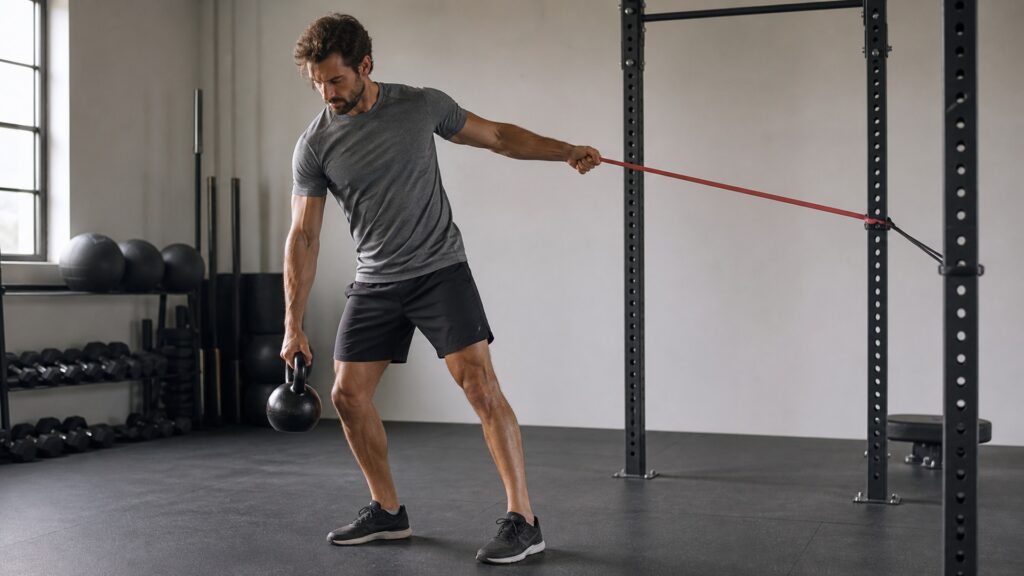
A practical comparison of offset weight, elastic tension, portability, progression, and exercise fit.
Tip: The difference is not just weight versus lightness. It is fixed offset load versus elastic tension.
These concepts explain why the two tools overlap without replacing each other.
An offset load places the weight away from the hand, changing balance and timing.
A ballistic movement uses controlled momentum instead of only slow lifting.
Grip security is how reliably the hand controls the handle during work.
Rack position holds the bell near the forearm and torso for squats, presses, and carries.
Load jump is the increase between available kettlebell weights.
Training role is the job the kettlebell has in the workout.
Tip: The right training tool is the one whose resistance and setup match the exercise goal.
A kettlebell has a known weight and a shape that changes balance. That makes it useful for loaded carries, swings, goblet squats, and rack positions.
Kettlebells are compact, measurable free weights.
Bands get harder as they stretch. That makes the exercise depend on band length, anchor point, and range of motion.
Bands are flexible, but less exact than a labeled weight.
Bands cannot fully copy the feel of a bell moving around the hand or being carried as a load. The kettlebell shape matters in these patterns.
The movement should decide the tool.
Bands are easier to pack and store than kettlebells. They are useful for warmups, travel workouts, rehab-style drills, and adding tension in tight spaces.
Portability is a real band advantage.
Many routines use kettlebells for loaded movement and bands for activation, assistance, or extra tension. They do not need to compete in every exercise.
The strongest setup may include both tools.
The tools solve different resistance problems.
The session needs fixed load, swings, rack work, or carries.
The user wants measurable external weight.
The user needs portable elastic tension or assistance.
The exercise benefits from a specific anchor angle.
Compact equipment can still have very different training effects.
Bands create elastic tension, not fixed offset load.
Bands can be useful when their tension curve fits the exercise.
Bands need secure anchors and inspection.
They often work best in different roles.
Tip: Compare how resistance is created before choosing the tool.
Short answers for practical training and equipment decisions.
Kettlebells use fixed offset weight; bands use elastic tension.
Kettlebells are usually easier to measure for loaded strength, while bands can add useful tension.
Bands travel better because they are light and compact.
They can replace some resistance needs, but not the feel of swings, carries, and fixed load.
Use kettlebells for fixed offset loading and bands for portable elastic tension.
Kettlebells differ from resistance bands because they use fixed offset weight rather than elastic tension.
Kettlebells fit loaded movement and carries; bands fit portability, assistance, and angled tension.
Use these Review Streets paths to compare related categories and practical next decisions.
Review the core kettlebell design and training setup.
Explore the kettlebells category.
Compare related strength-training tools.
Choose a retailer
Prices checked regularly. We may earn a commission at no cost to you.