
Specular Reflection
Concentrated light reflection perceived as shine or gloss.
- Use: understand dewiness
- Variable: surface smoothness and angle
- Tradeoff: Can emphasize contours
Matte makeup reduces broad, mirror-like reflection and often uses absorbent or light-scattering powders to create a lower-shine surface. Dewy makeup preserves or adds more directional reflection through emollient films, luminous particles, or a less powder-saturated finish.
These are optical and tactile outcomes, not skin diagnoses. A matte formula can remain flexible and comfortable; a dewy formula can set firmly or feel tacky. Lighting, camera flash, skin texture, sebum, humidity, layer thickness, and placement can make the same product appear different over time. Many successful looks use both finishes by zone.
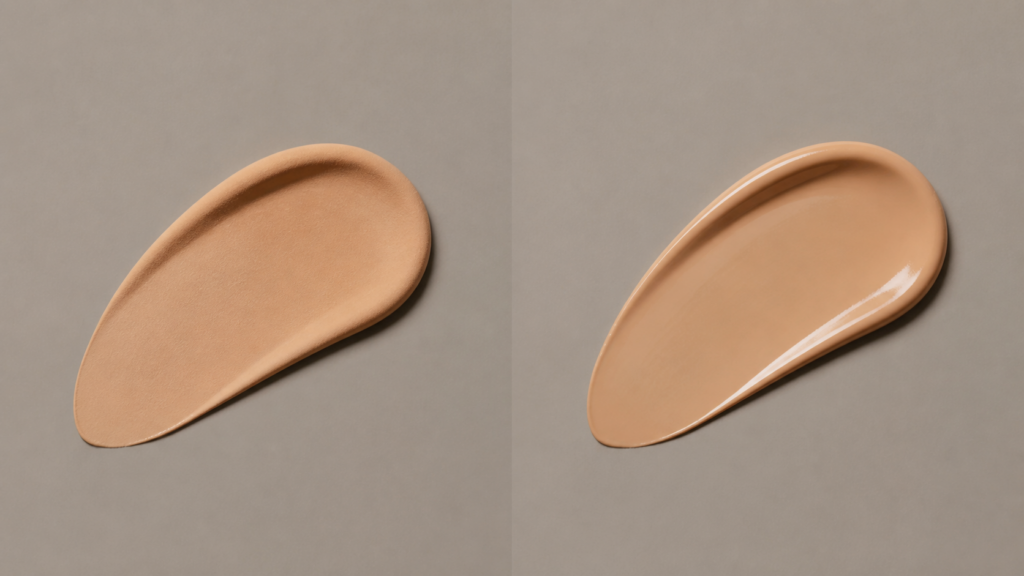
Compare optical reflection, oil absorption, film composition, tactile slip, texture visibility, environmental change, photography, touch-ups, and comfort rather than equating matte with oily skin or dewy with dry skin.
Tip: Finish is a relationship between surface and light.
These matte makeup vs dewy makeup concepts separate mechanism, application, limits, and purchasing consequences.
Concentrated light reflection perceived as shine or gloss.
Light scattered in many directions, creating a softer matte appearance.
Uptake of sebum by selected powders.
Fine material reflecting or refracting light.
How dry, slippery, tacky, or flexible the surface feels.
Use of different finishes on different facial areas.
Tip: Use these terms to test matte makeup vs dewy makeup instead of relying on a front-label promise.
Matte reduces concentrated shine; dewy increases controlled reflection. Evaluate in daylight, indoor light, and photographs because angle changes the result.
Finish is a relationship between surface and light.
Heavy matte layers can collect on flakes; strong dew can highlight bumps through reflection. Thin application and selective placement often matter more than the finish label.
Neither flatness nor shine erases physical texture.
Sebum can turn natural-matte makeup shinier; absorbent layers can become patchy; dewy films can transfer or collect particles. Touch up the changed zone, not the whole face.
A finish should age acceptably, not remain frozen.
A flexible matte film can feel comfortable, while a glossy film can feel occlusive. Use skin sensation and reaction—not visual language—to judge tolerance.
Appearance does not diagnose water content.
A natural foundation plus targeted powder and highlighter may offer more control than an extreme base. Include photography, workplace light, touch preference, and climate.
Finish tools are modular when the base remains thin.
Matte and dewy describe the visible residual surface; they do not reliably reveal hydration, ingredient safety, longevity, or skin compatibility.
Reflection is controlled intentionally across the intended zones.
The finish remains comfortable and correctable as oil and movement change it.
Matte can look flat or dry; dewy can appear greasy or transfer readily.
Neither finish permanently changes pore size, texture, or moisture status.
These claims flatten the variables that determine how matte makeup vs dewy makeup performs in a real routine.
Oil control can help, but a rigid or over-powdered formula may break apart. Oily skin still needs comfortable preparation and controlled touch-ups.
Dewiness is an optical finish. A glossy emollient film can reduce a dry appearance without correcting irritation, flaking, or an unsuitable skin-care routine.
Some do, but film strength, oil resistance, friction, humidity, dose, and compatibility drive wear. A dewy film can be durable and a matte powder can disappear.
Reflective particles can look intentional but may emphasize texture or appear metallic. Placement, particle size, base finish, and lighting determine naturalness.
Small targeted amounts can reduce tack or set high-movement zones while preserving reflection elsewhere. The effect depends on powder finish and dose.
Tip: Test the exact matte makeup vs dewy makeup tool, setting, and routine before generalizing from its category.
The remaining decisions about matte makeup vs dewy makeup concern technique, compatibility, safety, upkeep, and value.
Yes, if the films remain compatible. A natural base with matte center-face control and dewy high points often provides more precision than one extreme formula.
Sebum, sweat, humidity, emollients, and friction can wet or move powders. Blot first, then add a small compatible layer only where needed.
Reflection may be too broad, the film too thick, or placement too close to naturally oily zones. Reduce dose and confine shine to chosen planes.
It depends on lighting, flash, camera processing, texture, and desired dimension. Test the exact look in the expected photographic conditions.
No age group has one required finish. Movement, texture, comfort, lighting, and personal preference matter; thin flexible layers are often more useful than age rules.
Apply to a clean facial or jaw area when hygiene permits, wait for dry-down, view several lights and angles, and reassess after oil and movement develop.
Matte makeup scatters light and often manages oil; dewy makeup preserves or adds directional reflection. Both are adjustable surface finishes rather than diagnoses of skin type or hydration.
Choose reflection by zone, then judge comfort, texture, drift, transfer, photography, and correction over time. A controlled natural base with selective modifiers often provides the widest range.
These Review Streets paths narrow the next matte makeup vs dewy makeup decision by format, goal, and routine fit.
Browse face, eye, lip, brow, primer, and setting categories.
Compare liquid foundation coverage, finish, shade, and wear.
Choose a retailer
Prices checked regularly. We may earn a commission at no cost to you.