
What Makes Meditation Headbands Different from Attention Support Devices

Muse 2’s Mind Meditation turns brain-signal readings into sound feedback during practice. Pearson Revibe uses timed wrist prompts to ask wearers whether they’re on task. To tell whether either helps you do the work better, you’d need a separate measure of your performance on that work.

By: Review Streets Research Lab
Updated: November 27, 2026
Explainer · 9–12 min read
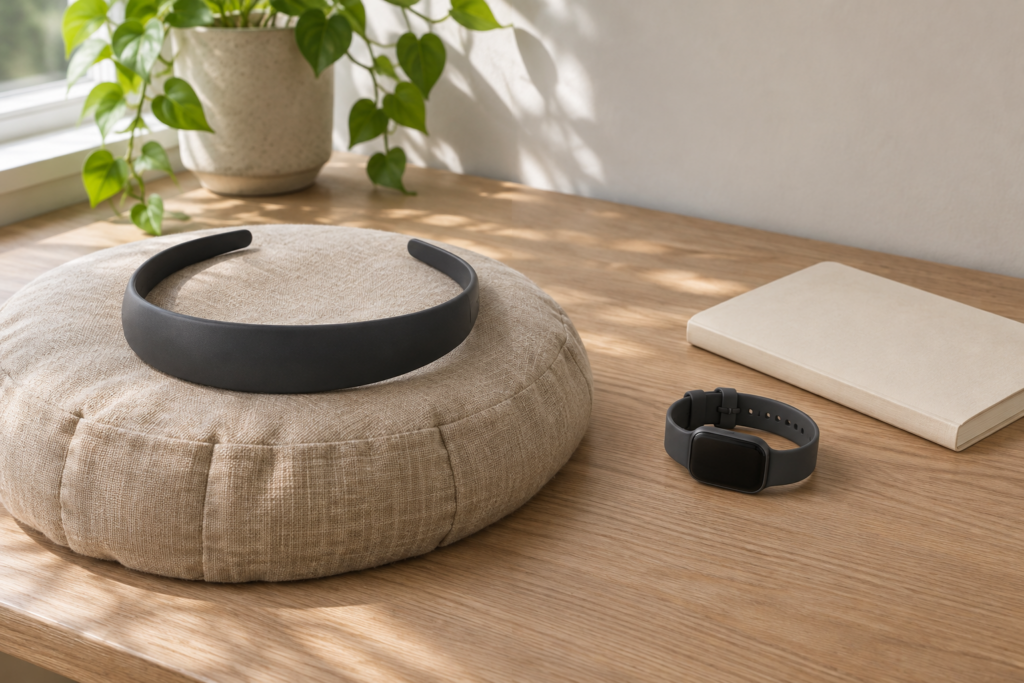
A dark meditation headband on a linen cushion beside a wrist wearable and a closed notebook.
What you’ll learn

From a cue to a result

Follow what happens before a cue and what you’re asked to do after it.

  • Identify the kind of signal a headband like Muse 2 records.
  • Read an app label as a classification.
  • Identify the practice the cue belongs to.
  • Identify who makes the on-task judgment.
  • Identify what gets scored in a separate task test.
  • Read a health claim within the use it describes.
  • Compare features that use the same word for focus.

Tip: Write down the activity you have in mind before you look at a feature list. That gives you something concrete to compare the descriptions against.

Key definitions

Six terms for reading device claims

These terms help you read a feature description or a results screen without mixing up what each tells you.

Physical signal

A change in a measurable quantity. With EEG, that quantity is electrical activity associated with the brain.

  • What it describes: An EEG trace is a recording of variations in that signal over time.
  • Where it comes from: In a headband like Muse 2, the recording comes from sensors worn on the head.
  • What to name: State the signal in plain language when a description just says the device senses something.

Derived label

A category the software assigns by interpreting data.

  • Example: Muse uses labels such as active and calm.
  • Unit: A time total can summarize several periods under one label.
  • Scope: Read the label within the session that produced it.

Attention task

The activity or object a person intends to attend to.

  • Target: Picture the thing you’re trying to stay with, down to the next paragraph or the next breath.
  • Work example: At work, the target might be the document you meant to finish.
  • Action: Name what returning to the activity would look like. If you were sorting photos, you might start again after the last one you filed.

Cue

A perceptible sign that invites someone to notice or do something.

  • Form: A vibration is a cue you can feel.
  • Timing: On the cited visual timer, an optional alert can mark the end of the countdown.
  • Response: Think about the next move the cue invites, even if that move is just pausing to decide.

Performance endpoint

A defined result of doing a particular task.

  • Setup: In a formal performance assessment, participants carry out a task under a consistent setup that can be repeated.
  • Quantity: An attention test can record how long someone takes to respond.
  • Interpretation: Name both the test and the quantity when describing its result.

Clinical claim

A statement about a device’s use for diagnosis or treatment.

  • Purpose: Look for a stated diagnostic or treatment use.
  • Population: The wording of an indication can limit use to people with a specific condition or symptom profile.
  • Result: The effect named in an indication can be narrower than the condition it addresses.

Tip: When a description says score, look for the thing being counted. A shared unit such as percent can hide very different inputs.

Inside the session

Inside an EEG meditation session

In the Mind Meditation mode, a change in what you hear starts with a reading from the headband.

  • The headband’s sensors record EEG, a way of tracking electrical activity from the brain.
  • Muse describes software that sorts the readings into active, neutral and calm categories.
  • The session sound changes. Muse gives the example of weather growing louder or quieter.
  • The changing sound cues you back to your breath.
  • The summary shows time under each label.

You can hear the cue without stopping to read a screen. If you open a dense report afterward, following its argument is a separate activity.

During another activity

A reminder to check in

Pearson describes Revibe for adults in the context of sticking with an intended task at work. That gives the prompt a target even when nothing about the work itself is being graded.

  • At a buzz, you tap the screen to say whether you’re on task.
  • Pearson says timing can adapt to replies, your schedule and your history.
  • The brochure describes sensor data gathered in the background as well as the replies you enter.

Imagine getting prompted while you’re already on the task you picked. You can answer yes and carry on.

The user’s part

What are you trying to get back to?

The useful distinction shows up in the action you take next. That action can look different even if you’d describe both moments as getting your focus back.

  • During practice, you might let a thought go and notice your next breath. The practice is the activity you came to do.
  • At a desk, you might find your place in a price sheet after answering a message. The task has a place you can pick up from.
  • A visual countdown offers another kind of help. On the Time Timer Original 8- and 12-inch models, a red disk shows how much of your set interval is left.

Picking up a photo edit and setting aside time to practice are different jobs, even if you’d call both getting back on track. Name the activity before deciding what kind of prompt would fit.

Reading the evidence

What does the result actually describe?

A result is easier to read when you know who or what produced it. In these examples, that might mean identifying what the app sorted, what the wearer reported or what the test timed.

  • The app assigns labels to stretches of a session. A longer stretch contributes more time to the total for that label.
  • A tap is the wearer’s judgment. Someone whose work looks unchanged can still answer differently from one check-in to the next.
  • In an earlier study using Muse, researchers assessed attention separately with a Stroop task and measured how quickly people responded. That timing belonged to the test.

Suppose a feature promises to help workers place labels within a marked area on outgoing parcels. An assessor could record the share of parcels whose labels are fully inside that area. A clinical claim would need evidence for its own population and outcome.

Where features overlap

What sets the cue off?

The word focus leaves two blanks in a product description. The trigger and the target tell you how to fill them in.

  • Muse’s guided meditation materials also describe returning to a point of focus. That describes something the person does.
  • The meditation sound follows the app’s reading. The timer can sound when the interval ends.
  • If one product offered both kinds of cue, each feature would still have its own trigger and purpose. Evidence for a claim about one activity would need to cover that activity.

When you compare cues, name the intended activity first. Then ask what you would do next and what, if anything, the feature would record.

Reality check

Two situations, two different records

These examples show how to read a result in the setting that produced it.

Example 1. A Calm result

Imagine meditating before opening a set of design notes. Your session summary shows a large Calm portion.

That portion comes from classified session time. If your question is how closely you read the notes, you could instead look at whether you picked up the revisions they asked for.

Example 2. A vibration while planning a display

Imagine a shop display planner choosing colors for a window. Your wrist reminder buzzes while you’re looking at a shipment notice. Since the job you picked was choosing colors, you report that you’re off task.

The reply records your answer to the prompt. To judge the display plan, someone could check whether your proposed colors fit the brief.

Common myths

What you can infer from the feature

These questions start with a feature you can observe and ask how far you can take that observation.

Does recording brain activity reveal an attention disorder?

EEG describes a kind of electrical recording. Muse markets its headband for wellness. An adult ADHD assessment can include a clinical interview and tools for rating symptoms or behavior.

Is a Calm percentage an attention test score?

It summarizes time the app assigned to a session label. A test score needs its own task and scoring rule.

Does attention support name a medical category?

The phrase is broad enough to describe a reminder about an everyday task. A clinical indication is specific about whom it covers and what outcome it addresses.

If two cues both ask me to refocus, do they work the same way?

Refocus might mean following another breath or returning to a document. A claim of equal effects would need a comparison using the same outcome.

Does taking part in a meditation session establish ADHD treatment?

Meditation participation alone leaves the treatment question open. The U.S. FDA filing for EndeavorOTC illustrates how narrow an indication can be. It describes improvement on a computerized attention test for adults with a demonstrated attention difficulty and primarily inattentive or combined-type ADHD. That improvement may come without a reduction in symptoms such as hyperactivity.

Tip: When a label or cue is used to make a health claim, look for the exact use and result the claim covers.

FAQ

Questions about focus and follow-through

Use these examples to read an ambiguous description, an incomplete record or a claim about another activity.

What if a description just says it improves focus?

Look for the activity and what was scored. For example, timing someone’s responses in a test would answer a more specific question than asking whether they felt focused at work.

Does a Revibe vibration mean I’ve drifted?

It’s an invitation to check. Pearson describes a personalized prompt schedule. Whether you’d drifted is a judgment you make when the cue arrives.

How would an unanswered prompt be counted?

In a pilot with children using Revibe Connect, researchers tracked the share of prompts that got an answer separately from the share of replies that said yes. An unanswered prompt counted toward the total sent, while a yes or no entered the second calculation. Those are the pilot’s definitions.

How would I read a device that does both?

Suppose one mode assists with meditation and another prompts a self-check during paperwork. Read each mode’s results against the activity it was running alongside.

Can I put two percentages side by side?

First see what counts as the whole. For Calm, ask which time was classified. In the Revibe Connect pilot, the focus rate used the number of replies as its denominator.

How could I use a timer cue in a rehearsal?

On the Time Timer models discussed here, the disk shows how much time is left. In a rehearsal, you could look at it when you reach the last slide to see how much of your slot remains. The optional alert marks the end of the set time.

What would show that a benefit carries into another activity?

A study would need to measure performance in the activity named in the claim. It would also need a comparison that helps separate an effect of the feature from improvements someone might make just by doing the task again.

Can one device record answer a question about ADHD diagnosis?

An adult ADHD assessment can look at how someone behaves in different settings and what that was like in childhood. Think of the difference between a single session and a history across settings.

Tip: Read the definition of a metric before deciding what a higher number would mean for you.

Bottom line

Start with what set off the cue and where it directs you. The headband’s sound changes during practice. The wrist cue asks about the task you chose.

If what you care about is doing the work better, picture the work itself and what a better result would look like. The evidence you need is a measure of that result.

Related reading

Meditation Headbands archives

Visit a Review Streets archive by article format.