What Makes Memory Training Devices Different from Dawn Simulation Lights

A memory trainer asks an awake user to encode information and attempt recall. A dawn simulation light changes the bedroom environment on a schedule, usually by increasing illumination before or around the chosen wake time.

Using a sunrise lamp before reviewing names for a morning appointment places two products in one routine, but it does not merge their mechanisms. The lamp delivers light; the training session creates opportunities to learn and retrieve.

By: Review Streets Research Lab
Updated: August 19, 2026
Explainer · 8-12 min read
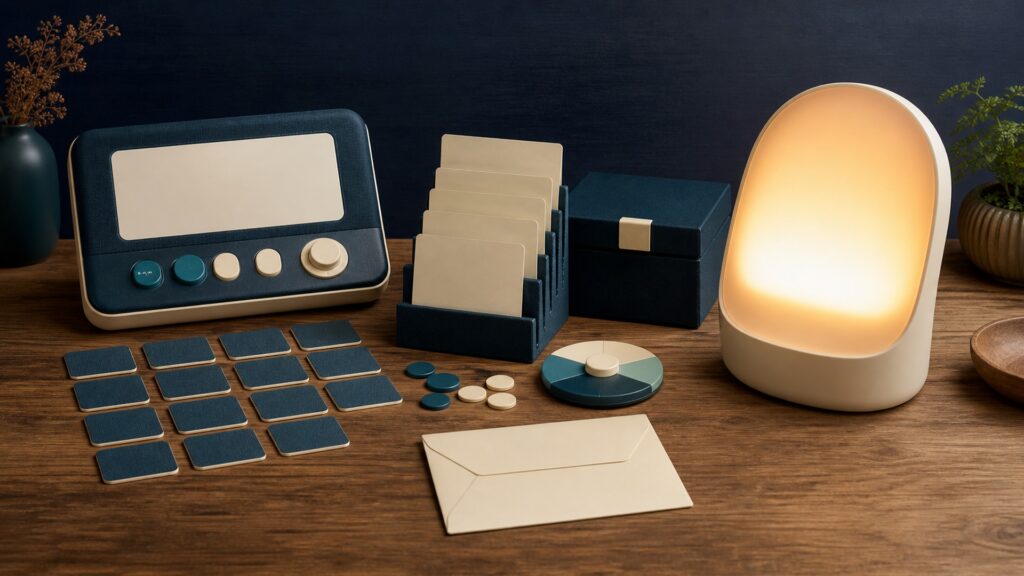
People-free editorial still life for What Makes Memory Training Devices Different from Dawn Simulation Lights
What You'll Learn

Keeping light and learning separate

These categories differ in who acts, how exposure is described, what output is meaningful, and where uncertainty remains. Combined use still calls for two evaluations rather than one blended score.

  • Define encoding trial before collecting a result
  • Separate illuminance from recall delay
  • Preserve ramp duration when comparing attempts
  • Check retrieval error on the intended activity
  • Use wake response to guide follow-up
  • Recognize when wake response points beyond a consumer product

Tip: Read the concept as part of a system, then connect it back to the use case.

Definitions

Six Concepts That Shape This Decision

These definitions connect the main idea to the variables, limits, and practical signals readers need to compare options.

Encoding trial

Encoding trial refers to an active attempt to organize information before it must be remembered.

  • For encoding trial, document what the awake user was asked to learn.
  • Measure illuminance with the room conditions and device position recorded.
  • Neither observation turns encoding trial into evidence about sleep or circadian health.

Illuminance

Illuminance refers to the amount of light reaching a surface at a particular position.

  • Express illuminance at the user's position rather than relying on a product setting.
  • Keep recall delay tied to a recall task completed after waking.
  • A different room may change illuminance even when the lamp setting stays fixed.

Recall delay

Recall delay refers to the elapsed period between learning and retrieval.

  • Set the interval for recall delay before looking at the answer.
  • Describe ramp duration in minutes and shape instead of calling the exposure gradual.
  • A short result for recall delay cannot predict memory over longer delays.

Ramp duration

Ramp duration refers to the programmed time over which the lamp rises from dim to brighter output.

  • Record the start, peak, and end of ramp duration for each trial.
  • Classify retrieval error by type so one mistake does not become a global score.
  • Comfort and ambient light can alter ramp duration without affecting the memory exercise.

Retrieval error

Retrieval error refers to an omission, substitution, intrusion, or ordering mistake during recall.

  • Count omissions and substitutions when evaluating retrieval error.
  • Read wake response as a waking observation, not as proof of improved cognition.
  • Repeated items can reduce retrieval error while leaving unfamiliar material unchanged.

Wake response

Wake response refers to the observed effect on awakening, leaving bed, comfort, and later alertness.

  • Define wake response before comparing mornings with different schedules.
  • Return to encoding trial if recall changes despite a stable lighting response.
  • A consumer log of wake response cannot identify every reason for difficult waking.

Tip: Keep the definitions connected; the strongest answer usually comes from the whole system, not one term.

Identify who acts

Memory practice depends on an awake learner making responses; a dawn lamp changes the room while the user may still sleep.

Identify the active participant. Memory exercises depend on deliberate responses from an awake learner, while the light can begin changing the room before the sleeper consciously engages with it.

  • Name the encoding trial outcome before starting
  • Describe the starting illuminance situation
  • Choose material with practical value for encoding trial
  • Protect high-consequence uses of illuminance

Take the next step only after the encoding trial outcome and illuminance comparison point are clear.

Describe the dose correctly

For training, specify material, attempts, cues, and delays; for lighting, specify timing, brightness, geometry, and ambient conditions.

Describe each dose in its own units. Memory practice needs material, cue, attempt, and delay; light exposure needs timing, brightness at the eyes, ramp shape, room geometry, and ambient light.

  • Set repeatable conditions for illuminance
  • Note which recall delay cues remain available
  • Watch for fatigue during illuminance checks
  • Save enough recall delay detail for comparison

Describe the illuminance observation narrowly enough that another person could repeat the recall delay check.

Read the output

A memory result concerns correct retrieval and error pattern, whereas a lamp record concerns schedule and wake response.

Read the outputs without crossing categories. Correct delayed recall speaks to the trained material, whereas a wake log speaks to timing and response around awakening; neither directly measures the other.

  • Observe recall delay at this stage
  • Separate ramp duration accuracy from speed
  • Test recall delay after a meaningful delay
  • Investigate results that conflict with ramp duration

When the recall delay score conflicts with daily ramp duration performance, review the conditions behind both results.

Test the morning sequence

Observe awakening first, then conduct a stable recall task after the user is fully ready.

When studying a combined morning routine, observe awakening first and conduct the same recall task after the user is fully ready. Association between the two observations does not establish that light trained memory.

  • Review ramp duration outside the exercise
  • Record interruptions affecting retrieval error
  • Count ramp duration burden alongside benefit
  • Avoid changing several retrieval error variables together

Treat fatigue, frustration, and access barriers as evidence when interpreting ramp duration beside retrieval error.

Choose or combine deliberately

Use the lamp for a pre-wake lighting goal and memory exercises for later retrieval goals.

Select each product for its actual job. Keep the lamp only for a worthwhile lighting or waking goal, and keep the memory exercises only when later retrieval improves enough to justify their burden.

  • Decide whether retrieval error supports another trial
  • Schedule the next wake response check
  • Preserve safety supports around retrieval error
  • Escalate concerning wake response changes appropriately

Continue only when change in retrieval error justifies the burden documented through wake response.

Quick Reality Check

Reading encoding trial without overstating wake response

A defensible conclusion connects encoding trial with a practical outcome, while wake response keeps the remaining uncertainty visible.

Results each device may support

A worthwhile encoding trial finding appears on a defined task under conditions recorded for ramp duration, not merely in accumulated sessions. Follow-up may adjust the routine when both encoding trial and ramp duration remain manageable.

A neutral illuminance result is useful too. When wake response remains unchanged amid frustration or poor fit, the product may not earn further time or data.

What wake response still cannot answer

Practice effects, changing cues, sleep, and stress can alter ramp duration; familiarity and assistance can also reshape encoding trial. Neither the ramp duration nor encoding trial record separates every cause, so this conclusion stays task-specific.

A concerning change beside wake response should pause self-training. Seek suitable help when the associated illuminance pattern is sudden, worsening, severe, or unsafe.

Common Myths

Misconceptions That Distort the Decision

Common shortcuts and misunderstandings can make the topic seem simpler than it is.

Can dawn light train memory during sleep?

A consumer sunrise lamp does not teach names or facts to a sleeping user. It changes illumination near waking; any later memory difference is indirect and needs a separate, controlled recall observation.

Does better morning recall prove the lamp worked?

Not by itself. Sleep duration, alertness, practice, caffeine, cueing, and material difficulty may differ. Log the light exposure and repeat a comparable memory task before suggesting an association, let alone causation.

Can a memory app reset the body clock?

Memory exercises are not substitutes for timed light or qualified sleep care. Late screen use may even affect a routine differently. Address waking goals and retrieval goals with mechanisms designed for each purpose.

Are both categories measured with session duration?

Duration means different things: a lamp has a ramp and exposure schedule, while training has encoding, retrieval, and delay periods. Equal minutes therefore describe neither equal mechanisms nor equivalent expected outcomes.

Tip: Treat strong claims as starting points for comparison, not final answers.

FAQ

Questions to Ask Before Choosing

Concise answers to common questions readers may have after the main explanation.

When should a dawn simulator be considered?

Consider it for a gradual scheduled-light goal around waking, after reviewing instructions, sensitivity, medications, and relevant health guidance. Measure comfort, awakening, and daytime response rather than expecting a memory-training result.

When should memory training be considered?

Use it when an awake learner wants structured encoding, spaced retrieval, or prospective-memory practice. Choose material tied to the goal and verify retention after delay without leaving the answer visible.

How can both be tested in one routine?

Keep the lamp schedule stable, allow a consistent waking interval, then use alternate memory material under matched conditions. Record each intervention separately so morning alertness does not become mislabeled as memory learning.

What warning signs require outside help?

Troubling mood activation, severe sleep disruption, eye symptoms, sudden confusion, rapid memory decline, or unsafe functional errors deserve appropriate professional attention. Neither a brighter lamp nor extra practice can identify the underlying cause.

Bottom Line

Dawn simulators alter timed illumination around waking; memory trainers rehearse encoding and retrieval after the user can participate. Because their doses and outcomes are different, a shared morning schedule still needs separate evidence for each product.

Write down when wake response will be checked again. Scheduling that encoding trial review preserves a testable record and provides a clear stopping point when illuminance remains unhelpful.

Next Steps

Go Deeper or Compare Your Options

Use these Review Streets paths to connect the explainer to related categories, comparisons, and next decisions.

How Memory Training Devices Works

Explore how memory training devices works to extend this specific decision without confusing its mechanism with retrieval exercises versus environmental light timing.

Quick Summary

Practical Takeaways

  • Begin with the practical question that makes encoding trial relevant.
  • Record conditions that could alter illuminance before interpreting a score.
  • Use recall delay and ramp duration as separate observations.
  • Judge ongoing value through retrieval error without ignoring burden.
  • Revisit the plan when wake response or safety evidence changes.