
Vehicle footprint
The exterior space a vehicle occupies.
- Example: overall length and width affecting garage access
- Check: measure the exact configuration including relevant mirror clearance
- Limit: a category label does not give parking dimensions
Midsize and full-size pickups differ chiefly in their overall packaging and the range of work their configurations are designed to accommodate. A full-size truck generally offers a larger physical platform and broader choices for passenger space, beds, and heavy-duty work. A midsize truck usually packages pickup usefulness into a smaller vehicle, with its own limits and daily advantages.
Those tendencies do not make every full-size truck more capable than every midsize truck in every measure. Cab, bed, engine, drivetrain, equipment, and the specific vehicle ratings determine the useful comparison. Full-size light-duty pickups and heavier-duty models also should not be treated as one interchangeable specification.
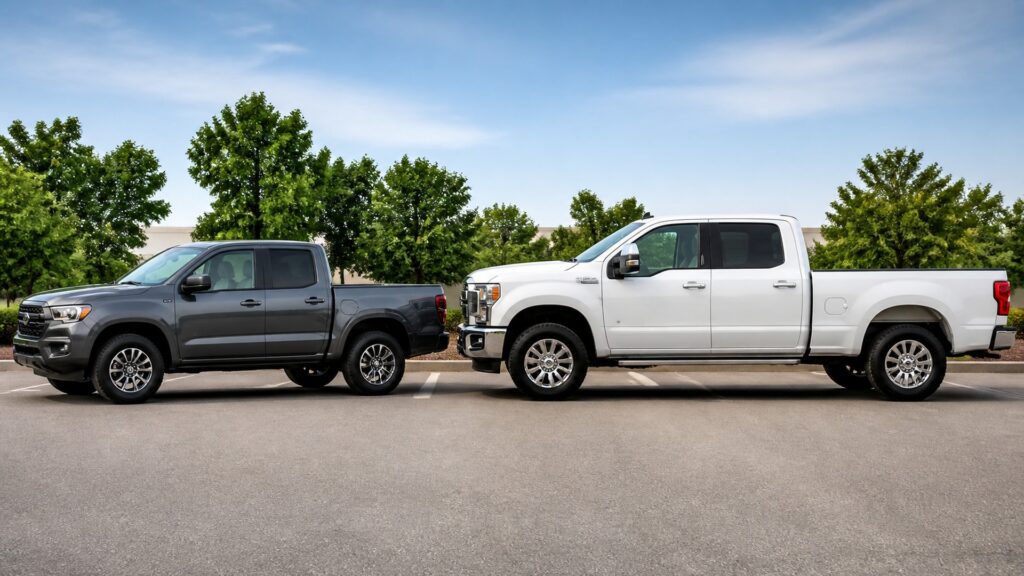
Understand the practical differences without treating class labels as ratings.
Tip: Compare two identifiable configurations, not the best advertised figure from one class against a typical example from the other.
Each measure describes a different part of practical suitability.
The exterior space a vehicle occupies.
The distance between the front and rear axle centers.
The allocation of passenger space and access within the cab.
The bed dimensions and arrangement available with a particular truck.
The specified load limits applying to a particular vehicle and combination.
The kinds and intensity of work covered by the available designs.
Tip: Keep dimensions, usable space, and load ratings in separate columns. A truck can improve one without improving every other measure.
Midsize pickups typically occupy less space than full-size alternatives, which can matter in parking areas, garages, and narrow access routes. Actual dimensions still vary with the design and configuration. Consider door-opening space, mirrors, turning requirements, and the room needed to load the bed. The difference becomes meaningful when measured against the places the truck must use repeatedly.
A truck that technically fits inside a garage may leave too little working space beside it. Practical fit includes using the vehicle after it has been parked.
A larger platform can accommodate a wider cabin or a broader range of cab-and-bed combinations, but the useful result depends on the version. A midsize crew cab can serve a household well, while another buyer may need the rear-seat space of a particular full-size truck. Bed length and passenger space should be evaluated together because configuration choices can trade one against another.
A spacious cabin does not prove that the chosen bed holds the equipment. Likewise, a long bed does not establish comfortable accommodation for everyone who travels.
Full-size ranges can offer higher maximum towing or payload capabilities, especially when heavier-duty models are included. That does not make the advertised maximum applicable to every example on a dealer lot. Equipment and configuration change the available allowance. Compare the whole intended load with the actual ratings, including occupants, cargo, added equipment, and the loads imposed by a trailer.
An extensively equipped full-size truck and a simpler midsize truck can narrow or alter an expected payload comparison. Read the actual figures rather than inferring them from exterior size.
Full-size light-duty pickups and heavier-duty series serve overlapping but different work needs. Including the strongest heavy-duty model in a comparison can exaggerate what an ordinary light-duty configuration offers. Midsize trucks also vary, from everyday-use versions to specialized equipment packages. The fair comparison identifies the actual series and configuration on both sides before discussing capability or comfort.
A buyer needing a particular heavy-load capability should verify the suitable series directly. Someone carrying modest household loads may have little use for the extra equipment and its tradeoffs.
Compare ride, access, visibility, tire replacement costs, insurance, and fuel or energy consumption for the actual candidates. Do not assume a smaller truck always costs less to run or that a full-size truck always rides better. Powertrain, equipment, use pattern, and local costs influence the result. Manufacturer model information is a starting point; an appropriate drive and concrete ownership estimates complete the comparison.
Choose midsize when it covers the real job with a useful footprint. Choose full size when its verified space or working capacity justifies the larger vehicle in everyday life.
The best choice follows the job and the specific truck.
The required loads and passenger needs fit within the actual configuration.
A smaller footprint improves repeated parking or access tasks.
Additional cabin or bed arrangements solve a real space requirement.
The selected series and configuration provide needed working capacity beyond the midsize candidate.
Broad tendencies should not become absolute purchasing rules.
Actual configuration and equipment determine the allowance.
Light-duty and heavier-duty series need separate consideration.
Powertrain, equipment, use, and local costs influence the total.
Cab dimensions, seating, and access still differ.
Tip: A useful comparison ends with why the differences matter to the intended owner, not just which number is larger.
Use class names to organize the search, then compare actual vehicles.
It is generally a smaller category, but compare the exact configurations and dimensions rather than treating the label as a measurement.
No. Cab-and-bed choices vary, and a particular full-size configuration may not have the longest bed.
Only as an initial range indicator. The selected truck and complete loaded combination must satisfy their applicable limits.
That depends on parking, passenger needs, comfort, and actual operating costs, alongside the truck work it must also perform.
When its verified capacity or equipment is needed for the intended workload, rather than simply because it belongs to a larger class.
Midsize pickups usually emphasize a smaller package; full-size ranges offer broader space and working-capacity choices.
Compare actual dimensions, configurations, and ratings. The right truck is the one whose useful advantages justify its daily compromises.
Use these Review Streets paths to compare related categories and practical next decisions.
Explore vehicle types and practical roles.
Compare pickup truck designs.
Continue with midsize pickup capability and care.
Further reading: Ford Ranger midsize configurations; Ford F-150 full-size configurations; Ford Ranger loading and towing instructions.
Choose a retailer
Prices checked regularly. We may earn a commission at no cost to you.