
Recovery Tool
A recovery tool supports comfort, mobility, or preparation around training.
- Example: a roller used after a run or before mobility drills
- Check: judge pressure, density, and target access
- Limit: it does not provide cardio
Muscle recovery rollers and elliptical machines are different because one supports recovery and movement preparation while the other provides cardio training. A roller applies pressure to soft tissue; an elliptical creates a low-impact exercise session.
That difference matters because these products should not be judged by the same criteria. Rollers are about pressure control, density, texture, target access, and recovery fit. Ellipticals are about stride feel, resistance, stability, footprint, and training consistency.
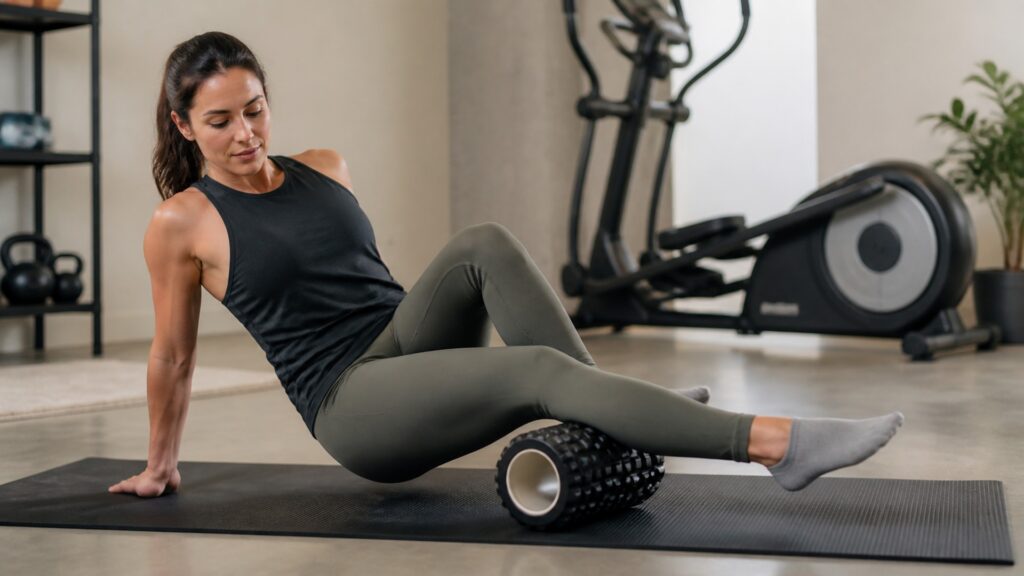
A practical comparison of a recovery tool and a cardio machine.
Tip: Ask whether you need pressure for recovery support or a machine that supplies the cardio session.
These concepts explain why recovery rollers and ellipticals belong to separate decisions.
A recovery tool supports comfort, mobility, or preparation around training.
A cardio machine creates a repeatable exercise session through motion and resistance.
Pressure control is how easily the user adjusts the intensity of rolling.
Exercise output is the work produced during a training session.
Routine sequence is where each product fits before, during, or after training.
Ownership burden is the cost, space, storage, and upkeep a product adds.
Tip: The roller supports recovery around movement. The elliptical supplies movement.
A muscle recovery roller is used around training to apply pressure. An elliptical is used during training to create movement and resistance.
The clearest difference is recovery support versus cardio training.
For rollers, important details include firmness, texture, diameter, length, vibration, and target access. For ellipticals, important details include stride path, resistance range, frame stability, console, and footprint.
A fair comparison uses the right standard for the product.
A roller is small, portable, and relatively inexpensive. An elliptical is a larger machine that needs dedicated space and consistent use.
The size of the commitment should match the size of the training problem.
A user might roll tight areas before warming up, use an elliptical for cardio, then roll gently afterward. The products support different stages.
Complementary roles make the comparison more useful.
If the problem is tightness management or recovery support, compare rollers. If the problem is low-impact cardio access, compare ellipticals.
The right choice follows the role the routine needs.
One product supports recovery. The other provides cardio.
You need controlled pressure for tightness, warmup, cooldown, or recovery support.
You want a small tool that can target specific areas.
You want a repeatable low-impact cardio session.
You have the space, budget, and habit for a dedicated machine.
The products support different parts of fitness.
A roller can support recovery, but it does not create a cardio workout.
The machine provides exercise, but recovery support may still be useful.
A roller may solve a specific problem more directly than a machine.
Intensity belongs to the elliptical. Controlled pressure belongs to the roller.
Tip: Compare recovery tools by recovery support and cardio machines by training quality.
Short answers about recovery tools and cardio equipment.
No. A roller supports recovery and preparation. An elliptical provides cardio training.
Yes. Rolling can fit before or after an elliptical session if it feels useful and tolerable.
Compare density, texture, size, pressure control, vibration, and target access.
Compare stride feel, resistance, frame stability, console features, footprint, and noise.
Use the roller for recovery support and the elliptical for low-impact cardio.
Muscle recovery rollers and elliptical machines differ because one supports recovery while the other provides cardio training.
They can fit the same routine, but rollers are judged by pressure and target access while ellipticals are judged by movement quality and training commitment.
Use these Review Streets paths to compare related fitness categories and practical buying decisions.
Explore the category before comparing individual products.
Browse related fitness categories and buying decisions.
Review the equipment category separately from this support tool.
Choose a retailer
Prices checked regularly. We may earn a commission at no cost to you.