What Makes Office Printers Different from Office Machines

Office printers are a subset of office machines. Their defining job is narrow and precise: convert digital page descriptions into physical paper output. The broader office-machine category also includes multifunction devices, copiers, scanners, fax services, finishers, folders, binders, laminators, shredders, mail equipment, and other shared administrative hardware.

That category relationship matters because a print engine does not explain the complete machine. Capture destinations, paper originals, communications, finishing, stored data, material handling, and disposal introduce mechanisms and controls beyond printer queues and page rendering. Managing that broader boundary requires a current capability inventory, subsystem-specific support, and retirement steps for every enabled direction of information.

By: Review Streets Research Lab
Updated: September 1, 2026
Explainer · 8-12 min read
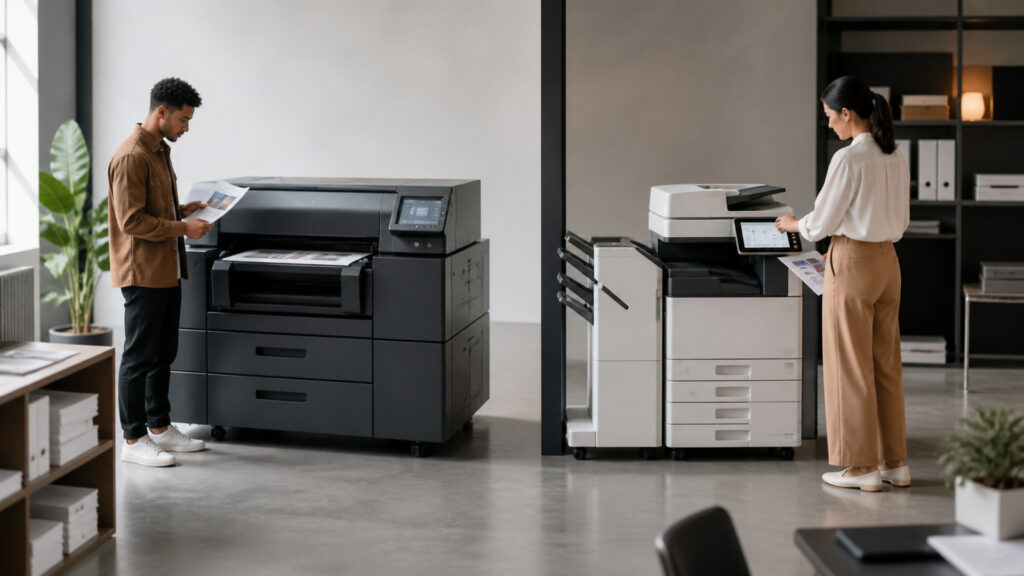
Editorial business scene illustrating office printers and office machines
What You'll Learn

The Control Chain Behind Office Printers and Office Machines

Follow digital page into marking engine, test the consequence at multifunction device, and require finishing system to reconcile with office equipment.

  • Comparing Category Scope
  • Comparing Primary Inputs and Outputs
  • Comparing Subsystems
  • Comparing Data and Permissions
  • Comparing Management Boundaries
  • How multifunction device changes the conclusion

Tip: Select one real digital page case and mark every owner, version, device state, exception, and completion artifact in the portfolio scope record.

Definitions

Six Boundaries That Define Office Printers and Office Machines

These terms assign independent jobs to office printer, marking engine, and scan destination instead of hiding them under one product label.

Office printer

A device whose primary function is rendering digital page descriptions onto paper.

  • Its specific operating role is this: it specializes page output.
  • A practical boundary remains: it is one type of office machine.
  • The equipment portfolio owner should verify multifunction device before accepting this term as complete.

Office machines

The broader category of shared equipment for printing, copying, scanning, faxing, finishing, mailing, binding, laminating, shredding, or related work.

  • Its specific operating role is this: it covers several job families.
  • A practical boundary remains: it cannot be reduced to printers.
  • The equipment portfolio owner should verify copy path before accepting this term as complete.

Marking engine

The toner, ink, or related mechanism placing the rendered page image onto media.

  • Its specific operating role is this: it creates printer output.
  • A practical boundary remains: it is only one subsystem in some machines.
  • The equipment portfolio owner should verify scan destination before accepting this term as complete.

Copy path

The combined optical capture and print process reproducing a paper original.

  • Its specific operating role is this: it supports walk-up copying.
  • A practical boundary remains: it handles temporary image data.
  • The equipment portfolio owner should verify fax service before accepting this term as complete.

Scan destination

The email, folder, repository, cloud service, or workflow receiving captured pages.

  • Its specific operating role is this: it moves information away from paper.
  • A practical boundary remains: it creates a separate permission boundary.
  • The equipment portfolio owner should verify finishing system before accepting this term as complete.

Office equipment

The managed collection of devices, accessories, supplies, contracts, locations, and workflows supporting administrative tasks.

  • Its specific operating role is this: it frames portfolio ownership.
  • A practical boundary remains: it includes varied risks and skills.
  • The equipment portfolio owner should verify office equipment before accepting this term as complete.

Tip: Do not collapse office printer into office machines; the first controls digital page, while the second has a separate effect on printer status.

Comparing

Comparing Category Scope

Office printers are the page-output subset; office machines include printers plus capture, reproduction, communication, finishing, material-handling, and disposal equipment.

  • Identify the source and current version of digital page
  • Name the decision maker responsible for print driver
  • Capture an independent status for spool queue
  • Test marking engine under a realistic failure condition
  • Reconcile the observed paper output result with printer status
  • Keep correction history when multifunction device is reopened

Close this stage only after the originating digital page, the decision affecting marking engine, and independent printer status evidence agree in the portfolio scope record. The portfolio boundary record should distinguish the relationship between copy path, scan destination, and fax service, so a category relationship does not erase subsystem responsibility. For comparing category scope, the equipment portfolio owner should record why that evidence was sufficient.

Comparing

Comparing Primary Inputs and Outputs

Printers receive digital page descriptions and produce sheets; broader machines may accept paper originals, electronic destinations, finishing instructions, or physical materials.

  • Identify the source and current version of print driver
  • Name the decision maker responsible for spool queue
  • Capture an independent status for marking engine
  • Test paper output under a realistic failure condition
  • Reconcile the observed printer status result with multifunction device
  • Keep correction history when copy path is reopened

Close this stage only after the originating print driver, the decision affecting paper output, and independent multifunction device evidence agree in the portfolio scope record. The portfolio boundary record should distinguish the relationship between scan destination, fax service, and finishing system, so a category relationship does not erase subsystem responsibility. For comparing primary inputs and outputs, the equipment portfolio owner should record why that evidence was sufficient.

Comparing

Comparing Subsystems

A printer centers on drivers, queues, rasterization, marking, duplexing, and output, while multifunction and specialty machines add optics, feeders, fax, finishers, cutters, folders, binders, or shredders.

  • Identify the source and current version of spool queue
  • Name the decision maker responsible for marking engine
  • Capture an independent status for paper output
  • Test printer status under a realistic failure condition
  • Reconcile the observed multifunction device result with copy path
  • Keep correction history when scan destination is reopened

Close this stage only after the originating spool queue, the decision affecting printer status, and independent copy path evidence agree in the portfolio scope record. The portfolio boundary record should distinguish the relationship between fax service, finishing system, and office equipment, so a category relationship does not erase subsystem responsibility. For comparing subsystems, the equipment portfolio owner should record why that evidence was sufficient.

Comparing

Comparing Data and Permissions

Printer controls focus on jobs, queues, release, drivers, and output; other office functions introduce scan destinations, address books, stored images, communications, and physical custody.

  • Identify the source and current version of marking engine
  • Name the decision maker responsible for paper output
  • Capture an independent status for printer status
  • Test multifunction device under a realistic failure condition
  • Reconcile the observed copy path result with scan destination
  • Keep correction history when fax service is reopened

Close this stage only after the originating marking engine, the decision affecting multifunction device, and independent scan destination evidence agree in the portfolio scope record. The portfolio boundary record should distinguish the relationship between finishing system, office equipment, and digital page, so a category relationship does not erase subsystem responsibility. For comparing data and permissions, the equipment portfolio owner should record why that evidence was sufficient.

Comparing

Comparing Management Boundaries

Printer fleet management emphasizes output capacity and supplies; office-machine management must cover multiple mechanisms, contracts, skills, workflows, and completion tests.

  • Identify the source and current version of paper output
  • Name the decision maker responsible for printer status
  • Capture an independent status for multifunction device
  • Test copy path under a realistic failure condition
  • Reconcile the observed scan destination result with fax service
  • Keep correction history when finishing system is reopened

Close this stage only after the originating paper output, the decision affecting copy path, and independent fax service evidence agree in the portfolio scope record. The portfolio boundary record should distinguish the relationship between office equipment, digital page, and print driver, so a category relationship does not erase subsystem responsibility. For comparing management boundaries, the equipment portfolio owner should record why that evidence was sufficient.

Quick Reality Check

What Office Printers and Office Machines Can Demonstrate in Practice

Operational evidence can connect marking engine, paper output, and printer status to a defined result. It cannot supply missing source facts or convert finishing system into proof of every upstream decision.

Evidence That Makes marking engine Credible

A versioned digital page record preserves the initial condition through later configuration and recovery work.

Independent printer status evidence shows whether fax service reached the intended physical or system outcome.

Claims That finishing system Cannot Support Alone

Local workload, media, policy, staffing, and environment can change the right treatment for copy path.

A completed finishing system cannot establish that the source, authority, physical artifact, and downstream record were all correct.

Common Myths

Misconceptions About Office Printers and Office Machines

These misconceptions mistake visible digital page activity for control over paper output, copy path, and finishing system.

Does digital page automatically establish marking engine?

No. digital page identifies one condition, whereas marking engine requires its own event and evidence. The equipment portfolio owner should link both in the portfolio scope record, inspect printer status, and open a specific scope confusion for any conflict.

Is a completed printer status the same as a completed outcome?

No. printer status marks a bounded mechanism. Completion also requires the intended copy path decision, observable fax service result, resolved exceptions, and reconciliation between finishing system and the authoritative office equipment record.

Can configuration alone govern scan destination?

No. Configuration can constrain scan destination, but it cannot choose unsupported exceptions or supply missing business context. The equipment portfolio owner remains accountable for approval, change history, failure recovery, and evidence preserved in the portfolio scope record.

Does finishing system prove every upstream step was correct?

No. A visible finishing system confirms only its own milestone. Verify the originating digital page, versioned paper output, authority over copy path, physical or system result, and final office equipment before closure.

Tip: Ask which source created print driver, who owned the scope confusion, and which independent artifact confirms fax service.

FAQ

Frequently Asked Questions About Office Printers and Office Machines

The questions below assign digital page, separate adjacent states, define multifunction device recovery, and reconcile fax service with the final record.

Who owns the authoritative digital page?

Assign digital page to a named equipment portfolio owner and one authoritative source. The portfolio scope record should retain its version, effective time, affected device or job, approval boundary, and the exact method used to correct a disputed value.

How should teams distinguish spool queue from marking engine?

Record spool queue when its own evidence appears, then create a separate timestamp for marking engine. Preserve the actor, source, resulting marking engine state, failure meaning, and rollback instead of deriving it from spool queue.

What belongs in a multifunction device exception?

Open a specific scope confusion containing the job or asset identifier, observed condition, current owner, operational consequence, supporting evidence, permitted recovery, deadline, and closure test. Never erase the event that revealed the problem.

What should reconcile around fax service?

Compare fax service with originating digital page, intermediate paper output, independent acknowledgments, later finishing system, and authoritative office equipment. Investigate timing, duplication, omission, rendering, routing, configuration, and version differences affecting fax service separately.

When does the office printers and office machines design need revision?

Revise the design when ownership of digital page is ambiguous, multifunction device failures lack a recovery route, or office equipment must be reconstructed repeatedly. Within office printers and office machines, those symptoms identify a broken boundary, not one operator mistake.

Bottom Line

Office printers specialize in digital-to-paper page output. Office machines is the broader category containing printers and equipment for capture, copying, communication, finishing, handling, or disposal.

Treat printer fleet controls as one discipline inside the larger equipment portfolio when devices perform more than printing.

Next Steps

Continue From the Printer Status Boundary

Use the neighboring explainer for the next decision involving scan destination, or browse the direct category for systems sharing digital page and office equipment.

Office Printers

Browse the direct Office Printers category for related systems involving digital page, multifunction device, and finishing system.

Quick Summary

Office Printers and Office Machines Explained

  • Digital page begins the controlled record.
  • Marking engine needs independent evidence.
  • Multifunction device changes the recovery path.
  • Fax service must retain ownership.
  • Finishing system reconciles with office equipment before closure.