What Makes Passenger Vans Different from Cargo Vans

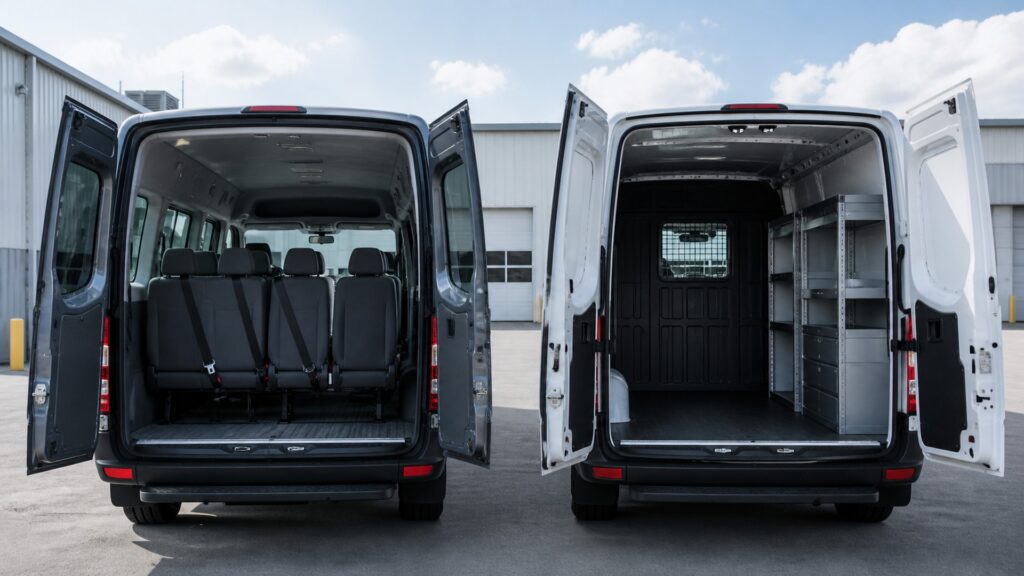
Passenger vans and cargo vans differ primarily in what their interiors are equipped to carry. A passenger configuration provides designated rear seating and the associated restraints, access, and cabin equipment. A cargo configuration devotes more of the rear space to goods, with equipment selected for loading, storage, and restraint of that load.

They may share a vehicle platform, engines, or exterior panels, but shared appearance does not establish identical seats, floor attachments, glazing, climate equipment, airbags, or load capacity. Compare the exact model year and configuration before treating parts or interior layouts as interchangeable.

By: Review Streets Research Lab
Updated: October 6, 2026
Explainer · 8-12 min read
passenger vans explainer hero image for Review Streets
What You'll Learn

Look Beneath the Shared Van Shape

Understand which differences come from the interior's intended occupants and load.

  • How rear seats connect to the vehicle as a system
  • Why passenger access differs from cargo loading space
  • Which cabin features vary with configuration
  • Why load ratings cannot be inferred from an empty interior
  • What remains different after seats are removed

Tip: Compare equipment lists and vehicle documentation, not just photographs of the same body shape.

Definitions

The Interior Systems That Separate the Configurations

These terms distinguish passenger accommodation from an open load area.

Designated rear seating

Designated rear seating provides intended occupant positions behind the front cabin.

  • Example: a documented rear-row arrangement in a passenger model
  • Check: the exact seat count and restraint arrangement
  • Limit: a cargo floor is not designated seating

Seat attachment system

A seat attachment system connects a seat to the vehicle through the specified mounts or locking mechanism.

  • Example: a removable seat engaging its intended floor attachments
  • Check: the seat and vehicle application information
  • Limit: matching visible holes do not establish equivalent structure

Cabin trim

Cabin trim comprises the interior panels, surfaces, and fittings surrounding the occupants.

  • Example: finished side panels around a passenger row
  • Check: the fitted trim and access it provides
  • Limit: trim can cover important attachment or service locations

Cargo partition

A cargo partition is an installed barrier separating the front occupant area from the rear load space.

  • Example: a specified partition behind the front seats
  • Check: its application, installation, and intended protection
  • Limit: a partition does not replace securing the load

Load-space dimensions

Load-space dimensions describe usable lengths, widths, and heights in a specified arrangement.

  • Example: floor length behind the last installed seating row
  • Check: which seats and equipment are present in the measurement
  • Limit: the largest advertised volume may describe a different layout

Vehicle load allowance

Vehicle load allowance describes what can be carried within the relevant ratings for the actual vehicle.

  • Example: accounting for fitted seats, shelving, people, and baggage
  • Check: vehicle labels and completed configuration
  • Limit: more empty-looking space does not guarantee more allowable weight

Tip: Passenger equipment and cargo equipment each use space and add weight; compare the completed arrangements.

Seating

Passenger Accommodation Includes More Than the Seat Cushion

A rear seat works with its attachments, restraint arrangement, and surrounding vehicle structure. Its position also relates to available space and safety equipment. A cargo version that shares the same body outline may not provide the same installation provisions. Before changing seating, use information for the exact vehicle and seat system and obtain qualified assessment where the proposal goes beyond the supported arrangement.

  • Identify the designated occupant positions.
  • Check the seat, restraint, and attachment information together.
  • Do not infer compatibility from appearance alone.

Ford's rear-seat instructions illustrate that even removable factory seats have defined removal and installation requirements.

Reference: Ford Transit seat removal, Ford Transit seat installation.

Layout

Passengers Need Access; Goods Need a Loading Arrangement

A passenger cabin needs routes to occupied rows and usable entry points. A cargo interior can instead be organized around a large item, shelving, or frequent access to parcels. A partition or rack may be useful in one arrangement and obstructive in another. The design difference is not simply that one van has more free floor area; the intended use of that area is different.

  • Compare the route through the doors and interior.
  • Measure with the intended seats or storage installed.
  • Check how people and carried items are kept in their proper places.

An airport group and a technician with cabinets of tools can need different interiors even when their vehicles occupy the same parking space.

Cabin equipment

Glazing, Airflow, and Interior Finish Depend on the Exact Specification

Passenger configurations may include rear windows, finished trim, lighting, and heating or cooling provisions intended for the occupied cabin. Cargo configurations and optional packages vary, so none of those features should be assumed from the name alone. Airbag equipment can also vary with the vehicle and seating arrangement. Check the actual specification and instructions instead of extending a claim from one trim to the whole range.

  • Review the equipment list for the model year.
  • Inspect rear airflow and lighting where passengers would sit.
  • Confirm safety equipment for the actual configuration.

The Ford Transit order guide separates cargo and passenger equipment and options, making it a useful example of why configuration details matter.

Reference: Ford Transit configuration and equipment guide.

Weight

Interior Volume and Carrying Capacity Are Different Measurements

An open cargo floor may look capable of holding a great deal, but shelving, partitions, equipment, and the load still contribute to vehicle weight. Passenger seats and cabin fittings also form part of the finished vehicle. Compare the actual labels and ratings after accounting for what is installed. Removing interior equipment changes mass and available space, but it does not by itself increase the vehicle's certified weight ratings.

  • Distinguish cargo volume from allowable weight.
  • Include permanent additions in the completed vehicle.
  • Check individual axle limits as well as total weight.

Ford's Transit explanation of gross vehicle weight rating includes the vehicle, passengers, cargo, and installed equipment within the total rating.

Reference: Ford Transit gross vehicle weight rating.

Changes

Removing Seats Does Not Establish an Identical Cargo Specification

Where the manufacturer permits seat removal, the result may provide more room, but the remaining floor, trim, glazing, climate hardware, and other equipment still belong to that vehicle. Nor does adding a seat to a cargo version prove it has become an equivalent passenger model. Evaluate any changed arrangement on its own documentation and installation requirements, including load restraint and occupant accommodation.

  • Use only supported seat-removal and installation procedures.
  • Protect and inspect the specified attachment components.
  • Have unsupported conversions assessed as complete systems.

A flexible seating arrangement is useful when its permitted configurations are understood; it should not be confused with unrestricted interchangeability.

Quick Reality Check

Shared Platform, Different Interior Priorities

Similar exterior dimensions can contain different equipment and usable space.

Passenger configuration

Organizes the rear cabin around designated occupants and their access.

Requires attention to seating, restraints, cabin conditions, and baggage.

Cargo configuration

Organizes the rear area around carried goods and loading access.

Requires attention to storage, restraint, installed equipment, and load limits.

Common Myths

Misconceptions About Passenger and Cargo Van Design

Shared bodywork does not prove that every component or rating is shared.

Windows determine whether a van is a passenger vehicle

Glazing is only one feature. The designated seating and complete configuration matter.

The same body shape guarantees interchangeable seats

Attachments, structure, restraints, and equipment can differ. Check the exact application.

Removing seats raises the weight rating

It may reduce vehicle mass, but it does not by itself change the certified ratings.

Every cargo van has fewer safety features

Equipment varies by model, year, and configuration. Compare actual specifications rather than relying on the label.

Tip: Treat the exact configuration as the unit of comparison.

FAQ

Questions About Passenger and Cargo Van Differences

Answers about shared platforms, interior equipment, and modifications.

Can the two versions share an engine?

Yes. Sharing propulsion or body components does not mean the rear cabin and equipment are identical.

Is a passenger van simply a cargo van with seats?

That description omits the seating attachments, restraints, access, cabin equipment, and configuration-specific details that need checking.

Do cargo vans always have greater payload?

Not universally. Compare the actual completed vehicles, ratings, and installed equipment.

Can I carry goods in a passenger van?

Where suitable space and restraint are available and the load stays within the vehicle's limits. Preserve occupant space and access.

What documentation is most useful?

The exact vehicle's specification, labels, owner's instructions, and any equipment or conversion documentation.

Bottom Line

Passenger and cargo vans can share a platform while organizing their interiors around different loads: people in designated seats or goods in a load area.

Check seating attachments, cabin equipment, usable dimensions, and actual ratings before assuming that similar-looking vehicles or parts are interchangeable.

Next Steps

Go Deeper or Compare Your Options

Use these Review Streets paths to compare related categories and practical next decisions.