
Percussive Motion
Percussive motion is the rapid back-and-forth movement of the massage head.
- Example: a massage gun pulsing against the quadriceps
- Check: look for controllable speed and smooth feel
- Limit: faster motion is not automatically better
Percussion massagers and elliptical machines are different because one supports recovery while the other provides cardio training. A percussion massager applies rapid pulses to targeted areas; an elliptical creates a low-impact exercise session.
That difference matters because the buying criteria are not the same. Percussion massagers are judged by control, amplitude, attachments, handle design, noise, and battery life. Ellipticals are judged by stride feel, resistance, stability, footprint, and training consistency.
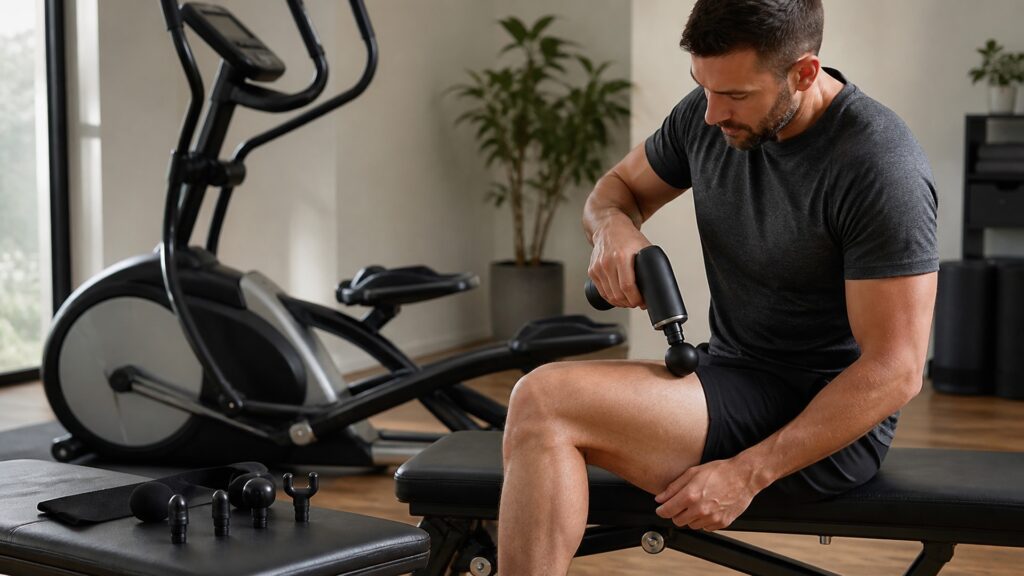
A practical comparison of a recovery device and a cardio machine.
Tip: Ask whether you need targeted recovery support or a machine that supplies cardio training.
These concepts explain how percussion massagers create rapid pressure and why control matters.
Percussive motion is the rapid back-and-forth movement of the massage head.
Amplitude is how far the massage head travels with each stroke.
Stall force is how much pressure the motor can resist before slowing or stopping.
Attachment shape changes how force spreads across the body.
Pressure control is the user's ability to keep force tolerable and targeted.
Recovery role is how the device supports warmup, cooldown, or comfort around training.
Tip: A percussion massager should feel controlled and useful, not like a test of pain tolerance.
A percussion massager is used around training to apply rapid pressure. An elliptical is used during training to create repeated low-impact movement.
The difference is recovery support versus cardio training.
Percussion devices need controllable speed, suitable attachments, comfortable handling, and manageable noise. Ellipticals need smooth motion, stable frames, resistance range, and usable consoles.
A fair comparison starts with the product's job.
A percussion massager is portable and easy to store. An elliptical is a large machine that needs room, setup, and consistent exercise habits.
The bigger product should solve a bigger training gap.
A user might use percussion briefly before warming up, train on an elliptical, then use the device again after the workout.
Complementary tools do not need to be rivals.
If the problem is tightness or recovery support, compare percussion massagers. If the problem is low-impact cardio access, compare ellipticals.
The right choice follows the routine's real need.
One product supports recovery. The other provides cardio.
You need controlled rapid pressure for warmup, cooldown, or recovery support.
You want a portable device for targeted areas.
You want a repeatable low-impact cardio session.
You have the space, budget, and habit for a dedicated machine.
The products support different parts of fitness.
It supports recovery but does not create an aerobic workout.
Cardio equipment can still leave room for recovery support.
The better choice depends on the current routine gap.
Intensity means different things for pressure tools and cardio machines.
Tip: Compare recovery tools by recovery support and cardio machines by training quality.
Short answers about recovery devices and cardio equipment.
No. A massager supports recovery. An elliptical provides cardio training.
Yes. Percussion can fit before or after elliptical sessions if pressure stays tolerable.
Compare amplitude, speed, attachments, handling, battery life, noise, and pressure control.
Compare stride feel, resistance, stability, footprint, noise, and console features.
Use the massager for recovery support and the elliptical for low-impact cardio.
Percussion massagers and elliptical machines differ because one supports recovery while the other provides cardio training.
They can fit the same routine, but massagers are judged by controlled pressure and ellipticals are judged by movement quality.
Use these Review Streets paths to compare related fitness categories and practical buying decisions.
Explore massage-gun features, attachments, and recovery use cases.
Compare related recovery and muscle-therapy tools.
Compare another recovery-tool category before deciding.
Choose a retailer
Prices checked regularly. We may earn a commission at no cost to you.