
Reformer carriage
The sliding platform that moves along rails.
- Guides whole-body motion
- Connects to springs
- Requires space
Pilates reformers and Pilates rings both belong to Pilates equipment, but they solve different problems. A reformer is a full apparatus with a moving carriage, springs, straps, and setup positions. A ring is a small prop that adds compression resistance or tactile feedback.
The difference changes scale. Reformers can organize whole-body sequences and guided resistance. Rings usually modify a mat or apparatus exercise by adding pressure between the hands, thighs, ankles, or arms.
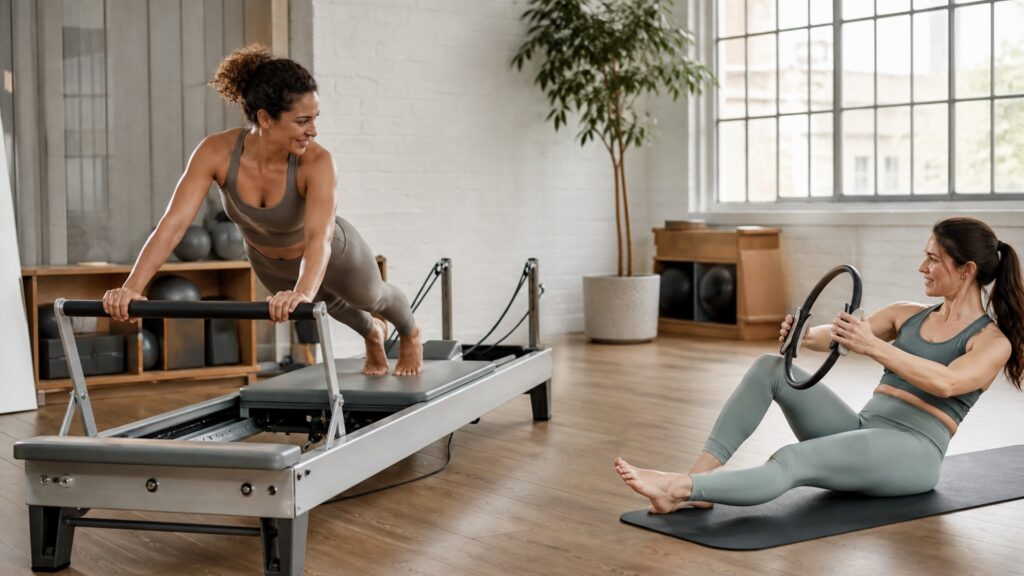
A focused explanation of the signals, movement constraints, tradeoffs, and limits behind Pilates Reformers vs Pilates Rings.
Tip: For Pilates Reformers vs Pilates Rings, compare the behavior first; the product or practice label comes second.
These definitions connect the main idea to the variables, limits, and practical signals readers need to compare options.
The sliding platform that moves along rails.
Adjustable resistance attached to the reformer.
A fixed bar used for pushing, bracing, or positioning.
A flexible circle squeezed between limbs or hands.
Pressure feedback from squeezing or resisting the ring.
The difference between a full machine and a handheld prop.
Tip: If the explanation skips moving carriage and spring load, it is probably too generic.
A reformer is not a larger Pilates ring. It is an apparatus with a carriage, springs, straps, pulleys, footbar, and defined setup positions. It changes where the body moves and how resistance enters.
The reformer owns the full-environment problem.
A Pilates ring usually adds pressure feedback inside an exercise that already exists. It can sit between thighs, ankles, hands, or arms to cue compression and control.
The ring owns the cueing and compression problem.
Reformer springs create resistance through travel and attachment points. A ring creates resistance by deforming under squeeze pressure. One changes the movement path; the other adds local feedback.
Resistance type is the core mechanical difference.
A reformer needs room, maintenance, and often instruction. A ring needs almost no setup but cannot reproduce the carriage, strap, or spring system.
Convenience and capability point in opposite directions.
The choice is clearest when the session goal is named. Reformer work fits guided resistance and apparatus sequences. Ring work fits mat modifications, pressure cues, and portable assistance.
They share a Pilates context, but they do not solve the same training problem.
A useful explanation should clarify the decision without pretending one rule covers every product, body, app, surface, or practice.
It clarifies why apparatus scale, spring load, and portable compression create different use cases.
It gives readers a practical vocabulary for comparing claims without leaning on vague fitness language.
It does not mean one tool is universally better; class style, instruction, space, and control change the answer.
The right interpretation can change with fit, setup, instruction, surface, activity type, and the exact product.
Common shortcuts and misunderstandings can make the topic seem simpler than it is.
A ring can add compression and feedback, but it cannot reproduce carriage travel, springs, straps, pulleys, or apparatus setup.
Depending on spring setup and exercise direction, a reformer can assist movement, increase resistance, or clarify range.
Rings can be used in simple or demanding ways because the cue depends on placement, pressure, tempo, and control.
They can overlap in Pilates classes, but reformers organize whole-body paths while rings add local pressure feedback.
Neither tool guarantees better instruction, safer movement, or stronger results. Context and setup still matter.
Tip: Treat strong claims as starting points for comparison, not final answers.
Concise answers to common questions readers may have after the main explanation.
A reformer is a spring-loaded apparatus with a moving carriage; a ring is a handheld compression prop.
No. It can modify mat exercises, but it cannot create carriage travel, strap resistance, or the same guided path.
Spring resistance changes as the spring stretches and as the body moves relative to the attachment point.
It is useful for pressure cues, compression resistance, and portable mat or apparatus modifications.
Both benefit from guidance, but reformers usually require more setup knowledge because spring, strap, and carriage positions change the exercise.
Pilates reformers and Pilates rings differ by scale, resistance, and the job they perform.
A reformer builds the movement environment around a spring-loaded carriage. A ring adds portable compression feedback inside a movement.
Use these Review Streets paths to connect the explainer to related categories, comparisons, and next decisions.
Use this hub to compare mats, props, reformers, rings, and balance tools across the broader Yoga and Pilates equipment space.
Use this path when surface grip, cushioning, sweat handling, and floor feel are the next equipment questions.
Use this path when springs, straps, rings, reformers, and resistance-assisted positioning are the next comparison point.
Choose a retailer
Prices checked regularly. We may earn a commission at no cost to you.