
Power Rack
A power rack supports free-barbell lifts with uprights, hooks, and safeties.
- Example: squatting inside a rack with a free bar
- Check: confirm safeties and hook positions fit the lift
- Limit: the user controls the bar path
Power racks and squat racks are different from Smith machines because racks support a free barbell, while Smith machines guide the bar on fixed rails. In a rack, the lifter controls the bar path. In a Smith machine, the machine controls the path and the user moves along that track.
The practical difference is movement freedom versus guided structure. Racks are better for free-barbell squats, bench presses, overhead presses, and pull-ups. Smith machines can be useful when a fixed bar path and built-in stops fit the exercise.
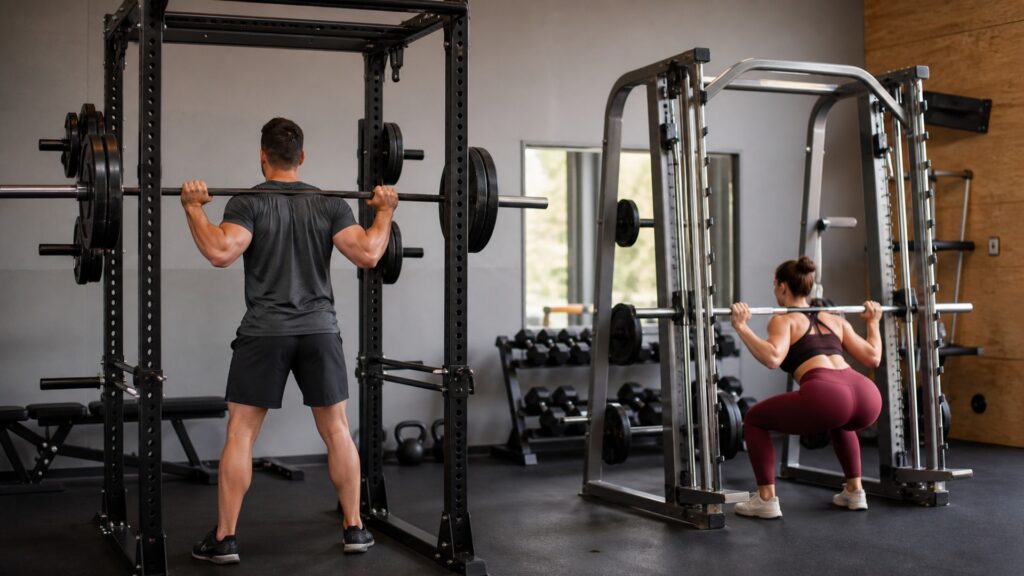
A clear comparison of free-barbell rack support versus guided-bar training.
Tip: Judge the rack by the lifts it supports safely and repeatedly, not by the largest number on the spec sheet.
These concepts clarify how rack design affects barbell training in a home gym.
A power rack supports free-barbell lifts with uprights, hooks, and safeties.
A squat rack supports a free barbell for squats and related lifts.
A Smith machine uses a bar that travels on fixed rails.
Free bar path is the path the lifter controls without rails.
Guided bar path is a fixed track that controls where the bar moves.
Movement tradeoff is the balance between natural bar control and machine-guided structure.
Tip: A rack is most useful when its frame, safeties, spacing, and room fit match the user's main lifts.
In a rack, the bar is not attached to rails. The lifter controls balance, bar path, and positioning while the rack provides hooks and safeties.
Rack training preserves free-bar movement.
A Smith machine fixes the bar path. That can make some exercises feel more controlled, but it can also force a path that does not match the user's mechanics.
The guided path is the Smith machine's defining feature.
Racks allow the bar to move naturally for the lifter. That freedom is useful for serious barbell training but requires technique, control, and good setup.
Freedom is valuable when the lifter can manage it.
A Smith machine can be useful for users who want a controlled track for certain presses, squats, calf raises, or accessory variations.
Guidance helps when the track supports the movement.
The decision usually comes down to whether the user wants free-barbell control or a guided track. Racks are the more direct choice for free-barbell training.
The equipment should fit the bar path the program needs.
The choice depends on free-barbell control versus guided-bar structure.
The user wants free-barbell squats, presses, bench work, pull-ups, and rack pulls.
Technique practice and natural bar path matter.
The user wants a fixed bar path for selected guided movements.
Built-in stops and controlled tracking fit the exercise.
Both hold a bar, but they train differently.
A Smith machine guides the bar; a rack supports a free barbell.
The path still has to fit the user's body and setup.
They are useful for anyone training free-barbell lifts appropriately.
Some users may prefer or benefit from guided variations for specific movements.
Tip: Treat rack claims as setup questions: what lift, what height, what safety, and what room?
Short answers for choosing and using rack-based home strength equipment.
A rack is better for free-barbell squats. A Smith machine may work for guided squat variations when the path fits.
It can replace some guided bar movements, but not true free-barbell rack training.
It can cover free-barbell training, but it does not provide a fixed bar track.
Either can work with proper setup, but the choice should match the intended lifts and instruction.
Choose racks for free-barbell control and Smith machines for guided-bar structure.
Power racks and squat racks differ from Smith machines by supporting a free barbell instead of guiding the bar on rails.
Choose racks when natural bar path and free-barbell training matter. Choose Smith machines when a fixed track fits the exercise.
Use these Review Streets paths to compare related categories and practical next decisions.
Explore rack-based strength equipment and setup tradeoffs.
Compare rack-based training with broader all-in-one stations.
Review cable-focused equipment for accessory and angle-based work.
Choose a retailer
Prices checked regularly. We may earn a commission at no cost to you.