
Starting Canvas
The natural and artificial pigment, gray, condition, and porosity present before coloring.
- Use: predict the result
- Variable: history and inspection
- Tradeoff: Reference photos do not show it
Professional hair color and box hair color may use related oxidative or direct-dye chemistry, but they package the decision-making differently. A box supplies a fixed shade family, developer, quantity, and general procedure for a broad audience. A colorist can inspect the starting level, gray pattern, porosity, condition, and color history, then change formula, placement, and timing by zone.
That control matters most when roots, midlengths, and ends are chemically different, or when the request requires lightening, neutralization, dimensional placement, gray blending, or correction. A box can still be a rational choice for a simple, repeatable deposit on healthy hair when the user accepts its limits and follows every warning.
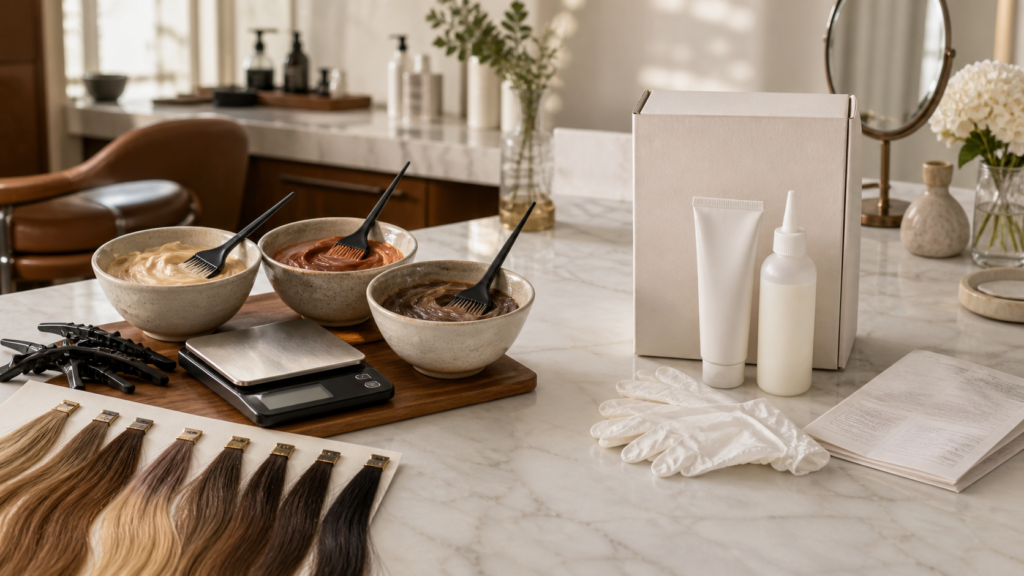
Compare a diagnostically formulated, zone-controlled salon service with a standardized retail kit by starting canvas, chemistry, application control, correction capacity, safety, upkeep, and total cost—without treating either route as universally superior.
Tip: Convenience is strongest when the variables are few.
These professional hair color vs box hair color concepts separate mechanism, application, limits, and purchasing consequences.
The natural and artificial pigment, gray, condition, and porosity present before coloring.
A mixture or timing plan assigned to roots, midlengths, ends, or selected sections.
Oxidizer paired with certain dyes or lighteners.
The percentage and distribution of hair lacking pigment.
A small application used to preview lift, deposit, timing, and fiber response.
A staged plan for unwanted or accumulated artificial pigment.
Tip: Use these terms to test professional hair color vs box hair color instead of relying on a front-label promise.
Retail color is easiest to reason about when healthy hair has little chemical history and the goal is modest deposit or familiar root maintenance, not dramatic lift or correction.
Convenience is strongest when the variables are few.
Complex histories, banding, major lightening, resistant gray, sensitive scalps, vivid placement, and fragile hair benefit from diagnosis, multiple formulas, section control, and a stop rule.
The service value is controlled decision-making.
Fresh regrowth, old permanent color, and porous ends do not respond alike. Unnecessary overlap can deepen pigment and increase structural stress.
Uniform application can produce a nonuniform result.
A skin test follows the product instructions for reaction risk; a strand test previews hair behavior. One cannot answer the other question.
Two risks require two tests.
Include root frequency, toner, color-safe care, fade, future removal, corrective appointments, and the value of professional recourse—not just checkout price.
Cheap first color can become expensive correction.
Professional service buys diagnosis, customization, monitoring, and correction options; it does not make dye allergy or damage impossible.
The plan distinguishes virgin regrowth from previously colored lengths.
Expected lift, tone, maintenance, and compromise are agreed before application.
A fixed kit cannot adapt its developer or pigment balance mid-service.
Repeated overlap can create bands, dark buildup, dryness, or breakage.
These claims flatten the variables that determine how professional hair color vs box hair color performs in a real routine.
Many professional and retail products rely on related chemistry. The larger difference is selectable formulas, application control, monitoring, and support.
A suitable product used exactly as directed can work for a limited goal, though repeated overlap or unrealistic lightening raises risk.
Professional oxidative dyes can still sensitize or irritate. Follow testing and warning instructions every time.
Color generally does not predictably lift accumulated artificial pigment; correction can expose uneven warmth and damage.
Starting pigment, integrity, time, and maintenance may require a staged plan or a different target.
Tip: Test the exact professional hair color vs box hair color tool, setting, and routine before generalizing from its category.
The remaining decisions about professional hair color vs box hair color concern technique, compatibility, safety, upkeep, and value.
For a modest, familiar result on healthy hair with a straightforward history, provided every instruction and test is followed.
Roots, lengths, ends, gray zones, highlights, and lowlights may require different pigments, developers, or timing.
Sometimes improvement is possible, but outcome and pace depend on dye history and fiber condition; several visits or compromise may be necessary.
Longevity depends on color type, shade, porosity, washing, heat, sun, water, and maintenance—not distribution channel alone.
Box and salon dye, bleach, direct pigments, henna or metallic salts, relaxers, smoothing services, reactions, and approximate dates.
Stop and follow instructions after intense burning, swelling, breathing symptoms, eye exposure, or alarming hair failure; seek urgent care for severe reactions.
Professional hair color differs from box color mainly in diagnosis and control: selectable chemistry, zone-specific application, active monitoring, and a correction plan. A retail kit standardizes those choices for convenience and price.
Use a box only for a goal that fits its fixed system and your known history. Choose professional help when lift, gray, damage, banding, placement, or previous pigment makes the canvas complex.
These Review Streets paths narrow the next professional hair color vs box hair color decision by format, goal, and routine fit.
Browse professional products, equipment, and salon-focused beauty categories.
Compare skincare and hair-removal device technologies.
Choose a retailer
Prices checked regularly. We may earn a commission at no cost to you.