What Makes Quality Travel Bags & Backpacks Different

A quality claim is easier to judge when you can tie it to the way the bag is built. The Atrack zipper has a specified closed position, and wraparound hand handles can support a duffle from below. Other design decisions determine which hardware can separate, which layer supplies color and what can be processed as a whole.

By: Review Streets Research Lab
Updated: November 24, 2026
Explainer · 10–12 min read
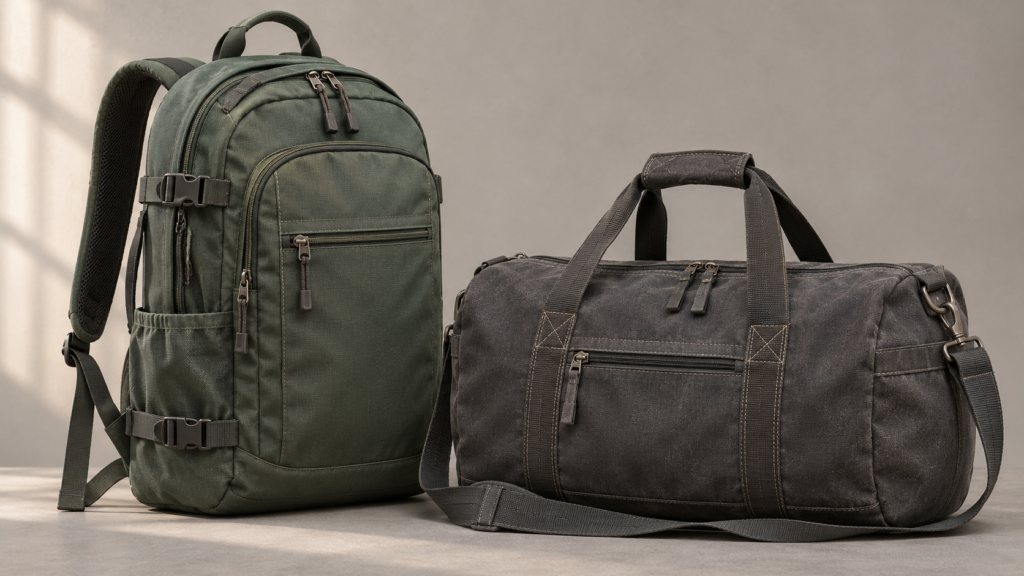
An olive travel backpack and a charcoal duffel with visible zippers and handles on a light tabletop.
Start here

What you’ll learn

Trace a part from where you first see it to where it does its job. A Field Repair Buckle’s pin sits at its webbing attachment.

  • What it means for the Atrack slider to be fully seated.
  • How grit at the teeth can affect a different part of the zipper.
  • Where the Small Duffle’s hand handles run beneath the load.
  • How the closure buckle attaches to the webbing.
  • Which layer supplies the standard Allpa’s front-panel color.
  • How different backpack parts can share a polymer.
  • What the designated processing route receives as a whole.

Tip: Keep the feature and its conditions together. ORTLIEB’s IP67 designation assumes complete closure.

Key terms

Six terms for reading bag construction

Names give you a way to separate details that sit close together. The sealing lip and the zipper teeth, for example, are different parts of the closure.

IP67

The Atrack’s specified rating for dust and temporary immersion with the zipper completely closed.

  • First digit: The 6 identifies the dust protection.
  • Second digit: The 7 refers to temporary immersion.
  • Configuration: The designation covers the bag in the specified closed state.

Sealing lip

The zipper surface that helps form the seal.

  • Nearby parts: TIZIP discusses the lip alongside its zippers’ teeth or coils.
  • Interference: Material lodged there can interfere with the lip.
  • Care context: TIZIP describes care by zipper model.

Wraparound hand handle

A hand grip whose strapping routes around the bag body.

  • Model: Filson documents the path on its Small Duffle.
  • Lowest point: The wrap reaches below the base.
  • Other strap: The model has its own adjustable shoulder strap.

Removable buckle pin

The screw that retains the buckle at its webbing loop.

  • Fastener material: Sea to Summit specifies stainless steel.
  • Textile side: Webbing is strap material.
  • Closure side: On the Big River Dry Backpack, the buckles secure the roll top.

Base fabric

The front-panel textile under the coating.

  • Textile: The UK Black 35L listing identifies its coated shell fabric as nylon.
  • Surface layer: The coated shell uses TPU over nylon.
  • Color source: The redesigned panel’s nylon supplies the color.

Single-polymer construction

Different working parts made from the same underlying polymer.

  • Material name: PA6 stands for polyamide 6.
  • Fabric and fastening: The material specification includes cloth and hardware.
  • Joining material: The thread used to sew the bag is PA6 too.

Tip: A name can describe a material as well as a part. Polyamide 6 is the material name shared by parts that do different things.

01 · Closure

The Atrack’s zipper endpoint

The U.S. Atrack uses an updated TIZIP zipper, according to ORTLIEB. The feature name identifies the closure. The zipper instructions describe the state it needs to be in, from the slider’s position to the condition of the sealing surface.

  • First identify which documentation describes which object. TIZIP’s handling notes discuss teeth or coils across its own zippers. The bag listing is the better starting place for the exact bag model.
  • ORTLIEB calls for the slider to seat correctly in the end stop.
  • TIZIP says debris caught between teeth or coils can interfere with the sealing lip, and ORTLIEB flags dirt between this bag’s teeth. Debris is a separate issue at the sealing surface.
  • ORTLIEB warns that folding or crushing the zipper may impair its function. The specified closed state assumes a clean, undamaged working closure.
  • ORTLIEB’s datasheet specifies IP67 for the completely zipped bag. It describes a dust-tight state and temporary immersion for 30 minutes with the bag’s lower edge at a depth of 1 m.

The slider must seat at the stop. Debris along the teeth can still interfere with the seal.

02 · Hand carry

How the Small Duffle’s hand handles carry the load

A hand grip is the part you touch. On Filson’s Rugged Twill USA Small Duffle, it is also the visible starting point for a handle structure that extends around the bag.

  • In a mental sketch, draw the bag in profile and mark where the hand takes hold. Mark the handle’s route under the base as well. You can follow one structure through both points.
  • Filson describes the wrap as cradling the load. In the sketch, put the contents above the wrap. That places the load and the supporting structure in the same view.
  • The wrap belongs to the hand handles. Filson also lists a separate adjustable shoulder strap that comes off. Looking at a strap’s purpose first helps you attach the right description to each part.

The description tells you where the bag is supported during hand carry. The amount it can carry is a separate question about the assembly.

03 · Hardware

Where the Big River’s closure buckle separates

Sea to Summit identifies the Field Repair Buckles securing the Big River Dry Backpack’s roll top as replaceable. The buckle has two connections, one to its mating half and one to the textile.

  • Start at the mouth. The clipped halves hold the roll top closed. This is the connection you interact with in the ordinary act of opening the bag.
  • The webbing attachment works differently. In its buckle family documentation, Sea to Summit calls the removable stainless-steel screw at the webbing loop a pin.
  • The maker illustrates the family principle on a different model, its Lightweight Dry Sack. On that example, separating the hardware leaves the closure strip intact. The Big River listing gives the model-specific replacement claim.

With the textile loop intact, the hardware can separate at the pin. That’s what it means for the design to have a separable joint.

04 · Panel layers

The standard Allpa’s color layers

Cotopaxi UK dates its standard Allpa redesign to 2025 across the 28L, 35L and 42L packs. For an illustration of the front panel, draw the coating and fabric as separate layers and mark which supplies the color.

  • The older panel placed colored TPU over white nylon. Label the coating with both its material and its color.
  • The revised panel gets color from its nylon beneath the coating. The UK Black 35L listing corroborates the type of coated fabric by identifying TPU-coated nylon as the first shell material.
  • Cotopaxi UK mentions cosmetic wear in the earlier design. In an illustrative case where wear exposes the white nylon, that white layer can show through. The layer order explains the possibility.

Keep each sketch with its design revision. Both panels have a coating, while the color comes from different layers.

05 · Material design

One polymer across different working parts

Consider how differently you would describe a buckle and a piece of cloth if you were drawing them. The point of putting them side by side is to see what they have in common. In the Mono[PA6] Backpack, FREITAG specifies the same underlying polymer for both.

  • FREITAG specifies 17 parts made with polyamide 6, including the outer fabric, buckles and sewing thread. Look at the maker’s count for the finished bag and you see how many individual design choices go into a single material specification.
  • In its design account, FREITAG describes selecting different textures and properties for parts such as zippers, shoulder straps and the cushioned back panel. Picture two labels on each part. One says what it does. The other says what it’s made from. Across those different jobs, the material label stays the same.
  • Return through FREITAG’s designated route is the condition for the next step. Its recycling partner mechanically processes the bag as a whole into granulate, or small grains, of PA6. The parts that did different jobs enter that particular process together.

There are two places to draw the boundary in this example. The material specification extends across the parts, and the whole-bag processing claim extends to the maker’s designated route.

Reality check

Two close looks at a connection

Pick two details you can point to. One is the zipper’s finishing position, and the other is the buckle’s webbing junction.

Illustration 1 · A pause while packing

Imagine setting down a dry Atrack after stopping its slider short of the end stop. From across a room you might call it zipped. In this scene the bag stays on dry land.

The datasheet makes complete closure a condition of the rating. Your observation in this illustration is about the slider’s position on dry land. Finding it short of the stop tells you the required closure condition remains unmet.

Illustration 2 · Opening the roll top

Imagine pointing out the two joints to someone who has only seen the bag closed. First point to the clipped joint at the roll top. In the family description, find the buckle’s separate textile attachment. Now you have names for both connections.

If the loop is intact, the family’s pinned junction lets the hardware separate while the webbing stays. The two connections answer different questions. One explains how you open the bag, and the other explains how far the separable part extends.

Common myths

Five shortcuts that miss a design detail

Words such as coated and closed are shorthand. They get more useful when you can point to the specific layer or position they describe.

Can you apply the Atrack rating as soon as the zipper looks closed?

ORTLIEB ties the designation to complete closure. The slider must seat at the stop.

Do the Small Duffle’s visible grips tell you where the load is supported?

The grips show where your hand goes. Filson also locates supporting material underneath the duffle.

Does the webbing loop make the closure buckle permanently attached?

Sea to Summit’s family description identifies a removable fastener at that loop. The presence of textile alone tells you little about how the buckle is held in place.

Does TPU-coated mean the coating supplies the standard Allpa’s color?

The coating supplied the color on the earlier panel. Cotopaxi UK says the redesigned panel gets its color from the nylon underneath.

Is PA6 just the name of the Mono[PA6] Backpack’s shell fabric?

FREITAG specifies PA6 for buckles and sewing thread as well as cloth.

Tip: Put the condition back into a shorthand description. For the Atrack, the datasheet uses completely closed as the condition for its designation.

FAQ

Questions about the exact specifications

Details such as the reference edge for depth and the distinction between shell and lining matter when you read the specifications for yourself.

Where does ORTLIEB reference the Atrack’s immersion depth?

At the bag’s lower edge. The datasheet gives the depth relative to that edge and specifies complete closure for the temporary immersion designation.

Why does ORTLIEB discuss the angle of the pull?

ORTLIEB warns that an angled pull may impair the zipper’s function or waterproof performance.

Does TIZIP give every zipper the same lubrication guidance?

TIZIP says care varies by model and calls for cleaning before applying lubricant when needed. ORTLIEB calls for proper Atrack lubrication before use. The care notes specify TIZIP’s original lubricant or a comparable option for maintenance.

Does Filson describe an underbody wrap on the Medium Duffle too?

Yes. Filson’s Medium product listing describes handles that wrap around the bag to support the load. Its Rugged Twill collection specifically puts the Medium’s handle route under the bag.

Which Big River buckles does Sea to Summit identify as replaceable?

Sea to Summit identifies the roll-top closure buckles as replaceable on the Big River Dry Backpack.

How does Cotopaxi list the two shell fabrics on the UK Black Allpa 35L?

The first shell entry is TPU-coated nylon. The second is ballistic ripstop nylon. The specifications list ripstop polyester separately as the lining, so each fabric name has a particular place in the material list.

How can the Mono[PA6] outer fabric have three layers?

FREITAG specifies polyamide 6 in each outer-fabric layer. Layer count describes construction. PA6 identifies the shared material.

What can the granulate from FREITAG’s designated process be used for?

FREITAG gives new bag components as one possible use. Granulate is the material that comes out of processing, and the component is one example of what might be made from it.

Tip: Keep model names attached to their specifications. Filson’s collection description of the Medium, for instance, identifies that size’s underbody wrap.

Bottom line

Ask what the quality claim would lose if you took out its most specific detail. The endpoint of a slider gives “closed” a specific position. A fastener at the buckle’s textile attachment marks where the hardware separates. Each claim answers a different question about the bag.

Try the same exercise with an after-use condition. For whole-bag processing, that means a return through the maker’s designated route. Imagine leaving that route out of a quality claim. A reader could still understand what the bag is made of while losing the detail that tells them where its stated process applies.

Related reading

Travel bags & backpacks archives

Find the format that suits your next question.