
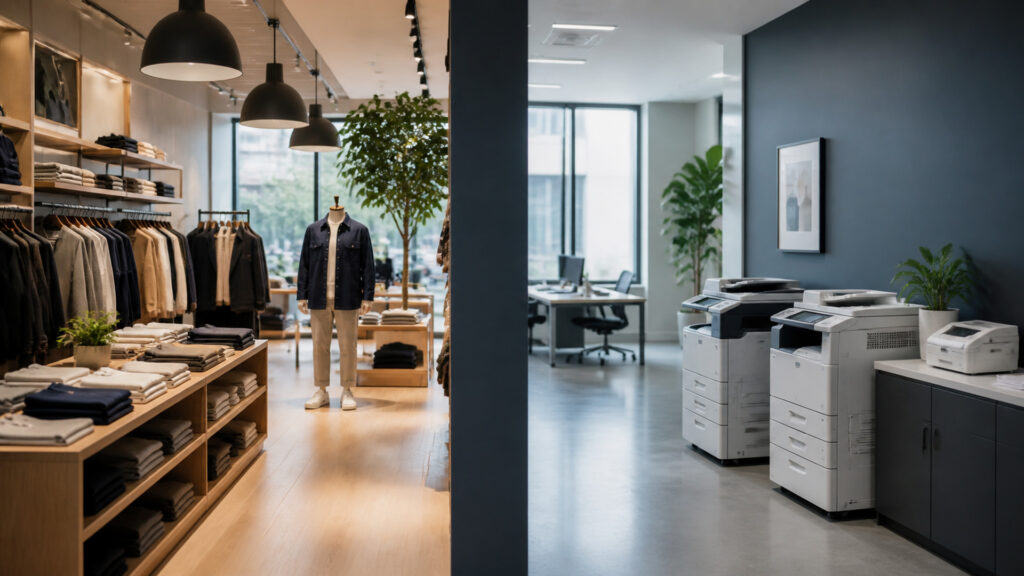
What Makes Retail Displays Different from Office Machines

Retail displays and office machines are both business equipment, but category membership does not make their operating roles alike. A retail display maintains a shopper-facing presentation made from merchandise, fixtures, graphics, prices, lighting, or screens. An office machine performs a bounded document or material task such as printing, copying, scanning, finishing, binding, laminating, or shredding.

The difference matters for duration, users, inputs, controls, maintenance, safety, evidence, and failure recovery. Displays must remain correct in a changing public environment; office machines must execute and close identifiable operator jobs. A digital sign with a printer nearby does not merge those responsibilities.

By: Review Streets Research Lab
Updated: September 1, 2026
Explainer · 8-12 min read
Editorial business scene illustrating retail displays and office machines
What You'll Learn

Operating Boundary Map

Follow the sustained presentation and the bounded document job through their different users, controls, and closure evidence.

  • Comparing Purpose and Duration
  • Comparing Inputs and Outputs
  • Comparing Interaction
  • Comparing Control Systems
  • Comparing Evidence and Failure
  • How document task changes the conclusion

Tip: Classify the work before comparing hardware attributes or service contracts.

Definitions

Purpose, Duration, and Closure

Each definition assigns a distinct operating job within retail displays and office machines, including the evidence that can support it and the claim it cannot make.

Retail display

A physical or digital composition intended to present merchandise, information, navigation, or promotions to shoppers.

  • In this analysis, the term has one bounded function: it operates in the selling environment.
  • Its evidence stops at this point: it must remain accurate over time.
  • Verify document task through an independent artifact before applying retail display to a real store case.

Office machine

Shared equipment that performs document or material tasks such as printing, copying, scanning, faxing, finishing, binding, laminating, or shredding.

  • In this analysis, the term has one bounded function: it processes defined work inputs.
  • Its evidence stops at this point: it is normally operator initiated.
  • Verify paper input through an independent artifact before applying office machine to a real store case.

Merchandise zone

A store location allocated to a product group, campaign, service, or navigation purpose.

  • In this analysis, the term has one bounded function: it gives presentation local context.
  • Its evidence stops at this point: it must fit circulation and safety constraints.
  • Verify page output through an independent artifact before applying merchandise zone to a real store case.

Document task

A bounded job that transforms, reproduces, routes, finishes, or destroys pages or related materials.

  • In this analysis, the term has one bounded function: it defines office-machine work.
  • Its evidence stops at this point: it does not create an ongoing retail scene.
  • Verify capture destination through an independent artifact before applying document task to a real store case.

Display compliance

Evidence that content, price, products, placement, condition, accessibility, and timing match the approved presentation.

  • In this analysis, the term has one bounded function: it tests continuing execution.
  • Its evidence stops at this point: it requires repeated observation.
  • Verify finishing function through an independent artifact before applying display compliance to a real store case.

Operator station

The physical or remote point where a person initiates and controls an office-machine job.

  • In this analysis, the term has one bounded function: it concentrates task interaction.
  • Its evidence stops at this point: it may require privileged functions.
  • Verify operator station through an independent artifact before applying operator station to a real store case.

Tip: Challenge every category distinction with a source, an observed condition, and a named decision recorded in the equipment scope file.

Comparing

Comparing Purpose and Duration

Retail displays sustain shopper communication over hours, days, or campaigns; office machines execute discrete document or material jobs initiated by operators.

  • Describe the continuing duty of shopper presentation
  • Identify the bounded job represented by merchandise zone
  • Observe the primary user interacting with fixture composition
  • Separate the input consumed by promotional content
  • Test the characteristic failure of viewing distance
  • Match closure evidence to display compliance

Close the comparison only after the enduring presentation and discrete operator job have different owners and completion evidence.

Comparing

Comparing Inputs and Outputs

Displays combine products, fixtures, graphics, lighting, screens, prices, and space; office machines accept pages, files, media, or materials and produce a task result.

  • Describe the continuing duty of merchandise zone
  • Identify the bounded job represented by fixture composition
  • Observe the primary user interacting with promotional content
  • Separate the input consumed by viewing distance
  • Test the characteristic failure of display compliance
  • Match closure evidence to document task

Close the comparison only after the enduring presentation and discrete operator job have different owners and completion evidence.

Comparing

Comparing Interaction

Shoppers perceive or explore displays while moving through a store; trained or occasional users submit, feed, release, collect, or supervise office-machine work.

  • Describe the continuing duty of fixture composition
  • Identify the bounded job represented by promotional content
  • Observe the primary user interacting with viewing distance
  • Separate the input consumed by display compliance
  • Test the characteristic failure of document task
  • Match closure evidence to paper input

Close the comparison only after the enduring presentation and discrete operator job have different owners and completion evidence.

Comparing

Comparing Control Systems

Displays use merchandising plans, content schedules, store assignments, availability, and compliance; office machines use queues, destinations, job settings, service intervals, and safety procedures.

  • Describe the continuing duty of promotional content
  • Identify the bounded job represented by viewing distance
  • Observe the primary user interacting with display compliance
  • Separate the input consumed by document task
  • Test the characteristic failure of paper input
  • Match closure evidence to page output

Close the comparison only after the enduring presentation and discrete operator job have different owners and completion evidence.

Comparing

Comparing Evidence and Failure

Displays need continuing evidence of accuracy, stock, visibility, and condition; office-machine completion is normally tied to a specific output, capture, finishing, or destruction event.

  • Describe the continuing duty of viewing distance
  • Identify the bounded job represented by display compliance
  • Observe the primary user interacting with document task
  • Separate the input consumed by paper input
  • Test the characteristic failure of page output
  • Match closure evidence to capture destination

Close the comparison only after the enduring presentation and discrete operator job have different owners and completion evidence.

Quick Reality Check

Operational Proof for Retail Displays and Office Machines

These observations distinguish an enduring public presentation from an operator-initiated transformation of pages or materials, even when the equipment shares a store, vendor, screen, or network.

Evidence That Separates the Categories

Display owners should measure continuing accuracy, visibility, availability, and condition across the campaign rather than treating installation as permanent completion.

Office-machine owners should tie faults to specific print, capture, finishing, communication, or destruction jobs and their corresponding recovery evidence.

Similar Hardware Does Not Mean Similar Work

A screen that presents documents in a store remains a display endpoint when its primary role is sustained shopper communication rather than operator-initiated document processing.

Shared electrical power, networking, service vendors, or floor space do not erase the different controls applied to public presentation and bounded office tasks.

Common Myths

Misconceptions About Retail Displays and Office Machines

These claims fail because they allow one evidence stream to substitute for the separate category distinction required by retail displays and office machines.

Are digital signs simply office computers with larger screens?

No. A retail display sustains public communication within a merchandise zone, whereas an office machine completes operator jobs. Similar processors, screens, networks, or operating systems do not create the same duty.

Does installation mark both categories complete?

No. Display installation begins a period of continuing accuracy, availability, visibility, and condition checks. Office-machine commissioning establishes capability, but each later document or material task still needs its own completion evidence.

Can one service contract govern both equally?

A contract may cover shared vendors or components, but response priorities, skills, parts, safety controls, uptime meaning, and acceptance tests differ. Contract lines should identify the business function actually restored.

Does shopper visibility turn an office machine into a display?

No. Equipment remains an office machine when its controlled purpose is printing, capture, finishing, communication, or destruction of a bounded job, even when located at a public service counter. Tie that classification to separate recovery evidence.

Tip: Classify the work before comparing hardware attributes or service contracts.

FAQ

Frequently Asked Questions About Retail Displays and Office Machines

The answers below turn the operating boundary map into practical ownership, testing, exception, and closure decisions.

What is the fastest way to classify ambiguous equipment?

Identify the primary work unit, intended user, duration, controlled inputs, expected output, and closure test. Sustained shopper presentation indicates a display; discrete document transformation indicates an office-machine function. Tie that classification to separate recovery evidence.

How should a multifunction kiosk be governed?

Separate each capability. Public content follows display controls, while printing, scanning, payment, identity, or document capture follows its own job, permission, retention, safety, support, and completion requirements. Tie that classification to separate recovery evidence.

Which failures belong to display operations?

Route stale claims, wrong prices, unavailable products, obstructed views, broken lighting, blank screens, damaged fixtures, or expired content according to the shopper-facing presentation and its scheduled exposure. Tie that classification to separate recovery evidence.

Which failures belong to office-machine support?

Route feed faults, rendering errors, capture failures, destination rejection, finishing defects, partial output, jams, unsafe mechanisms, or destruction exceptions using the affected job identifier and subsystem diagnostics. Tie that classification to separate recovery evidence.

Can performance be compared through one uptime metric?

Usually not. Display uptime concerns correct public exposure during scheduled periods; office-machine availability concerns the ability to accept and complete bounded jobs. Define denominators and excluded conditions separately. Tie that classification to separate recovery evidence.

Bottom Line

Retail displays maintain an ongoing shopper presentation in a merchandise environment. Office machines execute discrete document or material tasks for operators.

Manage each according to its duration, users, inputs, control system, safety conditions, completion evidence, and characteristic failure modes.

Next Steps

Continue From This Category Distinction

Open the neighboring article when the next question changes the work unit, evidence source, or control owner; use the direct category for adjacent retail displays decisions.

Retail Displays

Browse the direct Retail Displays category for related systems involving shopper presentation, document task, and finishing function.

Quick Summary

Retail Displays and Office Machines Explained

  • Define the category distinction before comparing equipment.
  • Keep shopper presentation tied to its authoritative source.
  • Test promotional content through an observed store condition.
  • Route document task failures to a named recovery owner.
  • Accept finishing function only with independent closure evidence.