
Sonic Motion
High-frequency side-to-side movement of bristles or head.
- Use: identify one powered system
- Variable: amplitude and frequency
- Tradeoff: Sonic is not a quality grade
Sonic toothbrushes generally move elongated bristles rapidly from side to side, while oscillating-rotating brushes use a smaller round head that alternates direction, sometimes with pulsation. Both are powered brushes: the meaningful difference is how the moving bristles contact tooth surfaces and how the user guides the head.
A sonic head can feel familiar to manual-brush users and cover a broader area; a round oscillating head encourages tooth-by-tooth placement and may fit some back-tooth spaces. Comparative reviews have found modest average advantages for oscillating-rotating designs in some plaque and gingival measures, but studies differ and the practical effect depends on coverage, pressure, duration, tolerance, and model quality.
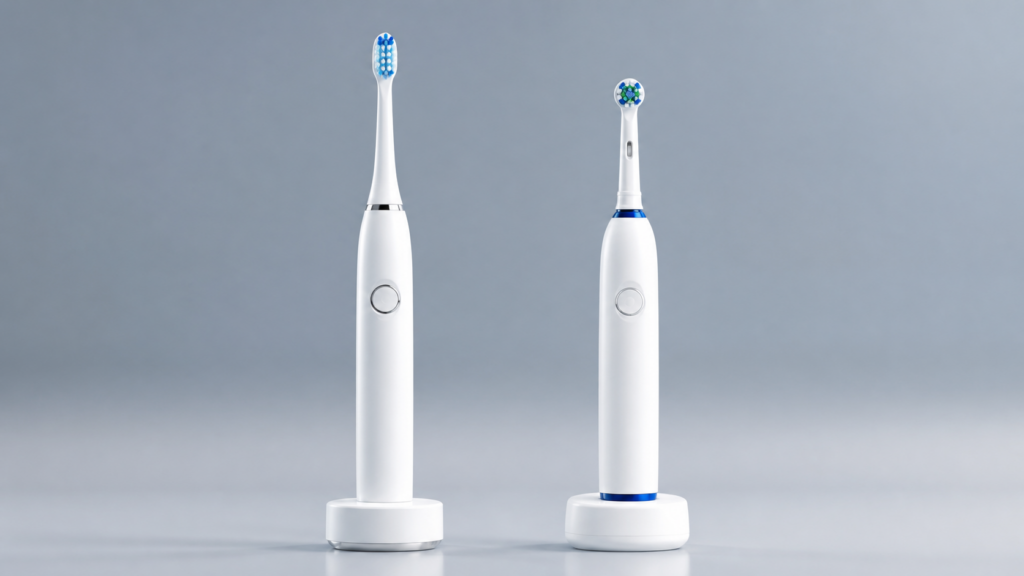
Compare high-frequency side-to-side bristle motion with small-head oscillating-rotating action by contact pattern, head geometry, guidance technique, sensory feel, feedback, evidence, refills, and access rather than marketing speed.
Tip: High frequency helps only where bristles make appropriate contact.
These sonic vs oscillating toothbrushes concepts separate mechanism, application, limits, and purchasing consequences.
High-frequency side-to-side movement of bristles or head.
Alternating rotational movement of a small usually round head.
Area traversed by moving bristles during operation.
Pausing the small head on successive surfaces.
Feedback when applied force exceeds a threshold.
Family of compatible replacement heads and availability.
Tip: Use these terms to test sonic vs oscillating toothbrushes instead of relying on a front-label promise.
Guide the head slowly at the gumline and across inner, outer, and chewing surfaces. Do not add frantic manual scrubbing to powered motion.
High frequency helps only where bristles make appropriate contact.
Position the head on each tooth surface and let the mechanism work before moving. The smaller head may aid access but can make skipping areas easy.
Tooth-by-tooth technique trades broad coverage for precision.
Systematic reviews can favor oscillating-rotating brushes on selected indices, but magnitude, sponsorship, follow-up, models, and user technique affect interpretation.
A statistical edge may be smaller than the effect of consistent use.
Handle price is only the entry cost. Check authentic refill cost, counterfeit risk, charger, warranty, travel lock, drying, and whether multiple users can identify heads.
The refill ecosystem outlasts the excitement of a new handle.
Evaluate comfort, missed zones, pressure alerts, two-minute completion, splatter, and gum response. Keep other routine variables stable.
Behavioral fit is the deciding technology.
Motion type changes technique and feel; it does not automate navigation or eliminate daily interdental cleaning.
The head reaches every surface comfortably.
The user follows the motion-specific instructions for two minutes.
Vibration, noise, splatter, and head size can undermine adherence.
Refill availability and cost may matter more than a small average difference.
These claims flatten the variables that determine how sonic vs oscillating toothbrushes performs in a real routine.
Powered motion may affect nearby fluid, but users still need bristle contact and complete surface guidance.
The user must position the head on all outer, inner, chewing, and gumline surfaces.
Frequency alone does not describe amplitude, bristle design, pressure, access, safety, or clinical performance.
Mouth size, dexterity, sensory tolerance, technique, cost, and refill access change the practical choice.
Neither head reliably contacts every space between teeth. A separate daily interdental method remains necessary.
Tip: Test the exact sonic vs oscillating toothbrushes tool, setting, and routine before generalizing from its category.
The remaining decisions about sonic vs oscillating toothbrushes concern technique, compatibility, safety, upkeep, and value.
Either can be gentle with soft bristles and light pressure. A useful pressure sensor and comfortable technique matter more than the motion label.
No. Marketing terms vary; check the actual movement description and evidence for the model rather than assuming equivalence.
Access varies with bracket shape and head geometry. Specialty heads and interdental tools may still be required.
Some households share a handle with separate identifiable heads, but follow manufacturer hygiene and storage instructions.
ADA recommends replacement about every three to four months or sooner when bristles are matted or frayed; follow the model directions.
Comfortable reach, soft compatible heads, pressure control, a reliable timer, refill availability, and a routine the user will sustain.
Sonic brushes use rapid side-to-side action; oscillating brushes use alternating rotation through a compact head. Their motion changes contact pattern, technique, sensory feel, and refill system—not the need to guide every surface.
Some reviews favor oscillating-rotating designs on average, but access, pressure, duration, tolerance, and consistent use remain decisive. Buy the system whose heads fit the mouth and budget, then use its intended technique.
These Review Streets paths narrow the next sonic vs oscillating toothbrushes decision by format, goal, and routine fit.
Browse toothbrushes, interdental cleaners, whitening, and daily oral-care categories.
Compare manual, electric, sonic, and specialty toothbrush formats.
Choose a retailer
Prices checked regularly. We may earn a commission at no cost to you.