What Makes Sports Cars Different from Off-Road Vehicles

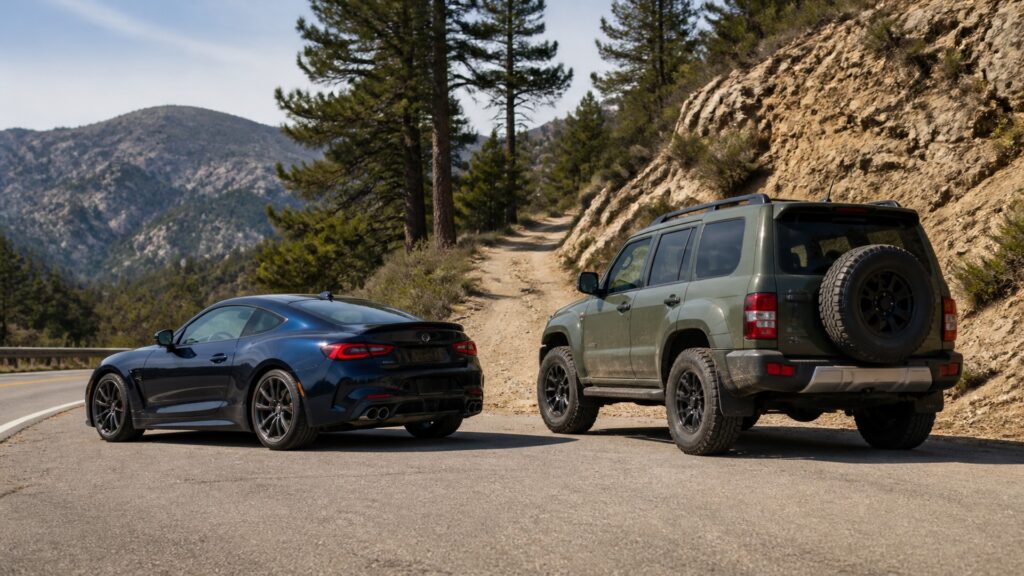
Sports cars usually prioritize responsive steering, braking, and cornering on paved roads. Off-road vehicles prioritize moving over uneven, loose, or obstructed terrain, where clearance, traction, and the ability of the wheels to follow the ground become central. The difference is the environment each vehicle is designed to handle, not simply its power or number of driven wheels.

The categories can overlap, but ordinary examples solve different problems. A low sports car may feel precise on pavement yet have limited clearance over an obstacle. An off-road vehicle may negotiate that obstacle while making different compromises in road response, noise, and ride. Compare the actual design and terrain rather than treating either category as universally more capable.

By: Review Streets Research Lab
Updated: October 1, 2026
Explainer · 8-12 min read
sports cars explainer hero image for Review Streets
What You'll Learn

Different Surfaces Create Different Vehicle Priorities

Compare clearance, suspension, tires, traction systems, and protection in their intended environments.

  • Understand why a low body and obstacle clearance serve different purposes.
  • Separate suspension body control from wheel travel.
  • Compare road-oriented and terrain-oriented tire needs.
  • Distinguish driven wheels from complete off-road capability.
  • Recognize exceptions without assuming all vehicles can cross roles.

Tip: Describe the surface and obstacles first; then assess whether the vehicle is designed and equipped for them.

Definitions

Six Differences That Matter on the Ground

These concepts explain why two powerful vehicles can be suited to very different routes.

Road response

How the vehicle reacts to steering, braking, and acceleration on its intended road surface.

  • Example: a sports car changing direction predictably on pavement
  • Check: evaluate the exact car and tires
  • Limit: responsive road behavior does not establish obstacle capability

Ground clearance

The available space beneath the vehicle relative to the ground.

  • Example: underbody components needing room above an uneven surface
  • Check: check the manufacturer's measurements and conditions
  • Limit: one clearance figure does not describe every point under the car

Obstacle angles

Approach, breakover, and departure geometry that influences contact with obstacles.

  • Example: a front overhang approaching a rise
  • Check: compare the relevant geometry for the intended terrain
  • Limit: adequate clearance in one area does not prevent contact elsewhere

Wheel travel

The range through which the suspension allows a wheel to move relative to the body.

  • Example: wheels following uneven ground at different heights
  • Check: assess the complete suspension design
  • Limit: travel alone does not establish traction or stability

Traction management

Hardware and controls that influence how drive reaches tires with different grip.

  • Example: a supported differential or terrain-control arrangement
  • Check: identify the fitted equipment and its intended use
  • Limit: driven wheels cannot compensate for inadequate clearance or unsuitable tires

Underbody protection

Equipment intended to shield vulnerable components from specified impacts or contact.

  • Example: a factory protection package for exposed areas
  • Check: check what is actually protected and the stated limits
  • Limit: protection does not make the vehicle immune to damage

Tip: Clearance, traction, suspension movement, and protection complement one another; none is a substitute for all the others.

Vehicle geometry

Low Road Packaging and Obstacle Clearance Serve Different Jobs

Sports cars often use low packaging to support their road-driving character. Off-road vehicles need geometry that helps the body and underbody avoid contact with uneven terrain. Ford's Bronco specifications distinguish ground clearance and approach, breakover, and departure angles, with capability varying by configuration. Those separate measurements explain why overall height alone is not an adequate comparison.

  • Look at overhangs as well as underbody clearance.
  • Check the exact trim, tires, and equipment.
  • Do not infer capability from a tall-looking body.

A long, low nose may be manageable on a paved route but encounter an obstacle before the front tires reach it. More engine power does not change that geometry.

Suspension

Body Control and Uneven-Ground Movement Ask Different Questions

A sports-car suspension is selected and calibrated around its intended road behavior. An off-road design must also accommodate wheels moving over uneven ground and the demands of the intended terrain. The correct compromise depends on the vehicle: some off-road models emphasize slow technical travel, while others are designed around different conditions. There is no single setting that makes all surfaces equivalent.

  • Compare intended use rather than stiffness alone.
  • Consider tire and suspension choices together.
  • Keep within the specific vehicle's supported terrain and operating limits.

A setup that feels precise on smooth pavement may be inappropriate for a rough route. Conversely, terrain capability does not automatically deliver the road response a sports-car buyer wants.

Tires

The Tire Choice Reflects the Surface

Road performance tires and terrain-oriented tires are designed around different combinations of grip, surface, durability, noise, and operating conditions. Tread appearance is only part of that design. Fitting a more aggressive-looking tire does not supply the clearance, protection, or suspension arrangement that may be required for off-road use.

  • Read the tire's intended application and limitations.
  • Use an approved fitment for the vehicle.
  • Consider road conditions as well as the occasional off-road route.

A tire suited to one surface can introduce compromises elsewhere. Select for the actual mix of use rather than assuming that one tread style is best in every condition.

Drivetrain

All-Wheel Drive Is Only One Part of Terrain Capability

A sports car can have all-wheel drive, and an off-road vehicle may have specialized traction equipment. The useful distinction is how the complete drivetrain, controls, tires, and chassis serve the intended task. Some off-road configurations provide low-range gearing or differential controls; others use different arrangements. Availability and operating instructions must be checked on the exact vehicle.

  • Identify fitted equipment rather than relying on a badge.
  • Read the supported uses of terrain and differential controls.
  • Assess clearance and tires alongside traction hardware.

Driving more wheels does not prevent a low underbody from contacting an obstacle. It also does not establish that a vehicle can safely cross any surface.

Category overlap

Exceptions Are Engineered, Not Implied

Specialized models can combine sports-car character with additional terrain capability. Porsche's 911 Dakar is a documented example, using changes including increased ground clearance and terrain-oriented tire choices. Such a vehicle demonstrates that the categories can overlap through coordinated design. It does not mean a standard sports car gains the same abilities from one modification.

  • Inspect the whole specification behind an unusual model.
  • Separate factory-supported capability from appearance changes.
  • Choose for the routes you genuinely need to travel.

For a buyer who mainly drives on pavement, ordinary sports-car strengths may be more relevant. For someone whose routes include suitable rough terrain, the off-road vehicle's geometry and equipment can be the deciding factors.

Quick Reality Check

Which Environment Does the Vehicle Need to Serve?

These are different design priorities rather than a simple better-or-worse ranking.

Sports-car priorities fit when

Paved-road response and the driving experience are the main objectives.

The car's clearance, tires, and packaging suit the routes and everyday duties.

Off-road priorities fit when

Uneven terrain and obstacles require the actual vehicle's clearance, traction, and protection.

You accept the road-use compromises of the chosen configuration.

Common Myths

Misconceptions About Sports Cars and Off-Road Vehicles

One capability does not establish another.

All-wheel drive makes a sports car an off-road vehicle

Driven wheels are only one part of the design. Clearance, suspension, tires, protection, and supported use still matter.

A tall vehicle can cross any obstacle

Overhangs, underbody geometry, traction, and operating limits all constrain what it can do.

Off-road tires are an all-purpose upgrade

They must match the vehicle and use. Their design priorities can bring tradeoffs on ordinary roads.

The two categories can never overlap

Specialized designs such as the 911 Dakar combine elements of both. Their coordinated changes should not be assumed on ordinary models.

Tip: Assess capability from the complete specification and intended conditions, not one visible feature.

FAQ

Questions About Road and Terrain Specialization

Choose based on the real route and the exact vehicle.

Can a sports car travel on an unpaved road?

It depends on the car, surface, clearance, tires, and manufacturer guidance. A smooth unpaved stretch and an obstacle-filled trail are different conditions.

Are sports cars always two-wheel drive?

No. Drivetrain layout varies. All-wheel drive does not by itself change the car's intended terrain.

Do all off-road vehicles have the same equipment?

No. Suspension, differentials, gearing, protection, and tires vary by model and package.

Which is better for everyday paved driving?

That depends on comfort, access, passengers, routes, and driving preferences. Compare the actual vehicles rather than assuming one category fits everyone.

Can I turn a sports car into an off-road vehicle with tires alone?

Tires alone do not address the full set of clearance, suspension, drivetrain, and protection requirements. Any proposed conversion needs a qualified assessment of the complete vehicle.

Bottom Line

Sports cars and off-road vehicles usually differ because pavement response and obstacle negotiation require different design compromises.

Match the entire vehicle to the surface and intended use. Power, driven wheels, and appearance cannot replace the appropriate geometry, tires, and equipment.

Next Steps

Go Deeper or Compare Your Options

Use these Review Streets paths to compare related categories and practical next decisions.

Vehicles

Compare the roles of different vehicle categories.

Sports Cars

Review sports-car characteristics and road-use priorities.

Further reading: Ford Bronco capability and configuration; Porsche 911 Dakar chassis design; Mazda MX-5 model information.