
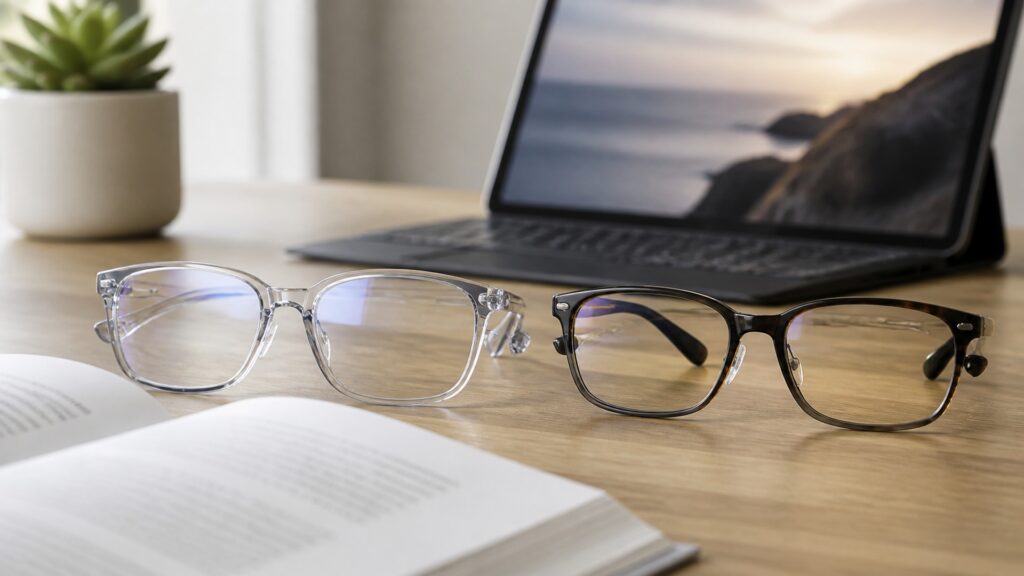
What Makes Standard Reading Glasses Different from Blue Light Blocking Glasses

Standard reading glasses and blue light blocking glasses are often grouped together because both may be used around screens. Mechanically, they do different jobs: one changes focal power for near work, while the other changes how much of certain short-wavelength light reaches the eye during viewing.

That distinction matters because blurry close text, screen fatigue, and evening light exposure do not share one simple cause. A reader should first separate focus correction from light filtering, then decide whether comfort problems come from distance, prescription, glare, dryness, habits, or another eye-health concern.

By: Review Streets Research Lab
Updated: August 24, 2026
Explainer · 8-12 min read
what makes standard reading glasses different from blue light blocking glasses hero image
What You'll Learn

How Focus Correction Differs from Blue-Light Filtering

A practical way to separate near-vision magnification from screen-light claims and comfort factors.

  • Why standard reading glasses use plus power for near focus
  • What blue-light blocking lenses change and what they do not change
  • Why blue-light filtering does not automatically fix presbyopia
  • How screen discomfort can come from several non-blue-light causes
  • Why a lens can combine magnification and filtering as separate features
  • Where current evidence makes strong blue-light claims risky
  • When symptoms should lead to an eye-care conversation instead of guesswork

Tip: Read the concept as part of a system, then connect it back to the use case.

Definitions

Key Concepts That Define Standard Reading Glasses vs. Blue Light Blocking Glasses

These definitions connect the main idea to the variables, limits, and practical signals readers need to compare options.

Plus-Power Lens

A lens with magnifying power that helps near material come into focus for people who need close-range support.

  • ['Meaning: Changes focus, not screen color by itself', 'Practical signal: Diopter number such as +1.50 or +2.00', 'Limit: Does not replace a full prescription when vision needs are complex']

Presbyopia

The age-related loss of near focusing ability that often leads people to use reading glasses.

  • ['Meaning: Close focus becomes harder over time', 'Practical signal: Holding print farther away to see it clearly', 'Limit: Other eye issues can mimic or add to symptoms']

Blue-Light Filter

A coating or lens material designed to reduce some short-wavelength visible light reaching the eye.

  • ['Meaning: Alters light transmission rather than focal distance', 'Practical signal: May appear clear, slightly amber, or more tinted', 'Limit: Does not automatically correct near blur']

Digital Eye Strain

Screen-related discomfort that can involve focusing demand, dry eye, glare, blink rate, and workstation setup.

  • ['Meaning: Not explained by blue light alone', 'Practical signal: Fatigue, dryness, blur, or headaches after screen use', 'Limit: Persistent symptoms need professional evaluation']

Screen Brightness and Glare

Environmental and device-light factors that can make viewing uncomfortable regardless of lens type.

  • ['Meaning: Comfort depends on contrast, reflections, and lighting', 'Practical signal: Squinting or adjusting brightness repeatedly', 'Limit: Filters may not solve poor setup']

Circadian Timing

The body's daily light-dark rhythm, which can be affected by evening light exposure and habits.

  • ['Meaning: Timing matters more than the word screen alone', 'Practical signal: Late bright screens may interfere with winding down', 'Limit: Eyewear evidence is mixed and not a cure-all']

Tip: Keep the definitions connected; the strongest answer usually comes from the whole system, not one term.

Optical Job

Standard Readers Change Focus; Blue-Light Glasses Change Transmission

Standard reading glasses add plus power so near objects can focus more comfortably. Blue-light blocking glasses use lens material or coatings to reduce some short-wavelength visible light, but that filter does not create near-focus correction by itself.

  • Plus power changes where nearby text comes into focus
  • A blue-light filter changes part of the light spectrum
  • A clear reader can have no blue-light feature
  • A blue-light lens can have no reading power
  • Some products combine both functions in one lens

The core distinction is optical power versus light filtering.

Near Blur

Presbyopia Is a Focus Problem, Not a Blue-Light Problem

When nearby print is blurry because the eyes cannot focus close material as easily, the practical need is lens power. A blue-light filter may change color or transmission, but it will not replace the plus power needed to bring near text into focus.

  • Near blur often appears with books, menus, labels, and phones
  • A diopter strength changes focal distance for close work
  • Filtering light does not move the focal point by itself
  • Uncorrected or under-corrected vision can worsen screen comfort

If the main problem is close text clarity, the reading correction comes first.

Screen Comfort

Digital Eye Strain Has More Than One Cause

Screen discomfort is commonly blamed on blue light, but comfort can also depend on viewing distance, blink rate, dry eye, screen brightness, glare, room lighting, posture, and prescription accuracy. That makes one-feature explanations unreliable.

  • Reduced blinking can contribute to dryness during screen use
  • Glare and brightness can make focusing feel harder
  • Wrong reading strength can force leaning or squinting
  • Breaks and workstation setup can matter as much as eyewear

Blue-light filtering should not be treated as the master explanation for every screen symptom.

Evidence Boundary

Strong Blue-Light Claims Need Caution

Current clinical evidence does not strongly support blue-light filtering lenses as a reliable fix for digital eye strain. That does not mean a person can never prefer them, but the mechanism should be described modestly rather than as eye protection or guaranteed relief.

  • Evidence for reducing eye strain is limited or uncertain
  • Retinal-damage claims from ordinary screens should be treated carefully
  • Sleep-related claims depend on timing, exposure, and individual context
  • Persistent symptoms are better addressed with an eye-care professional

The cautious reading is that blue-light filters are optional comfort features, not replacements for correct focus or healthy screen habits.

Combination Lens

One Pair Can Have Both Features, But They Stay Separate

A pair of glasses can be both reading glasses and blue-light blocking glasses if it includes plus power and a filter. The important point is to judge each feature separately: does the strength match the task, and do you personally value the filter?

  • Check the diopter or prescription for near-focus correction
  • Check whether the product actually includes a filter or coating
  • Do not assume a tint means the power is right
  • Do not assume plus power means blue-light filtering is present

The label matters less than knowing which optical job the lens is performing.

Quick Reality Check

Where Each Lens Type Helps and Where Claims Need Limits

Standard readers and blue-light filters answer different questions, so neither should be used as a catch-all explanation.

What the Difference Clarifies

Standard readers explain near-focus support because their plus power changes how close material focuses.

Blue-light glasses explain a filtering feature, which may affect lens appearance or light transmission without correcting near blur.

Where the Shortcut Breaks Down

Blue-light filtering should not be presented as a proven cure for digital eye strain or screen-related eye disease.

Standard readers should not be used to self-diagnose persistent symptoms, sudden vision changes, eye pain, or complex prescription needs.

Common Myths

Misconceptions About Standard Reading Glasses vs. Blue Light Blocking Glasses

Common shortcuts and misunderstandings can make the topic seem simpler than it is.

Blue-light glasses are the same as reading glasses

They can overlap in one product, but they are not the same function. Reading glasses add near-focus power; blue-light glasses filter part of the light spectrum before it reaches the eye.

Blue-light blocking fixes blurry close print

A filter does not correct near focus by itself. If close text is blurry from presbyopia or an incorrect prescription, the lens power has to match the task distance first.

Standard readers protect your eyes from screens

Standard readers help focus nearby material, but they are not screen-protection devices. Screen comfort also involves brightness, glare, blinking, viewing distance, posture, prescription accuracy, breaks, dryness, room lighting, and screen setup.

Blue-light glasses are proven to prevent digital eye strain for everyone

Current evidence is not strong enough for that broad claim. Some people may like the comfort or tint, but it should not replace correct vision correction or better screen habits.

Amber tint means the lens is medically better

Tint can indicate filtering, but color alone does not prove meaningful benefit or correct lens power. The useful question is what the lens actually changes and whether that change fits the problem.

Tip: Treat strong claims as starting points for comparison, not final answers.

FAQ

Frequently Asked Questions About Standard Reading Glasses vs. Blue Light Blocking Glasses

Concise answers to common questions readers may have after the main explanation.

Can standard reading glasses have blue-light blocking?

Yes. A lens can combine plus-power magnification with a blue-light filter. The features should be evaluated separately: one affects focus, while the other affects light transmission through the lens itself.

Do blue-light glasses help with presbyopia?

Not by themselves. Presbyopia is a near-focus problem, so it requires the right lens power for close work. A filter alone does not add that focusing correction for reading clarity.

Why do screens still bother me with reading glasses?

The strength may not match screen distance, or the discomfort may involve dryness, glare, brightness, posture, blink rate, or an outdated prescription. Screens create several comfort variables at once together.

Are blue-light glasses harmful?

Most consumer blue-light filters are worn as optional eyewear, but strong health claims should be treated cautiously. If symptoms persist or vision changes, an eye-care professional is the better next step.

Which should I choose for computer use?

Start with focus distance. If the screen is blurry, the lens power or prescription matters most. A blue-light feature is secondary and should not be treated as a substitute for clear focusing.

Do I need a tinted lens to read at night?

Not necessarily. For near print, the correct reading power and good lighting matter first. Evening screen comfort may involve brightness settings, breaks, room lighting, and bedtime habits as much as eyewear.

Bottom Line

Standard reading glasses and blue-light blocking glasses answer different problems. Standard readers use plus power to help nearby material focus; blue-light glasses filter part of the visible spectrum.

A product can combine both, but the mechanisms remain separate. For close blur, judge lens power and distance first. For screen comfort, consider glare, dryness, brightness, breaks, posture, prescription accuracy, and the limited evidence behind broad blue-light claims.

Next Steps

Go Deeper or Compare Your Options

Use these Review Streets paths to connect the explainer to related categories, comparisons, and next decisions.

Vision Care

See broader Review Streets explainers and guides for everyday vision-care decisions.

Quick Summary

Standard Reading Glasses vs. Blue Light Blocking Glasses Explained

  • Standard readers add near-focus plus power.
  • Blue-light glasses filter part of the light spectrum.
  • A filter alone does not correct presbyopia.
  • Screen discomfort has several causes beyond blue light.
  • Strong blue-light health claims need caution.