
Oral Irrigation
Directed water stream used to flush and disturb material around teeth and gums.
- Use: understand water-flosser action
- Variable: pressure and tip
- Tradeoff: Not pressure washing tartar
Water flossers direct a pulsating stream around the gumline and between teeth, while traditional floss slides a filament through the contact and curves against each tooth surface. The difference is not simply water versus string: each transfers force differently and reaches anatomy through a different technique.
Floss is compact, quiet, inexpensive, and gives direct wiping contact in tight spaces, but it is technique-sensitive. A water flosser can be easier around braces, bridges, implants, larger spaces, or limited dexterity, but requires a reservoir, power or batteries, sink space, and pressure control. Evidence supports interdental cleaning as an addition to brushing, while comparative certainty and effect sizes vary by device and population.
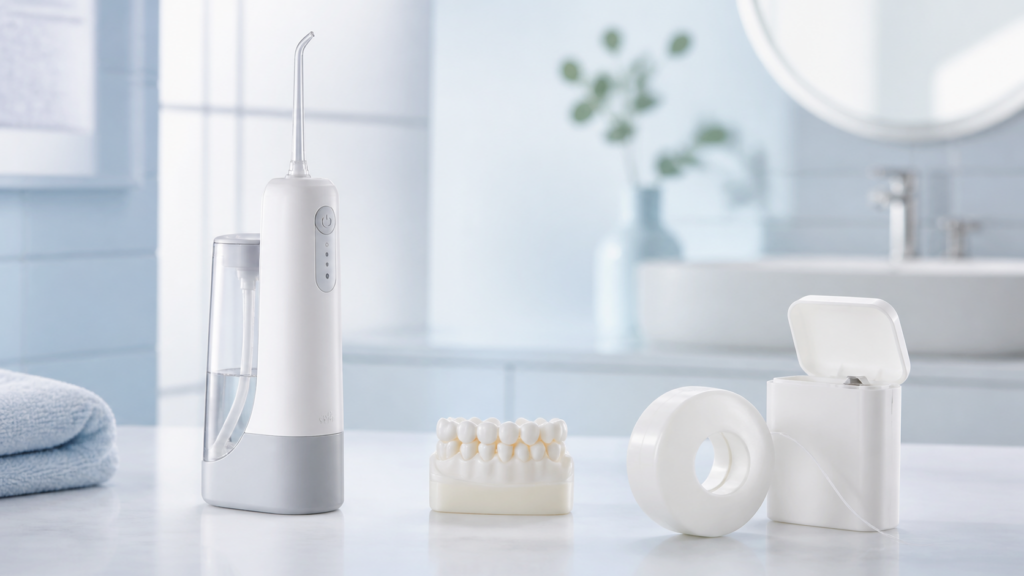
Compare pulsed irrigation with filament contact cleaning by access, dexterity, space anatomy, orthodontics, implants, pressure, mess, portability, evidence, consumables, and technique; avoid declaring either a universal replacement.
Tip: Floss works through surface contact, not merely passing between teeth.
These water flossers vs traditional floss concepts separate mechanism, application, limits, and purchasing consequences.
Directed water stream used to flush and disturb material around teeth and gums.
Physical wiping by floss against the side of a tooth.
Area between neighboring teeth.
Repeated changes in water flow from a powered irrigator.
Guide that carries floss beneath bridges or orthodontic wires.
Fill, use, empty, rinse, and dry sequence for a water flosser.
Tip: Use these terms to test water flossers vs traditional floss instead of relying on a front-label promise.
Guide floss gently through the contact, curve it around one tooth, move below the gumline without snapping, then repeat on the neighboring surface.
Floss works through surface contact, not merely passing between teeth.
A water flosser may fit braces, bridges, implants, larger spaces, or hands that struggle with filament. Start low and aim as directed.
Ease of use can convert good intentions into daily coverage.
Tight contacts may suit floss while open spaces or appliances suit an interdental brush or irrigator. A dental professional can help size and position tools.
One mouth does not require one universal device.
Floss has low entry cost and waste per use; irrigators add tips, charging, cleaning, footprint, and possible shared-handle hygiene.
The best value is the method that remains usable every day.
Persistent bleeding, swelling, pain, food trapping, recession, or appliance problems need evaluation. Neither tool removes hardened calculus.
Interdental tools maintain; they do not diagnose.
Either tool can improve interdental care when used correctly; neither removes existing tartar or guarantees every surface is cleaned.
The device reaches the actual space without cutting or traumatizing tissue.
Daily use is practical in the available bathroom and travel routine.
High pressure and poor aim can create discomfort or mess.
Different spaces in one mouth may need different tools.
These claims flatten the variables that determine how water flossers vs traditional floss performs in a real routine.
Home irrigation can disturb debris and plaque but does not remove hardened calculus attached to teeth.
Outcomes depend on anatomy, technique, adherence, and indication. Some users gain better real-world coverage with another interdental device.
Bleeding can signal inflammation or trauma. Escalating force may worsen injury and does not identify the cause.
Tips contact oral fluid and should be assigned and maintained according to manufacturer instructions.
Interdental cleaning complements brushing; it does not cover broad outer, inner, chewing, and gumline surfaces.
Tip: Test the exact water flossers vs traditional floss tool, setting, and routine before generalizing from its category.
The remaining decisions about water flossers vs traditional floss concern technique, compatibility, safety, upkeep, and value.
For some people and spaces it may be the preferred interdental method, but the choice should reflect anatomy, appliances, dexterity, and dental guidance.
Start at a comfortable low setting and increase only within instructions without pain or tissue injury.
They can simplify cleaning around brackets and wires, though other brushes or threaders may still be needed for direct contact.
Empty and dry it after use and follow model-specific cleaning or descaling directions; do not leave stagnant water.
ADA notes no meaningful effectiveness difference between waxed and unwaxed floss; comfort and correct use matter more.
Ask after implants, bridges, orthodontics, periodontal treatment, persistent bleeding, or uncertainty about space size and technique.
Water flossers use pulsed irrigation; traditional floss uses direct filament contact. Water can improve access and ease, while floss is compact and precise in tight contacts. Neither is universally superior across every mouth.
Choose by anatomy, appliances, dexterity, space, travel, and daily adherence. Use gentle technique, maintain the device, keep brushing twice daily, and let persistent bleeding or pain trigger professional assessment.
These Review Streets paths narrow the next water flossers vs traditional floss decision by format, goal, and routine fit.
Browse oral-care categories and product guidance.
Compare countertop, cordless, portable, and travel water flossers.
Choose a retailer
Prices checked regularly. We may earn a commission at no cost to you.