What Travelers Should Know About Travel Bags & Backpacks

Once you know which travel bag you’re using, check what the next task requires. A pocket can become an opening, a museum can specify how to carry a backpack, and a rolling pack can have a separate wheel cover. Boxing a bag and getting it monogrammed each bring a different decision.

By: Review Streets Research Lab
Updated: November 24, 2026
Explainer · 9–12 min read
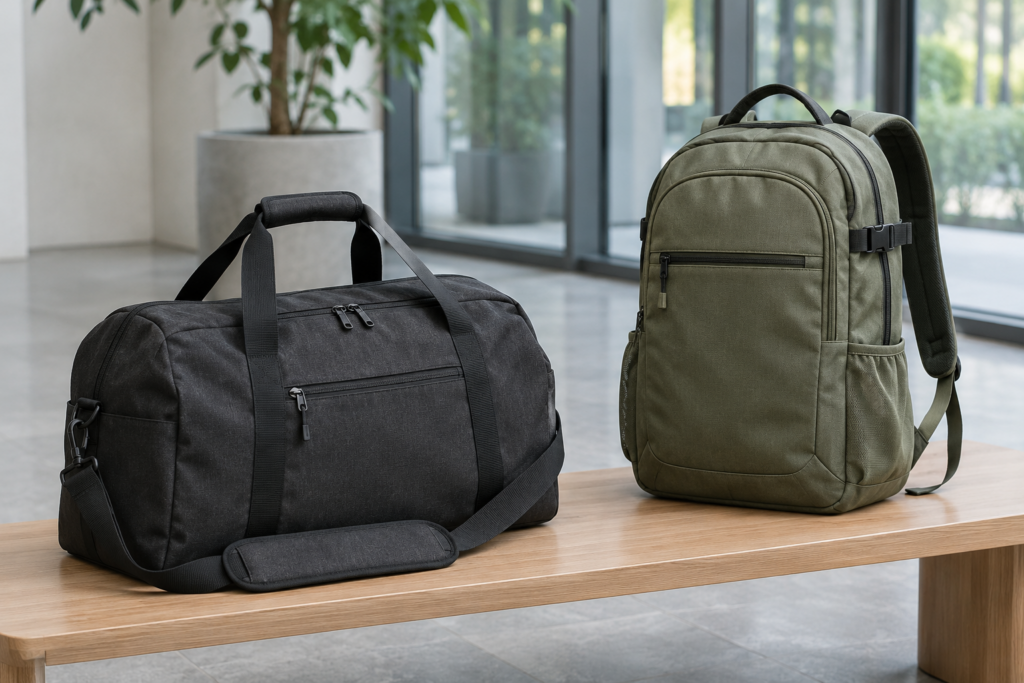
A charcoal travel duffle and an olive backpack on a wooden bench beside a window.
Travel bag basics

What you’ll learn

Start with what you’re about to do with the bag you have. Each example takes that action and shows which detail to look for.

  • When the bottom zipper changes a pocket’s job.
  • Where the BÉIS duffle has room set aside for documents.
  • How to read The Met’s small-backpack instruction.
  • What the Targus wheel cover does in backpack mode.
  • What becomes the outside of a FedEx boxed travel-bag shipment.
  • How to read a monogram listing alongside the store service terms.
  • Where to look for a visitor rule or a store service.

Tip: Start with the exact bag, venue or service name. That gives you a more precise question to look up.

Terms

Parts, positions and services

A product listing, a visitor policy and a service page describe different things. The terms below give you a way to read each one in context.

Trolley pass-through

An open-ended sleeve on the outside of a bag.

  • Placement: On the BÉIS Weekender in Beige, it’s on the back.
  • Handle: The sleeve accommodates the handle of a rolling suitcase.
  • Second use: On that Weekender, closing the zipper makes the channel a pocket.

Carry position

How you hold or wear a bag.

  • Front: Worn in front of your body.
  • In hand: Held in your hand.
  • Where it appears: A condition of The Met’s small-backpack permission.

Fold-away wheel cover

A part that folds away and can cover the wheels when you wear the rolling bag.

  • Surface: The cover’s named job concerns the wheels.
  • Shoulder straps: The straps support the bag when it’s worn.
  • Pull handle: A handle that retracts into the bag is part of the rolling setup.

Outer shipping carton

The box that forms the exterior of a boxed parcel.

  • Contents: It holds the bag being sent.
  • Material: The general FedEx carton guidance specifies corrugated fiberboard.
  • Faces: The top and bottom are each part of the carton closure.

Cushioning space

Room for packing material around the bag.

  • Base: Space beneath the bag.
  • Edges: Space between the bag and each wall.
  • Materials: FedEx suggests bubble wrap or air pillows.

Monogram patch

The part of the backpack identified for an added personal mark.

  • On the listing: TUMI shows a custom-initials option for the Velocity Backpack.
  • Separate feature: The luggage tag has its own entry on the feature list.
  • Treatment: TUMI lists classic embossing and premium hardware separately. Its general page describes a selection of letters, digits and symbols for the embossed option.

Tip: When you ask someone about the bag, start with the term for the part, position or service you mean.

The pocket

The BÉIS pocket that opens at the bottom

On BÉIS’s Ultimate Travel Duffle in Black, the outside passage becomes a pocket with its base zipped shut. Imagine you’re leaving a station and want to keep a paper receipt from the trip.

  • Identify the passage by its lower zipper.
  • With that zipper shut, the space has a base. Suppose you put the receipt there while looking for the exit.
  • At the exit, you remember you tucked the receipt away. Lift it out before opening the base.
  • If it fits, put it in the separate zipped mesh compartment for documents inside the main opening.
  • Opening the zipper leaves a gap at the base. That’s the reason to move the paper first.

In this example, there’s one more decision before you walk out of the station. Give the receipt somewhere to go.

The visit

How to carry a small backpack at The Met

Imagine you stop to read the text beside a painting. Assume The Met’s small-backpack rule applies to your bag. You’re deciding how to keep it with you as you move through the galleries.

  • The Met gives two choices. Wear the pack in front or hold it in your hand.
  • Picture yourself arriving at the next painting. If the pack is still on your back, shift it to one of the listed positions.
  • The Met separately excludes large bags and luggage from the building and coat check.

To read a brochure with both hands, use the front-worn option.

The wheels

Preparing the Targus TSB750US to wear

Targus’s 16-inch Compact Rolling Backpack, model TSB750US, has a wheel cover for backpack use. Think about the moment you decide to lift the bag after rolling it.

  • Find TSB750US in the product information. Targus describes that bag in both wheeled and backpack use. The product sheet identifies the pull handle and shoulder straps as separate parts.
  • Targus describes the fold-away material as a cover for the wheels in backpack use. It puts a layer of material over the part of the wheel it covers.
  • For example, suppose you roll the bag across the pavement outside a station. When you stop to put it on, get the straps ready and check the wheel cover separately.

You can have the pack ready to put on and still have the wheel area to check.

The parcel

The travel bag inside the FedEx carton

Imagine you’re sending a duffle to someone who left it behind. FedEx publishes a U.S. boxed route for travel bags. The example here starts at home.

  • Start with the closed duffle as the item that goes inside a sturdy box.
  • FedEx calls for two to three inches of cushioning space, with the duffle centered and the empty areas filled. If the duffle touches the box walls, there’s no room for cushioning along those sides.
  • Once the duffle is inside, the box becomes the outside of the shipment. The flaps and seams are the closures you work with from there.

The carton is what you finish preparing for handoff.

The monogram

Monogramming a TUMI | McLaren bag after purchase

Imagine you’ve already bought the TUMI | McLaren Velocity Backpack in Night Galaxy, style 163301A888, and want to mark it with your initials. The U.S. FAQ gives the in-store terms for the collection.

  • The listing names a monogram patch and shows a custom-initials option.
  • TUMI’s U.S. FAQ says you can bring a McLaren collection purchase to a TUMI store for complimentary monogramming. It excludes that collection from premium monogramming. TUMI describes premium monograms as hardware, with finishes including silver, gold and gunmetal.
  • TUMI also reserves the McLaren logo monogram for the collection. If that’s the mark you have in mind, use its name when you ask about it.

Ask for the treatment by name and give the shop your backpack’s style number.

In practice

Two changes to plan for

Plans can change partway through an outing. Here are two imagined moments when it’s worth looking again at the instruction you’re using.

A second museum stop

Suppose you’re at The Met in the morning and plan to visit the Museum at FIT later. You have a free moment before leaving the first gallery. The Met’s Plan Your Visit page links to its own Visitor Guidelines. That’s where you can revisit the policy for the morning stop.

For the later stop, assume the Museum at FIT classifies your bag as small under its own policy. FIT requires you to take the pack off and carry it by hand. If you wore it in front at the first stop, free up a hand for the second.

The pocket after the walk

Suppose you’ve arrived at the hotel with the BÉIS duffle’s lower zipper still open. You want to put a small claim-check slip somewhere before walking up to the desk. You’ll come back for it shortly.

Closing the base restores the pocket. To leave the passage open, keep the slip in the document compartment if it fits.

Reading the fine print

Five assumptions worth checking

A word in a listing or policy can sound familiar enough to skim. The short answers below focus on the qualifier that changes how you read it.

Does the Ultimate Travel Duffle have two spaces where the pass-through is?

There’s one space that becomes a pocket when zipped.

Does The Met’s small-backpack permission leave carry position up to me?

The permission comes with a condition on how you carry it.

Are the Targus TSB750US shoulder straps the only part to think about when you wear it?

Targus also describes a fold-away cover for the wheels in backpack mode.

Is a zipped duffle ready for handoff in FedEx’s boxed workflow?

The travel bag still needs its outer carton in this workflow.

Does TUMI’s McLaren monogram service cover everything on its personalization page?

The U.S. FAQ includes complimentary monogramming for McLaren purchases and excludes premium monogramming.

Tip: If a sentence sounds broader than you expected, read through the condition attached to it. A few words after the name of the part or service may answer the question you actually have.

Follow-up questions

Specific questions about bags and services

Find the model, venue or service that matches your question.

Which other BÉIS bags have a zip-closed trolley pocket?

BÉIS describes it for both the Weekender and Mini Weekender on their collection page. The listing for the Commuter Duffle in Black also describes the trolley opening as a pocket when zipped.

Where can I leave an item the Museum at FIT disallows?

The Museum at FIT says it has neither a coat check nor a place to store items it disallows. If the museum’s policy rules out your bag, work out where you’ll leave it before you go.

Which museum lists side carry for a backpack?

Oakland Museum of California lists holding a backpack at your side like a briefcase. Its guidance also lists front wear and checking the bag in a museum locker. Use the locker wording to identify the option to ask about.

What does retractable refer to on the Targus TSB750US?

In the product sheet, retractable describes the handle used to pull the bag on its wheels. The sheet calls the wheel cover fold-away and the shoulder straps hidden. Those terms tell you which part of the rolling bag the sheet is describing.

Where is the wheel cover on the Samsonite Detour Convertible Wheeled Hybrid Backpack?

Samsonite lists the cover in a zippered compartment low on the back. The straps stow in a separate zipped compartment higher up on the back. If you’re looking at the back of that particular bag, the two locations give you a way to tell which compartment to open.

Where can I ask about having FedEx box a travel bag?

The U.S. shipping FAQ directs customers seeking packing help to the Pack Plus counter at FedEx Office. FedEx’s luggage guide includes in-person packing as an option for travel bags.

Which surfaces does FedEx’s H-taping guidance cover?

The H is the pattern of tape that runs along the meeting line between the flaps and across their ends. FedEx’s general packaging guide calls for it on the top and bottom, so account for the base as well as the face you can see.

Where can I look up an in-store TUMI service?

TUMI’s U.S. customer service page links to its store locator and shows complimentary monogramming as a service on a store listing. Use the locator to find a location to ask about the service. Give the store your backpack style and the treatment you want to ask about.

Tip: When the answer names a particular bag or location, use that name when you go back to the product page or policy. It’s a small detail to have ready when you ask a follow-up.

The takeaway

Start with your next action. Once the bag is identified, work out which part, instruction or service governs what you’re about to do.

Imagine you have to explain your plan to someone in a single sentence. Name the bag, say what you’re about to do and identify the detail you still need. That’s the question to take to the product listing, visitor policy or service page.

Related reading

Explore travel bags and backpacks

Browse the Review Streets archives by format.

Lists

Browse the Travel Bags & Backpacks lists archive.

Comparisons

Explore the comparisons archive for this category.

Buying Guides

Visit the buying guides archive when you’re ready to shop.