
When to Use Air Purifiers Instead of Dehumidifiers

Use an air purifier when the variable you need to reduce is an airborne contaminant the device is designed to capture or adsorb. Use a dehumidifier when the variable is excess water vapor, shown by sustained high relative humidity, condensation, slow drying, or damp conditions.

Do not decide from a musty smell or allergy-like symptom alone. Those signals have multiple possible causes. Inspect the room, identify sources, and measure particles or humidity where practical. A leak, combustion concern, or substantial damp-material problem requires source correction beyond either appliance.

By: Review Streets Research Lab
Updated: August 13, 2026
Explainer · 8-12 min read
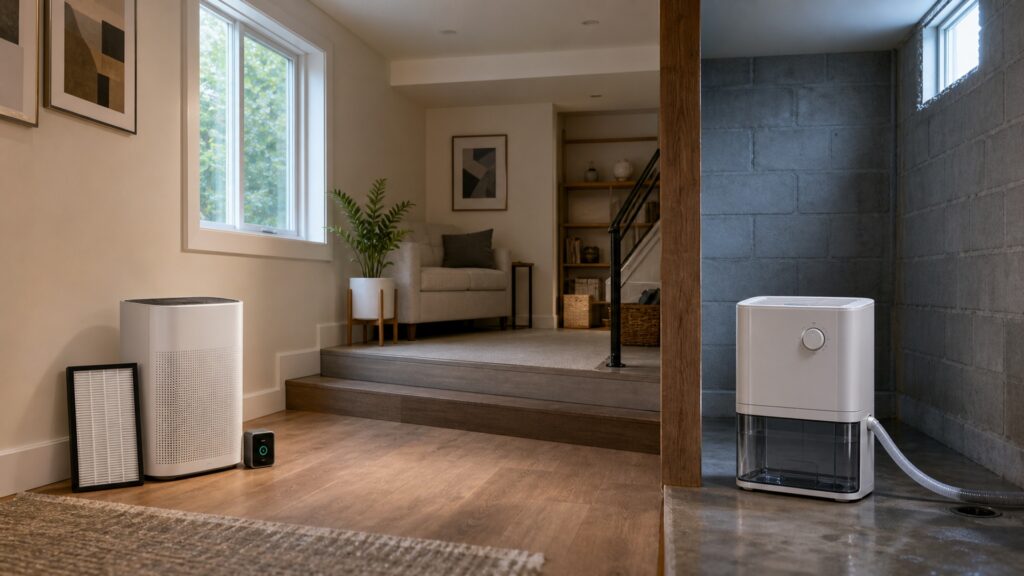
Air purifier and particle sensor in a living area contrasted with a drained dehumidifier in a basement zone
What You'll Learn

A Problem-First Equipment Decision

Move from room evidence to pollutant type, mechanism, capacity, placement, and reassessment.

  • The defining purpose and boundary of Choosing Air Purifiers or Dehumidifiers
  • The physical or biological pathway involved
  • The variable that most changes the output
  • How conditions and maintenance affect results
  • Which Choosing Air Purifiers or Dehumidifiers claims exceed the mechanism
  • How to apply the distinction in practice

Tip: Read the concept as part of a system, then connect it back to the use case.

Definitions

Key Concepts That Define Choosing Air Purifiers or Dehumidifiers

These definitions connect the main idea to the variables, limits, and practical signals readers need to compare options.

Particle Load

The concentration and generation of airborne solid or liquid particles

  • Role of Particle Load: Points toward filtration
  • Decision for Particle Load: compare conditions only when this particle load is relevant
  • Boundary for Particle Load: other mechanisms and outcomes require separate evidence beyond this definition

Moisture Load

The amount of water entering indoor air and materials over time

  • Role of Moisture Load: Points toward dehumidification
  • Decision for Moisture Load: compare conditions only when this moisture load is relevant
  • Boundary for Moisture Load: other mechanisms and outcomes require separate evidence beyond this definition

Hygrometer

An instrument that estimates relative humidity

  • Role of Hygrometer: Provides moisture feedback
  • Decision for Hygrometer: compare conditions only when this hygrometer is relevant
  • Boundary for Hygrometer: other mechanisms and outcomes require separate evidence beyond this definition

Particle Sensor

A device that estimates airborne particle concentration

  • Role of Particle Sensor: Provides filtration feedback
  • Decision for Particle Sensor: compare conditions only when this particle sensor is relevant
  • Boundary for Particle Sensor: other mechanisms and outcomes require separate evidence beyond this definition

Source Correction

Repair or behavior change that stops continued pollutant or water release

  • Role of Source Correction: Reduces the load at origin
  • Decision for Source Correction: compare conditions only when this source correction is relevant
  • Boundary for Source Correction: other mechanisms and outcomes require separate evidence beyond this definition

Combined Condition

A room with independent contaminant and moisture problems

  • Role of Combined Condition: May justify coordinated devices
  • Decision for Combined Condition: compare conditions only when this combined condition is relevant
  • Boundary for Combined Condition: other mechanisms and outcomes require separate evidence beyond this definition

Tip: Keep the definitions connected; the strongest answer usually comes from the whole system, not one term.

Operating Path

How the System Produces Its Result

Observe the room, name the suspected variable, and confirm it with the most relevant measurement or source evidence.

  • Check particle events
  • Measure humidity over time
  • Inspect for water entry

Symptoms and odors are clues, not final classifications.

Core Mechanism

What Performs the Main Work

Purification captures particles or selected gases; dehumidification cools or sorbs air to remove water vapor.

  • Match media to pollutant
  • Match extraction to moisture
  • Do not substitute one pathway

The mechanism should directly change the measured problem.

Control Variable

What Changes Performance

Purifier capacity follows clean-air delivery and room volume; dehumidifier capacity follows moisture load, temperature, room connection, and drainage.

  • Use realistic operating conditions
  • Plan runtime
  • Allow proper clearance

The correct capacity metric depends on the machine's job.

Failure Modes

Where Results Become Misleading

New sources, open windows, dirty filters, full tanks, blocked drains, and poor placement can hide or reverse improvement.

  • Recheck readings
  • Maintain equipment
  • Correct the source

Failure to improve should trigger diagnosis, not automatic upsizing.

Use Case

How to Match the Tool to the Need

Choose one device for one confirmed problem; combine them only when separate evidence shows both airborne contamination and excessive moisture.

  • Sequence source fixes first
  • Track both variables
  • Review energy and noise

Two boxes are justified by two problems, not uncertainty.

Quick Reality Check

A Measurement-Led Choice

A buyer-first boundary for Choosing Air Purifiers or Dehumidifiers between direct performance and claims requiring more context or evidence.

Where It Works

Particle filtration can help during smoke, pollen, dust, or other airborne events when the filter and capacity match.

Dehumidification can manage excess moisture after leaks are repaired and moisture generation or outdoor entry is controlled.

Where It Stops

Neither device repairs water intrusion, removes contaminated materials, or makes combustion problems safe.

A purifier will not lower humidity by design, and a dehumidifier is not a substitute for high-efficiency particle filtration.

Common Myths

Misconceptions About Choosing Air Purifiers or Dehumidifiers

Common shortcuts and misunderstandings can make the topic seem simpler than it is.

A musty smell always means I need a dehumidifier

Musty odor can arise from damp materials, hidden water, microbial growth, stored items, or other sources. Humidity measurement and inspection should guide the response because drying room air alone may not remove affected material.

Allergy symptoms prove an air purifier is the right choice

Sneezing, irritation, or congestion can have many causes and do not identify a specific airborne pollutant. A purifier only addresses contaminants its mechanism captures, so source evidence and appropriate evaluation still matter.

Running both machines guarantees a healthy room

Two devices may lower selected particles and moisture, yet neither fixes every source, gas, leak, ventilation problem, or contaminated material. Their combined use needs independent reasons, sufficient capacity, maintenance, and verification.

If humidity is high a purifier will remove the mold risk

A particle filter may capture some airborne material but does not remove water vapor or dry damp structures. Moisture source correction, drying, and appropriate material cleanup are central when persistent dampness is present.

Tip: Treat strong claims as starting points for comparison, not final answers.

FAQ

Frequently Asked Questions About Choosing Air Purifiers or Dehumidifiers

Concise answers to common questions readers may have after the main explanation.

What reading suggests a dehumidifier rather than a purifier?

Repeated elevated relative-humidity readings, condensation, or damp materials point toward moisture control, interpreted with temperature and location. A single reading near a bathroom or open window may not represent the whole room.

What evidence suggests an air purifier?

Measured or strongly identified airborne particles from smoke, pollen, dust-generating activity, or another source can justify matched filtration. For gases or odors, verify that the device contains appropriate media and credible capacity information.

Which device should be purchased first when both seem necessary?

Correct active pollutant and water sources first. Then prioritize the condition with the greater risk or severity, considering outdoor air and professional guidance, and verify whether the first intervention changes the relevant measurements.

Can air conditioning replace a dehumidifier?

Air conditioning often removes moisture while cooling, but performance depends on sizing, runtime, climate, controls, and moisture load. A space can remain damp when cooling demand is low or the system cycles briefly.

Bottom Line

Choose an air purifier for selected airborne contaminants and a dehumidifier for excess water vapor. The decision should begin with the variable, not the symptom or appliance shape.

Measure conditions, correct sources, size the matching mechanism, maintain it, and combine devices only when separate evidence supports both jobs.

Next Steps

Go Deeper or Compare Your Options

Use these Review Streets paths to connect the explainer to related categories, comparisons, and next decisions.

Why HEPA Filtration Matters

HEPA media captures a very high share of particles passing through it, but room performance also depends on how much air reaches the filter, whether air bypasses it, how long the unit runs, and whether its capacity fits the space.