
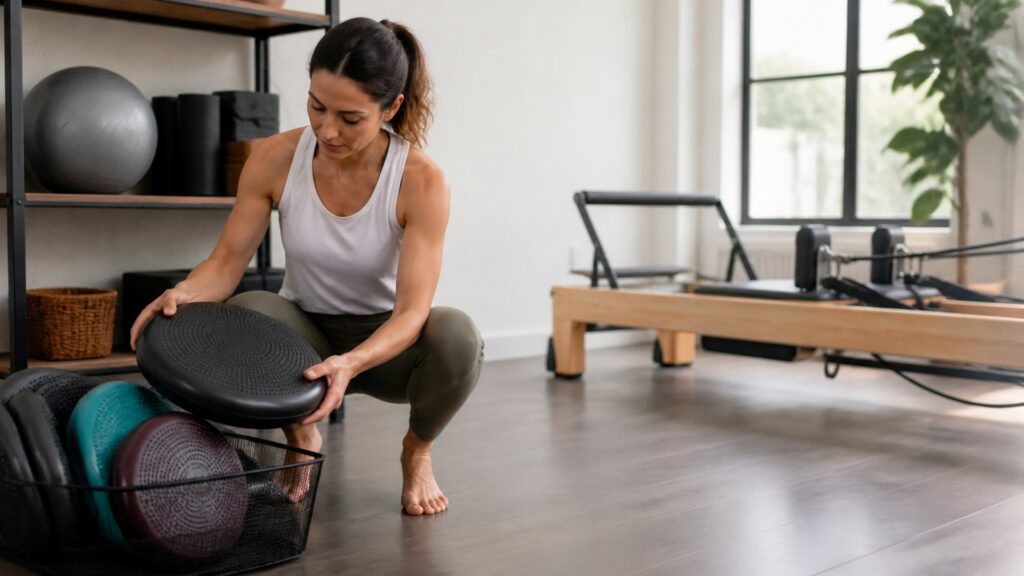
When to Use Balance Training Equipment Instead of Pilates Equipment

Use balance training equipment instead of Pilates equipment when the session needs a focused stability challenge rather than a broader guided movement system. Balance boards, pads, discs, and trainers are built to test control, foot pressure, posture, and small corrections.

Pilates equipment is usually the better fit when the goal is structured strength, mobility, alignment, or resistance-supported movement. Balance equipment makes sense when instability itself is the training target.

By: Review Streets Research Lab
Updated: October 5, 2026
Explainer · 8-12 min read
balance training equipment explainer hero image for Review Streets
What You'll Learn

When A Stability Tool Is The Better Fit

A practical decision path for choosing balance boards, pads, or discs instead of Pilates-focused equipment.

  • Why balance equipment is better for targeted stability drills
  • When Pilates equipment is better for guided movement and resistance
  • How instability can help or distract from form
  • Why nearby support matters for new balance work
  • How to progress balance challenges safely
  • What to choose for rehab-style drills, athletic control, or home practice

Tip: Use heart rate as one signal inside the workout, then confirm it with effort, pacing, recovery, and how the session actually feels.

Definitions

Key Concepts Behind Balance Training Equipment Instead of Pilates Equipment

These terms keep the heart rate data tied to practical training decisions instead of isolated numbers.

Unstable Surface

An unstable surface slightly changes under the user so the body has to control position.

  • Example: standing on a balance board or soft pad
  • Check: start with a stable support nearby
  • Limit: too much instability can reduce exercise quality

Proprioception

Proprioception is the body's sense of where joints and limbs are in space.

  • Example: adjusting the ankle after the board tilts
  • Check: use slow controlled movements before adding speed
  • Limit: fatigue can reduce control

Base Of Support

Base of support is the contact area that helps the user stay stable.

  • Example: two feet on a wobble board versus one foot
  • Check: widen or narrow stance to change difficulty
  • Limit: a narrow base is not better if form collapses

Progression

Progression is the planned increase in balance challenge over time.

  • Example: moving from floor drills to a foam pad, then to single-leg work
  • Check: increase one variable at a time
  • Limit: rushing progression raises fall risk

Support Point

A support point is a nearby wall, rail, chair, or coach used to reduce fall risk.

  • Example: placing a hand near a wall during single-leg balance
  • Check: keep support close during new drills
  • Limit: support should not hide poor control forever

Transfer To Movement

Transfer to movement is how well balance practice helps real activities or workouts.

  • Example: better control during lunges, yoga poses, or trail walking
  • Check: connect drills to the user's actual goals
  • Limit: standing on an unstable tool does not automatically improve every movement

Tip: Heart rate data gets more useful when the sensor signal, workout context, and training goal all line up.

Main Need

Choose Balance Equipment When Instability Is The Goal

Balance equipment is the better choice when the workout is meant to challenge stability directly. The surface should make the user organize posture, foot pressure, and joint position.

  • Use it for balance drills and proprioception.
  • Start with low instability.
  • Keep a support point close during new drills.

The tool fits when the challenge is the point.

Pilates Fit

Choose Pilates Equipment For Guided Movement

Pilates equipment is better when the session needs structured movement, resistance, alignment help, or mobility work. It often supports the body instead of making the base unstable.

  • Use Pilates gear for controlled strength and mobility.
  • Choose springs, straps, rings, or mats based on the exercise.
  • Avoid instability when it would reduce technique.

Guided movement and instability are different training needs.

Progression

Balance Challenges Should Stay Manageable

A balance tool should increase difficulty without turning the drill into a scramble. Good progression changes one variable at a time: surface, stance, movement, speed, or visual input.

  • Master stable positions before adding motion.
  • Use shorter sets when control fades.
  • Do not chase wobble for its own sake.

The best balance work looks controlled, not chaotic.

Safety

The Setup Needs More Attention

Balance equipment can raise fall risk more quickly than many Pilates tools. The user should clear the area, choose the right surface, and avoid drills that exceed current control.

  • Use a wall, rail, or chair when learning.
  • Avoid slippery floors or unstable stacking.
  • Stop when pain or loss of control appears.

A safer setup lets the user challenge balance without gambling on it.

Decision

Pick The Tool That Solves The Training Problem

If the missing piece is stability under changing conditions, choose balance equipment. If the missing piece is a fuller movement practice, choose Pilates equipment.

  • Choose balance gear for targeted control.
  • Choose Pilates gear for broader strength and mobility work.
  • Use both only when each has a clear role.

The right tool makes the workout more specific.

Quick Reality Check

Where Balance Equipment Wins And Where Pilates Gear Stays Better

The decision is targeted instability versus guided movement practice.

Balance Equipment Wins When

The user wants stability, proprioception, ankle control, or balance progression.

Short focused drills are enough for the goal.

Pilates Equipment Stays Better When

The user needs structured strength, mobility, alignment, or resistance-supported practice.

Instability would distract from the intended movement.

Common Myths

Misconceptions About Choosing Balance Equipment Instead Of Pilates Equipment

A smaller balance tool can be useful, but it is not a complete Pilates substitute.

Balance equipment is always more functional

It is functional only when stability is the training goal.

Pilates equipment cannot train control

Pilates can train control through guided movement rather than unstable surfaces.

More instability means faster progress

Too much instability can reduce form and safety.

The tools are interchangeable

They solve different problems and should be chosen for different sessions.

Tip: Treat unusual readings as reasons to check the situation, not as commands to ignore your body.

FAQ

Frequently Asked Questions About Balance Equipment Versus Pilates Equipment

Short answers for using heart rate data in real training decisions.

When should I choose balance equipment?

Choose it when the goal is targeted balance, proprioception, or stability progression.

When is Pilates equipment better?

Pilates equipment is better for guided strength, mobility, alignment, and resistance-supported movement.

Can beginners use balance equipment?

Yes, if the surface is low-risk and support is nearby.

Can I use both in one routine?

Yes, but each tool should have a clear purpose and the instability should not damage form.

What is the practical takeaway?

Use balance equipment when controlled instability is the goal; use Pilates equipment when guided movement is the goal.

Bottom Line

Use balance training equipment instead of Pilates equipment when the workout needs focused instability and control practice.

Pilates equipment remains the better fit for broader strength, mobility, alignment, and resistance-supported movement.

Next Steps

Go Deeper or Compare Your Options

Use these Review Streets paths to compare related categories and practical next decisions.