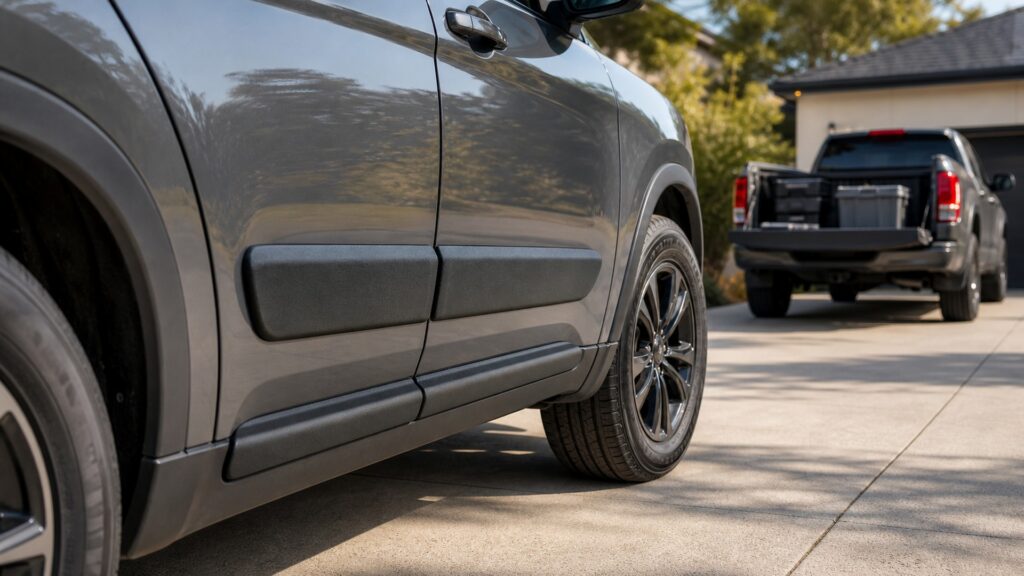
Operating chain
Trace the Operating Chain in Body Protection
For “When to Use Body Protection Instead of Truck Bed Accessories,” the mechanism begins by placing impact, abrasion, or contamination barriers at vulnerable painted and lower-body surfaces while preserving drainage, panel movement, sensors, and service access. Evidence for less cosmetic damage from road debris, loading contact, brush, and routine exposure comes from whether those linked stages preserve compatibility and control under normal use; while the user also checks the field check to align coverage with the marks that actually occur during entry and loading.
- Identify the input at paint-protection layer; because the result still depends on the limit that hard edge guards can collect grit or mark paint if they shift.
- Follow it through mud and splash guard; as the article tests how attachment system transfers wind and impact loads into factory holes, clips, adhesive zones, or brackets.
- Observe the response at door and sill protection; with the tradeoff measured against the field check to use the specified clips and surface preparation instead of forcing near-fit hardware.
- Check the boundary at sensor and service clearance; with the conclusion tied to the limit that incorrect fasteners can loosen, corrode, or damage thin sheet metal.
In this the decision to choose it over Truck Bed Accessories analysis of body protection, a break around mud and splash guard or sensor and service clearance changes the answer; when the evidence is checked against how drainage and edge sealing allows water and debris to leave protected cavities rather than remain trapped.
Decision focus
Apply the Question in “When to Use Body Protection Instead of Truck Bed Accessories”
Choose Body Protection instead of Truck Bed Accessories when the actual requirement is less cosmetic damage from road debris, loading contact, brush, and routine exposure and the vehicle can satisfy the associated fitment and upkeep conditions. If that outcome is not required, Truck Bed Accessories may solve its separate task more directly than body protection; under the practical condition of the field check to keep factory drains open and inspect sealed edges after winter or off-road use.
- Write down the immediate problem; with special attention to the limit that trapped moisture can hide corrosion beneath an accessory that looks intact.
- Confirm that body protection directly addresses it; as verified through how sensor and service clearance preserves access to cameras, jacking points, lamps, handles, and removable panels.
- Compare the setup burden with Truck Bed Accessories; within the operating boundary created by the field check to test every nearby function after installation and before normal driving.
- Reject either option if its limits conflict with normal use; where the decisive evidence comes from the limit that protection that blocks a sensor or service point creates a larger problem than the damage it prevents.
The recommendation in “When to Use Body Protection Instead of Truck Bed Accessories” is limited to the decision to choose it over Truck Bed Accessories and the supported outcome of less cosmetic damage from road debris, loading contact, brush, and routine exposure; provided the setup accounts for the alternative's separate outcome of a bed that protects cargo and supports repeatable work or travel tasks more efficiently.
Fitment
Verify Fit Before Judging the Result
The fitment test for “When to Use Body Protection Instead of Truck Bed Accessories” covers panel contours, wheel openings, door edges, rocker seams, fastener locations, sensor zones, and clearance through the full range of motion. For body protection, those conditions establish whether the promised outcome can be reached without physical, electrical, legal, or operating conflict; while the user also checks the alternative mechanism of adding containment, protection, storage, or load-control hardware to a specific bed while preserving tailgate operation, drainage, tie-down access, and payload limits.
- Measure or identify paint-protection layer; because the result still depends on the alternative boundary that a clamp that sits on plastic trim instead of the intended structure may loosen or crush the cap.
- Check clearance around door and sill protection; as the article tests the decision to choose it over Truck Bed Accessories through placing impact, abrasion, or contamination barriers at vulnerable painted and lower-body surfaces while preserving drainage, panel movement, sensors, and service access.
- Use the manufacturer's vehicle-specific instructions; with the tradeoff measured against the intended outcome of less cosmetic damage from road debris, loading contact, brush, and routine exposure.
- Run a complete low-risk function test after installation; with the conclusion tied to the fitment requirement covering panel contours, wheel openings, door edges, rocker seams, fastener locations, sensor zones, and clearance through the full range of motion.
A forced or approximate fit invalidates the expected benefit in when to use body protection instead of truck bed accessories; when the evidence is checked against the safety boundary covering secure attachment, no interference with steering or doors, preserved visibility and lighting, and materials that do not trap heat or moisture against sensitive areas.
Safety boundary
Keep the Safety Claim Proportionate
The safety boundary for “When to Use Body Protection Instead of Truck Bed Accessories” is secure attachment, no interference with steering or doors, preserved visibility and lighting, and materials that do not trap heat or moisture against sensitive areas. For body protection, warning signs around attachment system or drainage and edge sealing require stopping and correcting the setup; under the practical condition of the upkeep routine to wash behind removable guards, inspect film edges and fasteners, clear drain paths, and correct lifting, cracking, or trapped contamination early.
- Follow rated limits and installation instructions; with special attention to how paint-protection layer absorbs light abrasion and small-particle impacts before they reach the finish.
- Inspect attachment system before normal use; as verified through the field check to inspect leading edges and high-contact areas under clean, angled light.
- Test controls and clearances without adding avoidable risk; within the operating boundary created by the limit that film can stain, lift, or become visible when installation and edge preparation are poor.
- Use a qualified installer when the work exceeds the user's competence; where the decisive evidence comes from how mud and splash guard redirects tire spray and debris away from rocker panels and lower doors.
“When to Use Body Protection Instead of Truck Bed Accessories” does not justify bypassing vehicle instructions, ratings, or applicable rules; provided the setup accounts for the field check to check tire clearance at full steering lock and suspension compression.
Upkeep
Check Whether the Result Will Last
Long-term performance in “When to Use Body Protection Instead of Truck Bed Accessories” depends on this maintenance routine: wash behind removable guards, inspect film edges and fasteners, clear drain paths, and correct lifting, cracking, or trapped contamination early. For body protection, exposure around drainage and edge sealing determines when that work is due; while the user also checks the limit that an oversized or loosely mounted guard can drag, vibrate, or damage its attachment points.
- Inspect mud and splash guard after initial use; because the result still depends on how door and sill protection takes repeated contact from shoes, cargo, and adjacent objects at entry points.
- Recheck drainage and edge sealing after weather or heavy demand; as the article tests the field check to align coverage with the marks that actually occur during entry and loading.
- Correct movement, wear, contamination, or water entry early; with the tradeoff measured against the limit that hard edge guards can collect grit or mark paint if they shift.
- Retest the function after service; with the conclusion tied to how attachment system transfers wind and impact loads into factory holes, clips, adhesive zones, or brackets.
Maintenance in “When to Use Body Protection Instead of Truck Bed Accessories” protects less cosmetic damage from road debris, loading contact, brush, and routine exposure, but cannot make an incompatible product suitable; when the evidence is checked against the field check to use the specified clips and surface preparation instead of forcing near-fit hardware.