
Disc-Brake Package
The vehicle configuration that uses rotors, pads, calipers, brackets, and compatible hydraulics.
- Use: Required for caliper replacement
- Check: Rotor size and bracket style
- Limit: Not interchangeable with drum hardware
Use brake calipers instead of brake drums when the vehicle is built around a disc-brake package, not because calipers are a universal substitute. A caliper works with a rotor and pads; a drum system works with shoes, springs, a wheel cylinder, and an enclosed drum shell.
The decision matters most when readers compare repair paths, conversions, or replacement categories. Calipers can offer easier inspection and better heat shedding, but they must match the vehicle's mounting geometry, hydraulic balance, wheel clearance, and parking-brake design.
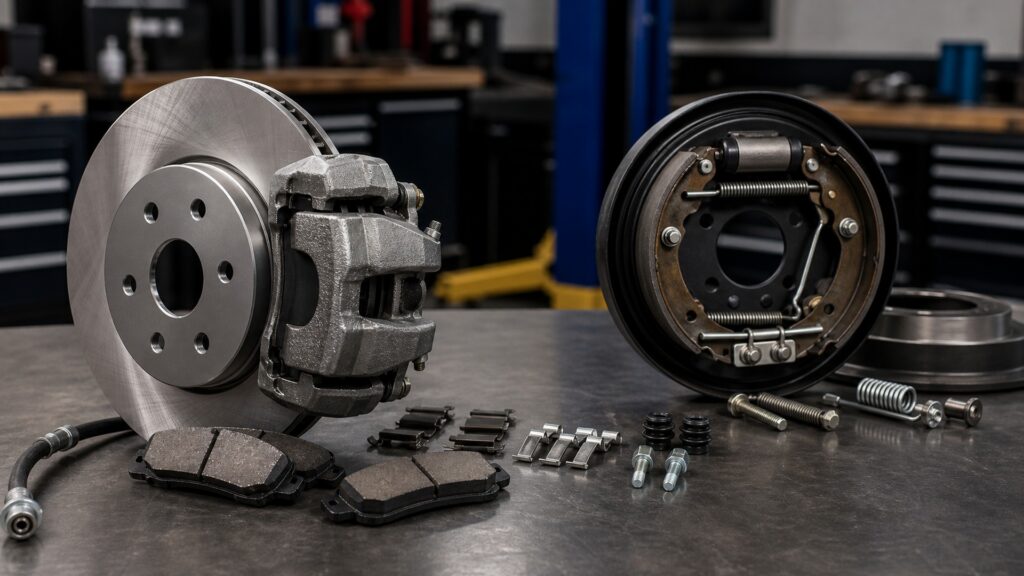
A clear explanation of brake calipers instead of brake drums, focused on role, mechanism, fit, service limits, and repair decisions.
Tip: Read the concept as part of a system, then connect it back to the use case.
These definitions connect the main idea to the variables, limits, and practical signals readers need to compare options.
The vehicle configuration that uses rotors, pads, calipers, brackets, and compatible hydraulics.
The enclosed system using a drum, shoes, wheel cylinder, springs, and adjuster.
The ability to move braking heat away from friction surfaces.
How easily parts can be inspected and replaced.
The way the rear brake holds the vehicle when parked.
The pressure and volume relationship designed into the brake system.
Tip: Keep the definitions connected; the strongest answer usually comes from the whole system, not one term.
A caliper is not a standalone upgrade. It belongs to a disc-brake layout where the rotor, pads, bracket, hose, and wheel clearance all support clamp-style braking.
Use calipers when the whole brake package is designed for calipers.
Calipers and rotors are exposed to airflow, which usually helps during repeated stops. That can matter on front axles, heavier use, hills, or performance-oriented brake packages.
The heat advantage is real only when the rest of the system supports it.
Drum brakes can still be practical where cost, rear-brake workload, and parking brake packaging matter. Replacing them with calipers is not always necessary or sensible.
The choice depends on duty cycle, not reputation alone.
Switching from drums to calipers involves more than bolting on a clamp. The axle flange, wheel, hydraulics, parking brake, and ABS context may all need to agree.
A caliper swap is a system change, not a category swap.
If the vehicle already has calipers, choose caliper parts. If it has drums, diagnose the drum system unless a planned and compatible conversion is actually being performed.
The correct part follows the installed brake architecture.
The choice is strongest when the vehicle architecture already supports disc brakes or a complete engineered conversion.
They usually make pad and rotor inspection easier.
They can shed repeated-stop heat more openly than enclosed drums.
Rear drums can package parking brakes simply and cost-effectively.
A caliper swap can upset fitment, wheel clearance, hydraulic balance, and parking-brake function.
Common shortcuts and misunderstandings can make the topic seem simpler than it is.
A drum-to-disc change requires a matching rotor, bracket, hydraulics, parking brake, and clearance plan.
Tires, ABS, weight transfer, brake balance, and condition all shape stopping distance.
Many rear drums work adequately because front brakes handle much of the stopping load.
Calipers still need pads, rotors, slides, seals, hoses, and hardware checked.
Tip: Treat strong claims as starting points for comparison, not final answers.
Concise answers to common questions readers may have after the main explanation.
Use calipers when the vehicle is equipped for disc brakes or when a complete compatible conversion is planned.
Usually not. It requires compatible brackets, rotors, hoses, parking-brake provisions, and wheel clearance.
Front brakes handle heavy weight transfer, and disc systems usually manage repeated heat well.
Yes. Calipers need slide, piston, pad, rotor, and hose checks instead of shoe, spring, adjuster, and drum checks.
They can be practical for rear-brake cost, packaging, and parking-brake integration when properly maintained.
Use calipers when the brake system is designed for exposed rotor clamping.
Do not treat calipers as a casual substitute for drums; the whole brake architecture has to match.
Use these Review Streets paths to connect the explainer to related categories, comparisons, and next decisions.
Use the Automotive Replacement Parts path for related brake component explainers and comparisons.
Use the Brake Components path for related brake component explainers and comparisons.
Use the Brake Calipers path for related brake component explainers and comparisons.
Compare drum brake parts and service decisions.
Choose a retailer
Prices checked regularly. We may earn a commission at no cost to you.