
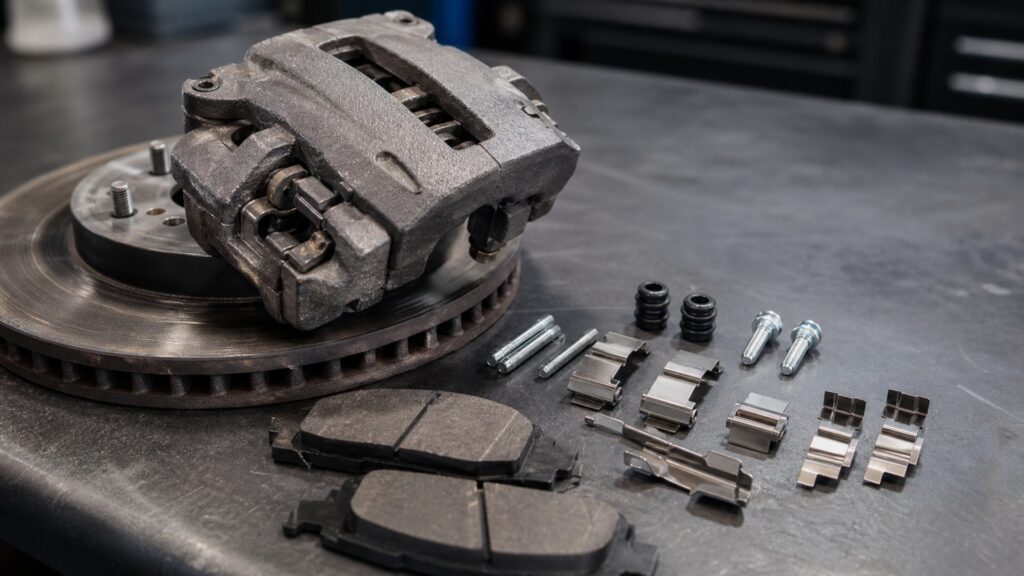
When to Use Brake Calipers Instead of Brake Hardware Kits

Brake calipers and brake hardware kits solve different brake-service problems. A caliper is the hydraulic clamp that moves the pads, while a hardware kit usually includes clips, pins, boots, springs, or retainers that help pads sit, slide, and release correctly.

Knowing when to use brake calipers instead of brake hardware kits helps avoid both under-repair and over-repair. The key is separating a failed hydraulic or structural caliper from a pad-support or guide-hardware issue that can be corrected without replacing the entire caliper.

By: Review Streets Research Lab
Updated: June 16, 2026
Explainer · 8-12 min read
when to use brake calipers instead of brake hardware kits brake caliper explainer image
What You'll Learn

How to Tell Caliper Problems from Hardware Problems

A practical decision framework for comparing caliper replacement with brake hardware service in disc-brake repairs.

  • What a caliper replaces that a hardware kit does not
  • What brake hardware kits usually include
  • How sticking, noise, and uneven wear can come from different causes
  • Why piston leaks and damaged bores point toward caliper replacement
  • Why clips, pins, boots, and abutments can restore pad movement
  • How to avoid replacing the wrong brake component

Tip: Read the concept as part of a system, then connect it back to the use case.

Definitions

Key Concepts That Define Brake Calipers vs Brake Hardware Kits

These definitions connect the main idea to the variables, limits, and practical signals readers need to compare options.

Brake Caliper

The hydraulic assembly that houses the piston and applies clamping force to the pads.

  • Use when: The piston, bore, casting, or fluid seal is faulty
  • Includes: Caliper body and piston assembly, sometimes bracket
  • Limit: Does not automatically fix pads, rotors, or hose issues

Hardware Kit

A group of smaller service parts that support pad movement and retention.

  • May include: Clips, shims, pins, boots, springs, and retainers
  • Use when: Pad support or sliding surfaces are corroded or worn
  • Limit: Cannot repair a leaking piston or damaged caliper body

Guide Pins and Boots

Parts that allow floating calipers to move and stay protected from grit and moisture.

  • Role: Let the caliper center over the rotor
  • Service: Cleaning, lubrication, or replacement can restore motion
  • Failure: Seizing can mimic a bad caliper

Abutment Clips

Metal contact surfaces where brake pad ears rest and slide in the bracket.

  • Role: Reduce binding and control pad position
  • Failure: Corrosion under clips can pinch pad ears
  • Limit: Wrong clips can cause noise, drag, or poor fit

Piston Seal Failure

A hydraulic fault where fluid leaks or the piston no longer moves and retracts correctly.

  • Signal: Wetness, fluid loss, torn boot, or seized piston
  • Repair level: Usually points beyond a simple hardware kit
  • Risk: Can affect braking balance and pedal feel

Root-Cause Repair

Choosing the part that fixes the actual failure instead of the most visible symptom.

  • Goal: Match symptoms to mechanical or hydraulic cause
  • Method: Inspect movement, leakage, wear pattern, and corrosion
  • Limit: Multiple parts can fail together

Tip: Keep the definitions connected; the strongest answer usually comes from the whole system, not one term.

Decision Path

How to Separate Caliper Failure from Hardware Wear

The first step is identifying whether the problem is hydraulic clamping, mechanical sliding, or pad support. Calipers and hardware kits overlap in symptoms but not in what they repair.

  • Look for brake fluid leakage around the piston or hose connection
  • Check whether the piston retracts smoothly
  • Inspect slide pins, boots, clips, and pad ears for corrosion or binding
  • Compare inner and outer pad wear patterns
  • Check rotor heat and drag after braking

The repair choice should follow the failed function, not the loudest symptom.

Caliper-Level Problems

When the Whole Caliper Becomes the Better Repair

A caliper replacement makes sense when the hydraulic or structural assembly is compromised. Hardware cannot restore a pitted piston bore, cracked casting, damaged threads, or leaking seal.

  • Fluid leakage points to seal or connection problems
  • Severe piston corrosion can stop smooth movement
  • Damaged bleeder screws can make service impractical
  • Cracked castings or stripped mount points require replacement

Use a caliper when the clamp mechanism itself cannot be trusted.

Hardware-Level Problems

When Small Parts Can Solve the Issue

A hardware kit can be the right repair when pads bind because the support parts are rusty, bent, missing, or worn. In those cases, replacing the caliper may not address the friction points.

  • Fresh abutment clips restore clean pad contact surfaces
  • Guide-pin boots protect lubricated sliding surfaces
  • Correct shims and springs reduce rattle and uneven movement
  • Cleaning bracket corrosion matters as much as installing new clips

Hardware work is small, but it can control whether pads move freely.

Overlap Symptoms

Why Drag, Noise, and Uneven Wear Need Diagnosis

Both bad calipers and bad hardware can cause heat, noise, and uneven wear. The difference is where motion is being blocked and whether hydraulic parts are leaking or binding.

  • A seized piston often wears the inner pad heavily
  • Seized slide pins often create inner/outer pad imbalance
  • Rust under clips can make pad ears stick in the bracket
  • A collapsed hose can hold pressure and imitate caliper drag

Shared symptoms are why brake repairs need inspection before parts selection.

Practical Repair Check

How to Choose Without Overbuying Parts

A sensible repair plan weighs condition, access, age, corrosion, and axle balance. Sometimes the right answer is a caliper plus hardware; other times fresh hardware solves the issue.

  • Replace missing or corroded hardware whenever pads are serviced
  • Choose calipers when leakage, piston damage, or structural damage is confirmed
  • Service both sides of an axle consistently when brake balance could be affected
  • Do not ignore hoses, rotors, pads, and fluid condition

The least expensive part is not always the correct repair, and the biggest part is not always necessary.

Quick Reality Check

Where Brake Calipers vs Brake Hardware Kits Helps and Where It Has Limits

A practical check on what this concept clarifies, plus the points that still need vehicle-specific context.

What Brake Calipers vs Brake Hardware Kits Clarifies

It clarifies which failures require a hydraulic clamp assembly and which can be addressed with smaller support parts.

It helps readers avoid replacing a caliper when pad clips or slide hardware are the actual cause of drag or noise.

Where the Shortcut Breaks Down

The distinction is not always either-or. High-corrosion brake jobs may need calipers, pads, rotors, hoses, and hardware together.

Symptoms alone are not enough because several brake faults can create the same heat, pull, or wear pattern.

Common Myths

Misconceptions About Brake Calipers vs Brake Hardware Kits

Common shortcuts and misunderstandings can make the topic seem simpler than it is.

A hardware kit is just optional extra pieces

Hardware controls pad position, slide behavior, and noise. Missing or corroded hardware can create real braking problems.

A new caliper fixes every brake drag issue

Drag can also come from seized slide pins, rust under clips, swollen hoses, parking brake faults, or pad binding.

If the pads are uneven, the caliper must be bad

Uneven wear can point to a piston issue, but guide pins, brackets, clips, and pad fit can produce similar patterns.

Hardware kits can repair a leaking caliper

They cannot. Fluid leakage, damaged pistons, and compromised caliper bodies require caliper-level repair or replacement.

Tip: Treat strong claims as starting points for comparison, not final answers.

FAQ

Frequently Asked Questions About Brake Calipers vs Brake Hardware Kits

Concise answers to common questions readers may have after the main explanation.

When should I replace a brake caliper instead of using a hardware kit?

Replace the caliper when the piston, seal, bore, bleeder, casting, or hydraulic function is damaged. Use hardware for pad support and sliding problems.

What comes in a brake hardware kit?

Kits vary, but they often include abutment clips, shims, guide-pin boots, springs, retainers, or small pad-positioning parts.

Can bad hardware make a caliper seem stuck?

Yes. Rusty clips, dry guide pins, torn boots, or pad binding can keep pads from releasing and mimic a caliper problem.

Should brake hardware be replaced with pads?

It is often wise when hardware is included or visibly worn, corroded, missing, or distorted because it affects pad movement and noise control.

Can I replace only one caliper and use hardware on the other side?

The right choice depends on diagnosis and axle balance. Many brake repairs consider side-to-side consistency, but unnecessary caliper replacement is still worth avoiding.

Bottom Line

Use brake calipers when the hydraulic clamp assembly is faulty; use brake hardware kits when the pad-support and sliding parts are the problem.

The practical distinction is root cause: replace the part that controls the failed motion, seal, or support surface instead of treating every brake symptom the same way.

Next Steps

Go Deeper or Compare Your Options

Use these Review Streets paths to connect the explainer to related categories, comparisons, and next decisions.

Brake Calipers

Explore related Review Streets coverage in Brake Calipers.

Brake Hardware Kits

Review the small support parts that affect pad movement and brake service.

Quick Summary

Brake Calipers vs Brake Hardware Kits Explained

  • Calipers handle hydraulic clamp force.
  • Hardware kits support pad movement, retention, and release.
  • Leaks and piston damage point toward caliper replacement.
  • Corroded clips or guide parts can mimic caliper failure.
  • Brake repairs often need root-cause inspection, not part-size guessing.