
Rear Drum Package
The complete axle-side setup built for drum shells and shoes.
- Role: Defines compatible parts
- Check: Backing plate and hardware
- Limit: Not a caliper mount
Use brake drums instead of brake calipers when the vehicle's rear brake package is designed around an enclosed drum assembly. A drum system uses shoes, springs, an adjuster, and often parking-brake hardware in a way a caliper cannot replace by itself.
The choice is not a universal ranking of drum versus disc. It is a fitment and architecture decision shaped by axle design, parking-brake needs, cost, rear-brake workload, and whether the vehicle already supports a caliper-and-rotor package.
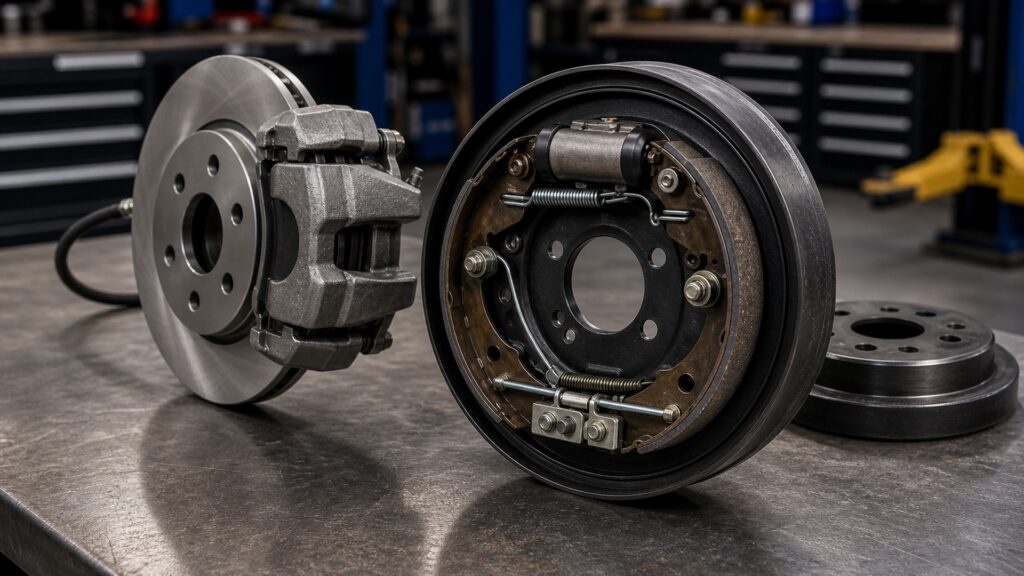
A practical explanation of brake drums instead of brake calipers for brake-component comparison and service decisions.
Tip: Read the concept as part of a system, then connect it back to the use case.
These definitions connect the main idea to the variables, limits, and practical signals readers need to compare options.
The complete axle-side setup built for drum shells and shoes.
The way drums often integrate mechanical holding parts.
The lower braking workload often handled by rear brakes.
The bracket and knuckle features needed for disc hardware.
The work required to change from drums to discs.
The cost and parts-availability side of staying with drums.
Tip: Keep the definitions connected; the strongest answer usually comes from the whole system, not one term.
A drum should be used when the axle and brake package were designed for drum operation.
The vehicle architecture comes before preference.
Many rear drums integrate the parking brake naturally inside the assembly.
Parking-brake packaging is a real drum advantage.
Rear drums can be practical when rear braking load is moderate and service cost matters.
A modest duty cycle can favor keeping drums.
Repeated heat, towing, performance use, or easier inspection can favor disc hardware if the vehicle supports it.
Drums make sense until the use case or architecture says otherwise.
A drum repair should not become a disc conversion unless the whole system is planned.
Use the brake type the vehicle can actually support.
Drums make sense when the vehicle package, parking brake, and duty cycle support them.
It explains why rear drums remain common in some designs.
It prevents treating calipers as a simple substitute.
Heavy repeated braking can favor disc designs.
Drums require internal inspection and careful hardware service.
Common shortcuts and misunderstandings can make the topic seem simpler than it is.
They remain practical on many rear axles.
A disc setup needs rotors, brackets, hoses, parking-brake solutions, and clearance.
Condition and system design matter more than the label.
Neglected drums can still require shells, shoes, hardware, and cylinders.
Tip: Treat strong claims as starting points for comparison, not final answers.
Concise answers to common questions readers may have after the main explanation.
When the vehicle is designed for rear drums and the repair does not involve a complete compatible disc conversion.
They often package mechanical parking-brake functions simply.
Many do when correctly sized and maintained.
Conversion can affect mounting, hydraulics, parking brake, ABS behavior, and wheel clearance.
Only inspection can decide among drums, shoes, hardware, wheel cylinders, and cables.
Use brake drums when the vehicle's brake package is designed around drum hardware.
The practical takeaway is to treat drum-versus-caliper as an architecture decision, not a popularity contest.
Use these Review Streets paths to connect the explainer to related categories, comparisons, and next decisions.
Explore related Review Streets coverage in Automotive Replacement Parts.
Explore related Review Streets coverage in Brake Components.
Explore related Review Streets coverage in Brake Drums.
Compare brake caliper fitment and operating context.
Choose a retailer
Prices checked regularly. We may earn a commission at no cost to you.