
Friction Face
The main working surface or detail in brake rotors.
- Role: Sets the primary service clue
- Check: Compare condition with the installed system
- Limit: Cannot explain every symptom alone
When to Use Brake Rotors Instead of Brake Drums is about reading brake rotors by their real job in the disc-brake corner. The useful question is not just what the part is called, but how knowing when the failed role is brake rotors rather than brake drums changes fit, performance, and repair scope.
This explainer connects friction face, thermal mass, hat offset, hub seating, runout, and pad transfer to practical buying and service decisions. It also separates normal wear from clues that point to hydraulic clamp faults or drum-brake architecture.
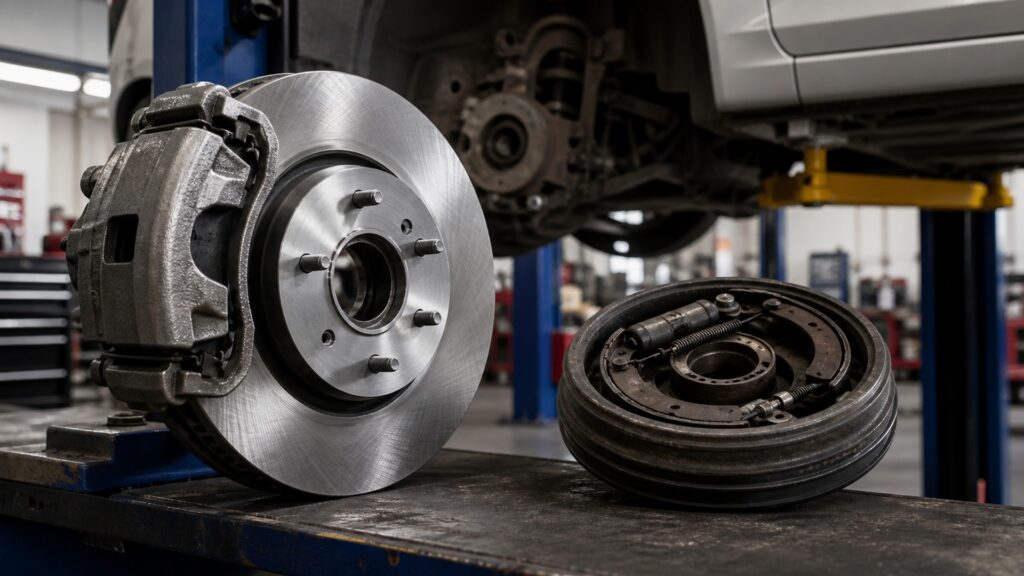
A clear explanation of brake rotors, focused on knowing when the failed role is brake rotors rather than brake drums, common failure clues, and category-specific tradeoffs.
Tip: Read the concept as part of a system, then connect it back to the use case.
These definitions connect the main idea to the variables, limits, and practical signals readers need to compare options.
The main working surface or detail in brake rotors.
A supporting detail that changes how brake rotors behave under normal use.
The fitment detail that helps decide whether the part belongs in this application.
The installed interface where the part meets the vehicle system.
A diagnostic clue that often separates normal wear from a repair problem.
The final condition clue before deciding repair scope.
Tip: Keep the definitions connected; the strongest answer usually comes from the whole system, not one term.
Brake Rotors Instead of Brake Drums makes sense when the part is followed through the whole disc-brake corner. The part only works when its surface, media, mounting point, and surrounding hardware all support the intended flow or contact.
The correct decision follows the failed function, not just the broad part category.
Friction Face matters because it is where the part performs its main job. Damage, restriction, mismatch, or poor contact here can change the result even when the replacement category sounds correct.
The visible clue should be tied back to the real mechanism.
Repair scope changes when the evidence points away from brake rotors and toward another system. That is why the comparison with hydraulic clamp faults or drum-brake architecture matters before buying parts.
A narrow repair is useful only when it matches the failed role.
Real use changes how brake rotors age and behave. Heat, moisture, dust, debris, vibration, service history, and installation quality can all change the clues a buyer sees.
Condition matters because the same part can age differently in different vehicles.
A practical check starts with the exact vehicle application, then compares the old part, the housing or mounting point, and the symptom that triggered replacement.
The best replacement decision is specific to the system, not just the part name.
A practical balance: what brake rotors instead of brake drums clarifies, and where the idea needs surrounding-system context.
It explains why friction face, hat offset, and hub seating matter before treating brake rotors as a generic replacement.
It helps connect visible clues such as scoring, heat checks, and thickness variation to real service decisions.
It cannot diagnose hydraulic clamp faults or drum-brake architecture without inspection of the adjacent system and installation details.
A better decision uses fitment, condition, vehicle-specific layout, and the original symptom together.
Common shortcuts and misunderstandings can make the topic seem simpler than it is.
The label matters, but the decision depends on the part's role in the disc-brake corner. Fit, condition, mounting, and surrounding evidence decide whether replacement solves the problem or simply changes a visible component.
Visual similarity is not enough. Hat Offset, hub seating, sealing surfaces, channels, and vehicle-specific dimensions can differ enough to cause leaks, bypass, contact problems, or repeated service symptoms after installation.
A new part helps only when the old part caused the complaint. If rust ridges, hub debris, or adjacent-system faults remain, the same symptom can return even with a clean replacement installed.
Service timing changes with dust, moisture, heat, driving pattern, storage, and installation quality. The best clue is the part's condition in its housing, not a universal mileage number by itself.
Tip: Treat strong claims as starting points for comparison, not final answers.
Concise answers to common questions readers may have after the main explanation.
The main idea is to connect brake rotors to their actual system role, then read fitment and condition clues. That approach keeps the decision tied to evidence instead of a broad category name.
Hat Offset matters because it determines whether the replacement sits where the vehicle expects it. A mismatch can reduce sealing, contact, airflow, or clearance even when the part looks close.
Look for clues such as scoring, heat checks, thickness variation, poor fit, unusual noise, weak flow, vibration, or repeated service complaints. The exact symptom depends on the vehicle system involved.
Photos help identify the broad shape, but they cannot confirm hat offset, hub seating, material condition, or installed behavior. Use fitment data and compare the old part before deciding confidently.
Confirm the vehicle application, compare the old part, inspect the housing or mounting point, and note the original symptom. Then choose the replacement that matches the failed function and surrounding evidence.
Brake Rotors Instead of Brake Drums matters because brake rotors work as part of the disc-brake corner, not as isolated catalog objects.
The practical takeaway is to follow friction face, hat offset, hub seating, and scoring before choosing the next replacement path.
Use these Review Streets paths to connect the explainer to related categories, comparisons, and next decisions.
Explore related Review Streets coverage in Automotive Replacement Parts.
Explore related Review Streets coverage in Brake Components.
Explore related Review Streets coverage in Brake Rotors.
Compare related Brake Drums context.
Choose a retailer
Prices checked regularly. We may earn a commission at no cost to you.