
Fleet status
Fleet status identifies a vehicle within an organization’s managed transport resources.
- Example: a cargo van in a company vehicle inventory
- Check: who assigns and supports it
- Limit: fleet status is not a body style
A cargo van can be a fleet vehicle. Cargo van describes an enclosed body for goods or working equipment; fleet vehicle describes a vehicle managed by an organization. The practical decision is when an assignment needs a cargo van rather than another available vehicle, and whether that van should be dedicated to the work or shared.
Choose the van because its enclosed space, access, carrying limits, and fitted equipment support the job. A technician transporting a stocked working interior has different needs from an employee carrying a laptop to a meeting. Treating both as simply needing an available vehicle can create avoidable handling, capacity, or scheduling problems.
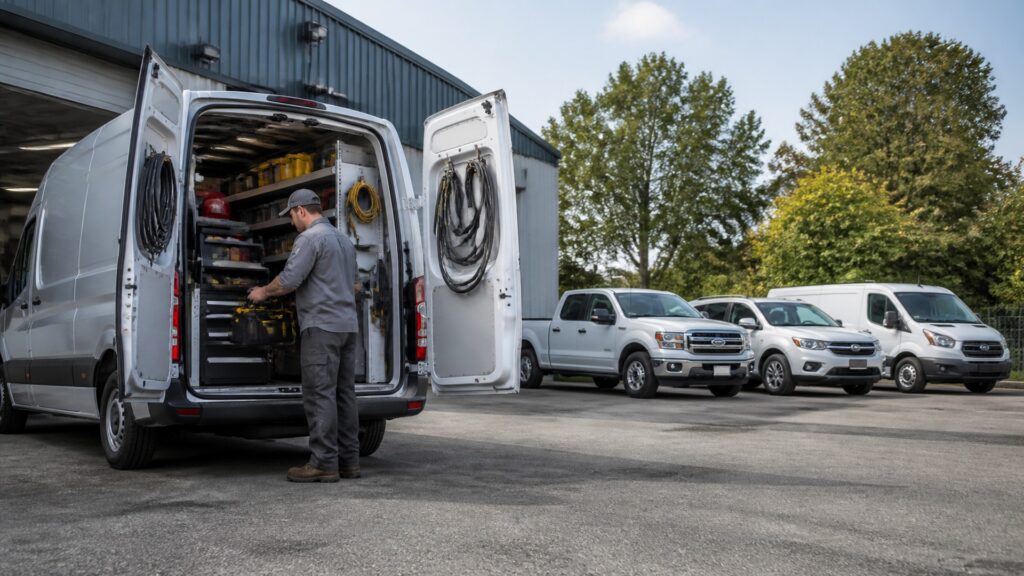
Connect the body and assignment without treating the categories as opposites.
Tip: Define the people, load, equipment, and timing before looking for an unbooked vehicle.
Separate physical capability from the way the organization provides it.
Fleet status identifies a vehicle within an organization’s managed transport resources.
A cargo mission is work requiring the transport or use of goods and equipment.
Dedicated equipment is fitted or stocked for a recurring task.
A pool vehicle is available for assignment to multiple authorized users.
Simultaneous demand is the need for suitable transport by multiple assignments at overlapping times.
A suitable substitute can meet the affected assignment’s relevant requirements.
Tip: The available vehicle must be suitable for the work, not merely absent from the booking calendar.
Fleet management supplies vehicles for different jobs. A cargo van may be one of those resources alongside cars, passenger vehicles, or trucks. The organization still needs assignment records, maintenance responsibility, and support for the cargo van. Choosing its body does not remove those obligations or create a separate unmanaged category.
The Department of Energy’s fleet overview includes different vehicle types and acquisition arrangements. Cargo design and fleet membership answer separate questions.
Reference: Department of Energy fleet overview.
Consider the load’s shape, mass, handling, and exposure requirements. A cargo van can provide enclosed space and useful rear or side access for tools and goods, subject to its actual configuration. Check the intended load path and relevant limits. A large item that will not pass through the doorway remains unsuitable even if its calculated volume is smaller than the compartment.
Ford’s loading guidance supports checking the completed vehicle and its ratings. Selecting a van body does not settle the weight assessment.
Reference: Ford vehicle loading guidance.
A van carrying a stable tool and parts arrangement may serve a recurring crew efficiently. Sharing it with unrelated work could require repeated unloading, checking, and restocking. Assess those tasks explicitly before deciding to pool it. Dedication should follow the need for capability and availability, not simply a preference for exclusive use.
For example, a mobile repair van may be a poor general-purpose pool vehicle if each parcel run displaces the parts needed for the next service call.
Sharing can work when users need compatible loads and do not require the van simultaneously. Review collection location, booking duration, return preparation, and responsibility for condition reports. A calendar with no visible overlap may still fail if one assignment routinely returns late or leaves the next user to rebuild the load arrangement.
DOE rightsizing guidance considers vehicle missions and use. Those observations can help distinguish a genuinely shareable resource from one whose low mileage hides a time-critical role.
Reference: Department of Energy fleet rightsizing.
A small load may fit a suitable car without requiring an entire cargo-van interior. A group journey may need a passenger vehicle, while a load exceeding the van’s relevant limits needs a different transport arrangement. Compare suitable candidates and their supported service, including availability during maintenance. Do not default to a cargo van for every trip simply because one is already owned.
The goal is to assign the capability the work requires. The best choice can vary from one assignment to another within the same fleet.
Both can be appropriate when supported by the assignment pattern.
Recurring specialist equipment that needs to stay ready.
Time-critical demand that conflicts with other users.
Compatible loads with manageable handover and reset tasks.
Nonoverlapping demand and a workable collection location.
Separate the body choice from the management arrangement.
The van can be one of the organization’s fleet vehicles.
Assess equipment, timing, location, and the actual need for exclusive availability.
Simultaneous demand and standby responsibilities also matter.
The substitute must support the actual people, load, equipment, and assignment.
Tip: Use real assignments and handover requirements to choose between dedication, pooling, and another vehicle type.
Answers for allocating enclosed cargo capability.
When its enclosed space, load access, capacity, and equipment suit the intended work.
Yes. Cargo body and propulsion are separate choices; assess the exact vehicle and its energy support.
When recurring equipment or availability requirements justify keeping it ready for that specific work.
Compatible loads, overlapping demand, location, turnaround, condition reporting, and support for delays.
When it better meets the people, load, route, or timing requirements, or when the cargo van’s capability is unnecessary or insufficient.
Use a cargo van within the fleet when enclosed cargo space and its working arrangement fit the assignment.
Choose dedication or sharing from equipment and timing needs, and keep suitable alternatives available for different work.
Use these Review Streets paths to compare related categories and practical next decisions.
Understand allocation and support responsibilities.
Assess the preparation and turnaround needed for sharing.
Review vehicle missions and use together.
Choose a retailer
Prices checked regularly. We may earn a commission at no cost to you.