
Fleet vehicle
A fleet vehicle is managed within an organization’s transport resources.
- Example: a car assigned through a shared vehicle pool
- Check: who assigns, maintains, and records its use
- Limit: fleet membership does not specify the body
A cargo van can be a fleet vehicle. Cargo van describes a body intended primarily to carry goods or equipment; fleet vehicle describes a vehicle managed as part of an organization’s transport resources. The practical choice is whether cargo vans should handle every assignment or whether a managed mix of vehicles would better match the work.
A repair crew carrying tools may need a fitted cargo van every day. An inspector traveling alone with a small case may have different needs, while a team traveling together needs suitable passenger accommodation. Fleet planning connects those assignments to appropriate vehicles instead of making one body type the default for all of them.
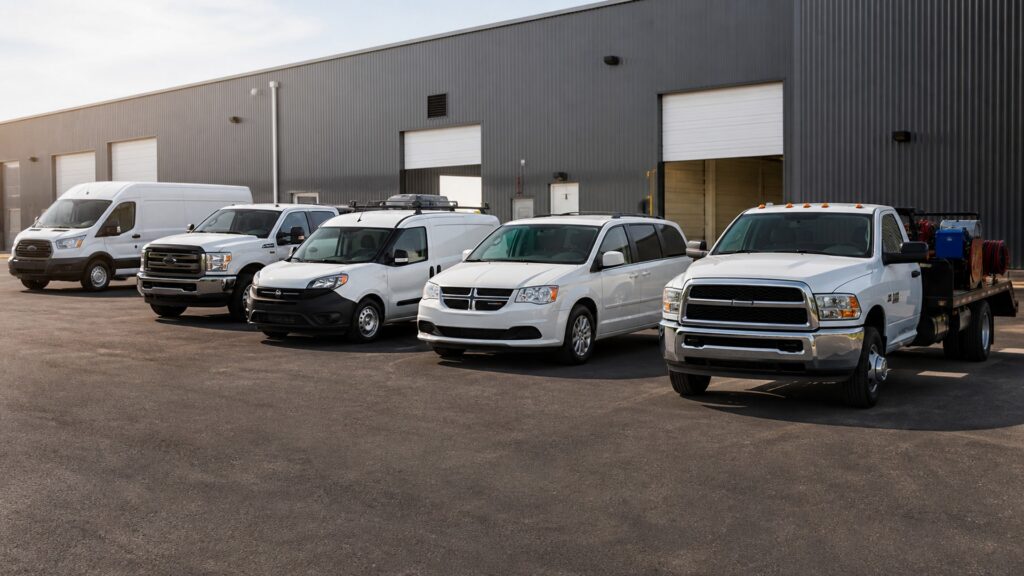
Decide where cargo vans belong within the wider transport plan.
Tip: Write down the people, load, route, equipment, and frequency for each assignment before comparing vehicles.
These concepts separate the work from the vehicle selected to do it.
A fleet vehicle is managed within an organization’s transport resources.
A cargo van provides an enclosed area primarily for goods or working equipment.
A vehicle mission is the work the vehicle must support.
Utilization measures how a vehicle is used over a defined period.
A vehicle pool makes suitable vehicles available to multiple authorized users.
Whole-use cost considers acquisition or lease and the expenses of supporting the vehicle’s work.
Tip: Keep capability and availability visible alongside cost. An inexpensive vehicle that cannot do the assignment is not a useful substitute.
A mobile technician may need organized shelves, secured tools, parts, and frequent access to equipment. A cargo van can provide a consistent working arrangement that a small passenger car cannot reproduce. Assess the installed equipment and carried load together. Repeatedly unpacking a specialist van to share it with an unrelated team may consume time and introduce missing-equipment problems.
A dedicated cargo van can remain the best fleet choice when its space and equipment serve recurring work.
A group journey starts with designated seats, suitable restraints, and room for belongings. Available floor space in a cargo area is not a substitute for those features. If an organization regularly transports a team, it should assess a suitable passenger vehicle as part of the fleet. Compare boarding, luggage, route clearance, and the occupied load rather than simply counting how many bodies a large van appears able to hold.
For example, a training-day shuttle and a tool-delivery run need different interiors even when both visit the same building.
A site inspector with a laptop and a small case may not need a large cargo compartment. A suitably sized car or other vehicle could satisfy that assignment, subject to route, access, and equipment needs. This is a planning question rather than a claim that one vehicle always costs less. Compare real candidates and include exceptional trips that may need a different arrangement.
The Department of Energy’s rightsizing guidance recommends assessing fleet composition against vehicle missions and actual use.
Reference: Department of Energy vehicle rightsizing.
Sharing vehicles can be useful when assignments occur at different times and suitable vehicles are easy to collect. It becomes less attractive when teams need the same vehicle simultaneously or must travel a long way to retrieve it. An occasional rental may cover a rare group trip, but the booking, pickup, approved driver, and equipment arrangements need to be realistic.
A pool with no spare capacity during its busiest hour can be less useful than its annual mileage figures suggest.
List the trips, people, loads, and equipment for an ordinary busy week. Assign candidate vehicles to those trips and identify conflicts or capability gaps. Then compare the supported service and associated costs. A mixed fleet may solve recurring mismatches; a largely uniform cargo-van fleet may be sensible where the work itself is uniform.
The decision should explain which job each vehicle supports and how the organization will cover exceptions.
One provides physical capability; the other organizes suitable resources.
Enclosed storage, load access, and installed working equipment.
A specific vehicle’s capacity for a specific assignment.
Allocation of different vehicles across people, loads, and schedules.
Maintenance cover, availability, and records across the organization.
Avoid treating a management category as a competing body style.
Cargo vans can remain a central part of the fleet.
Common vehicles may simplify support, but missions can require different capabilities.
Consider standby duties, location, timing, and the consequences of unavailability.
Include support, equipment, use, and downtime over a comparable period.
Tip: A uniform fleet is useful when the work supports it; uniformity alone is not a reason to ignore a mismatch.
Answers for organizations reviewing their vehicle mix.
Yes. Fleet refers to managed vehicles; it does not require a mix of body types.
When recurring equipment, load, or availability needs justify keeping that vehicle assigned.
When the assignment needs only suitable passenger space and a small load, and booking and collection are practical.
Evaluate how often it occurs and whether a reliable suitable alternative can cover it.
Confirm the replacement can handle the mission, the schedule, and any necessary equipment, then compare supported costs.
Use fleet planning to assign cargo vans where their enclosed working space is needed and other vehicles where the mission differs.
The useful comparison is between workable transport arrangements for real assignments.
Use these Review Streets paths to compare related categories and practical next decisions.
Separate managed use from physical design.
Plan servicing and replacement transport.
Review the Department of Energy’s planning guidance.
Choose a retailer
Prices checked regularly. We may earn a commission at no cost to you.