
Intensive Rinse-Off
A larger conditioning step designed for directed contact and removal.
- Use: raise wash-day slip
- Variable: formula and amount
- Tradeoff: May add time and weight
Use a hair mask instead of a leave-in conditioner when the lengths need more wash-day slip or conditioning than the regular rinse-out step provides, but leaving a similarly rich amount on the hair would create weight, residue, or styling conflict. This often follows chemical processing, unusual tangling, weather exposure, or a deliberately intensive wash day.
The choice is not simply severe damage equals mask. A leave-in is often better when detangling continues after the shower, daily control is needed, or hair benefits from a small persistent film. Choose a mask when contact time and rinsing solve a defined problem, then reassess the dried result. The exact formula, not the format name, determines richness and repair claims.
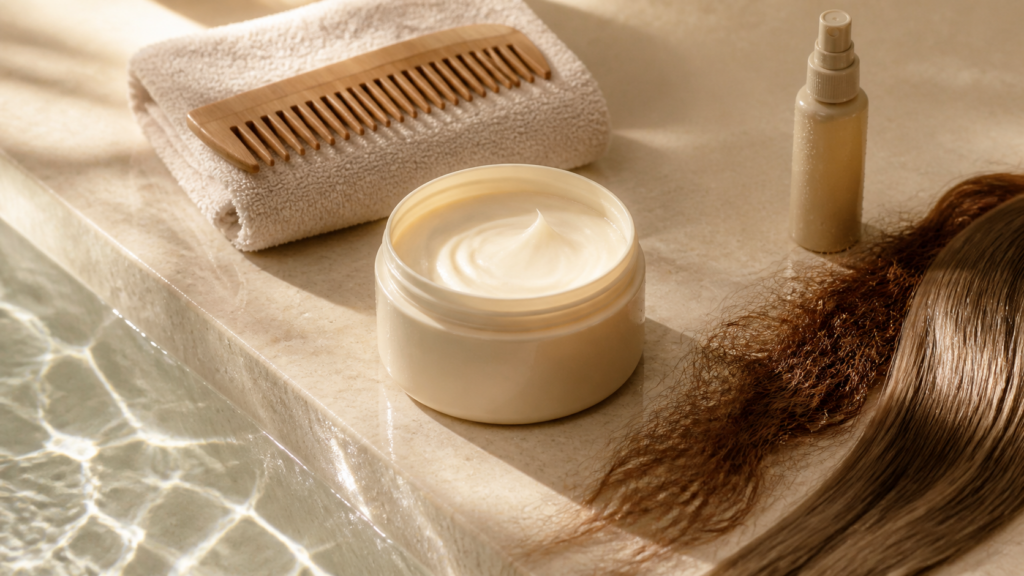
Make a mask the situational choice for a larger controlled rinse-off deposit when ordinary conditioning is insufficient and persistent leave-on weight would be counterproductive.
Tip: Treat the observed handling change, not the drama of the event.
These when to choose hair masks concepts separate formula behavior, application choices, limits, and purchasing consequences before the mechanisms are compared.
A larger conditioning step designed for directed contact and removal.
Conditioning that remains through detangling, drying, and styling.
A recent chemical, thermal, environmental, or mechanical exposure that changes handling.
The ability to remove excess while retaining enough deposited conditioning.
Loss of volume, hold, definition, or drying behavior from overlapping films.
Evaluation of wet handling, dry result, and next-wash residue after the treatment.
Tip: Use the terms to test when to choose hair masks rather than relying on a front-label promise.
Bleaching, coloring, prolonged sun, swimming, or repeated heat may leave lengths unusually rough. When the service provider and product directions permit, a mask can deliver concentrated wash-day conditioning without becoming a permanent styling layer.
Treat the observed handling change, not the drama of the event.
If ordinary conditioner does not provide enough slip, a mask can reduce combing force before the hair leaves the shower. Work gently, add water as needed, and do not use product richness to justify pulling through knots.
The mask should reduce force, not merely make detangling feel luxurious.
Fine, low-density, or volume-focused hair may benefit from a rinseable treatment more than a heavy leave-in. Apply away from roots, rinse thoroughly, and assess movement after full drying before rejecting masks as too rich.
Rinsing creates dose control that a persistent film cannot provide.
If the main problem appears during post-shower combing, air-drying, curl styling, or an explicitly supported heat step, a small leave-in may be more relevant. A mask's retained effect may not supply that continuing function.
The timing of the need determines the format.
After a helpful use, extend the interval until the benefit fades rather than repeating automatically. Compare detangling, softness, volume, breakage during handling, and cleansing burden to find the least frequent useful schedule.
Frequency should be earned by response, not printed by influencers.
Choose it when a larger rinse-off treatment addresses a wash-day problem and removing excess is part of the benefit.
Lengths are unusually rough or tangled after a defined exposure and ordinary conditioning is insufficient.
A richer step helps before rinsing, while persistent leave-on weight would interfere with styling.
Support is mainly needed during post-shower detangling, styling, static control, or directed heat protection.
The mask adds time and residue without improving a measured handling outcome.
These when to choose hair masks claims collapse several variables into one rule and can lead to poor application or unnecessary purchases.
A mask may support dry, long, coarse, curly, weather-exposed, or tangle-prone lengths without severe damage. The decision follows the missing conditioning job and the formula's response, not a damage label.
Fine hair may tolerate a light formula, small dose, end-focused placement, and thorough rinse. It should avoid unnecessary weight, but strand diameter alone cannot rule out every rinse-off treatment.
Some masks are designed for regular use, while others suit occasional intervals. Replacing the daily conditioner can increase cost, time, and residue without added benefit; follow directions and compare outcomes.
Performance does not necessarily increase after the directed interval. Extended exposure can add inconvenience, skin contact, swelling, or residue; comply with the product's timing instead of turning contact into a contest.
Leave-ins are designed around a smaller dose that remains during drying and styling. Their ongoing detangling, static, curl, or heat-support role is different, not simply weaker than a rinse-off treatment.
Tip: Test the exact when to choose hair masks product, dose, and routine before generalizing from a category label.
The remaining when to choose hair masks decisions concern application, compatibility, frequency, safety, and value in an ordinary routine.
It may help rough or tangled lengths after chlorine, salt, sun, and friction, but first rinse and cleanse appropriately. Follow product directions and consider swim caps and pre-swim protection to reduce repeated exposure.
Yes when compatible with the color service and timing guidance. Choose a formula intended for color-treated hair, avoid irritated scalp, and remember that water, heat, sunlight, and washing also influence fading.
Only if the product directs scalp use. Most rich conditioning masks are better concentrated on lengths and ends; scalp application can add residue or irritation without solving the intended fiber problem.
Use enough to coat the target sections thinly and evenly rather than saturating until product drips. Amount depends on length, density, texture, and formula; more does not prove better coverage.
Yes. A mask may cover an occasional wash-day need while a leave-in supports selected styling days. Track each separately so their intervals and doses reflect results rather than a fixed product calendar.
Persistent limpness, dull coating, difficult rinsing, reduced curl response, stiffness, or more frequent cleansing can indicate excess or incompatibility. Simplify the stack and extend the interval before adding corrective products.
Use a hair mask instead of a leave-in when a larger, timed conditioning step improves wet handling and rinsing away excess is desirable. The decision should follow a specific wash-day bottleneck, not a generic damage hierarchy.
Use leave-in when the needed function occurs after rinsing. Whichever format wins, keep the smallest effective dose and interval, protect root volume, and judge the fully dried hair plus the next wash.
These Review Streets paths narrow the next when to choose hair masks choice by format, goal, and routine fit.
Compare masks, oils, serums, and bond-focused formulas by goal and format.
Explore intensive conditioning options for slip, softness, damage, and moisture needs.
Choose a retailer
Prices checked regularly. We may earn a commission at no cost to you.