
When to Use Health Monitoring Devices Instead of Traditional Tracking Methods

A sensor can collect repeated measurements with little active effort, producing timestamps, trends, and sometimes alerts. A paper journal or manual log records fewer points but can capture symptoms, meals, circumstances, and observations that a device cannot sense.

The better method answers a defined question with acceptable burden and uncertainty. Automated data helps when frequency or timing matters. Traditional tracking often wins when context, simplicity, flexibility, privacy, or deliberate reflection is the priority.

By: Review Streets Research Lab
Updated: August 13, 2026
Explainer · 8-12 min read
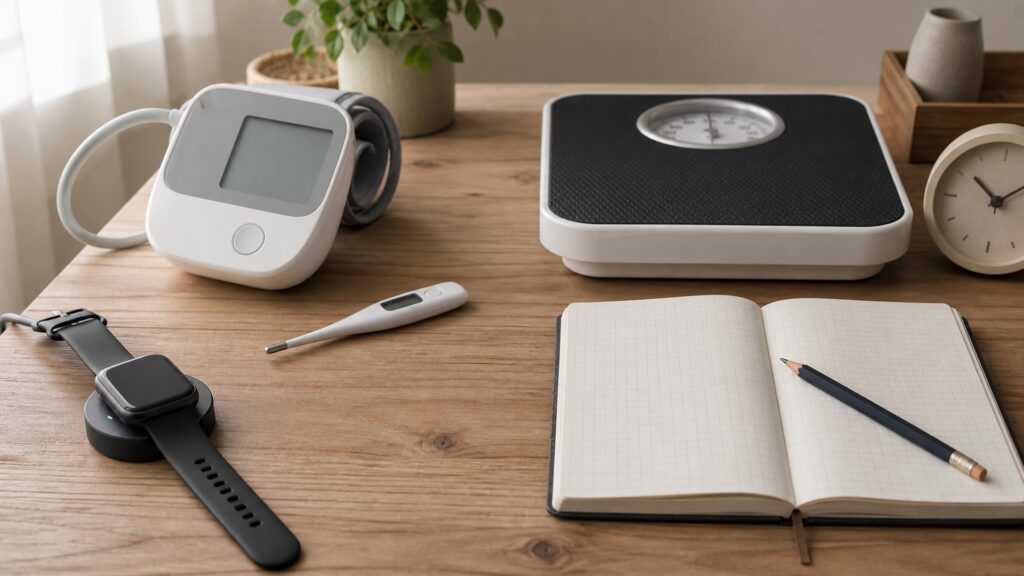
Unbranded health monitoring devices arranged beside a blank grid notebook and pencil for manual tracking
What You'll Learn

The System Behind Health Monitoring Devices

A practical guide to the mechanism, decision variables, and limitations that shape the result for Health Monitoring Devices.

  • The defining purpose and boundary of Health Monitoring Devices
  • How inputs travel through the working pathway
  • Which variable changes performance
  • Why placement, timing, and maintenance matter
  • What Health Monitoring Devices cannot establish
  • How to match the tool to the problem

Tip: Read the concept as part of a system, then connect it back to the use case.

Definitions

Key Concepts That Define Health Monitoring Devices

These definitions connect the main idea to the variables, limits, and practical signals readers need to compare options.

Sampling Rate

How often a device captures or estimates a signal

  • Role of Sampling Rate: Controls detail, battery, and volume
  • Decision for Sampling Rate: compare conditions only when this sampling rate is relevant
  • Boundary for Sampling Rate: other mechanisms and outcomes require separate evidence beyond this definition

Sensor

A component that converts a signal into data

  • Role of Sensor: Creates the measurement input
  • Decision for Sensor: compare conditions only when this sensor is relevant
  • Boundary for Sensor: other mechanisms and outcomes require separate evidence beyond this definition

Baseline Trend

A repeated pattern used to interpret change

  • Role of Baseline Trend: Adds context to deviations
  • Decision for Baseline Trend: compare conditions only when this baseline trend is relevant
  • Boundary for Baseline Trend: other mechanisms and outcomes require separate evidence beyond this definition

Artifact

A distorted reading from motion, placement, or processing

  • Role of Artifact: Can resemble a real event
  • Decision for Artifact: compare conditions only when this artifact is relevant
  • Boundary for Artifact: other mechanisms and outcomes require separate evidence beyond this definition

Manual Log

A user-entered record of measurements or observations

  • Role of Manual Log: Captures context sensors miss
  • Decision for Manual Log: compare conditions only when this manual log is relevant
  • Boundary for Manual Log: other mechanisms and outcomes require separate evidence beyond this definition

Action Threshold

A predefined result that prompts a response

  • Role of Action Threshold: Prevents purposeless collection
  • Decision for Action Threshold: compare conditions only when this action threshold is relevant
  • Boundary for Action Threshold: other mechanisms and outcomes require separate evidence beyond this definition

Tip: Keep the definitions connected; the strongest answer usually comes from the whole system, not one term.

Working Path

How the Input Becomes an Output

A monitor samples automatically; traditional tracking depends on deliberate entries that can combine numbers with context.

  • Define the signal
  • Choose the interval
  • Record circumstances

Collection should follow the decision.

Active Mechanism

What Creates the Useful Change

Sensors translate motion, light, pressure, electrical activity, or chemistry into software estimates.

  • Algorithms infer outcomes
  • Placement changes quality
  • Firmware may change interpretation

A dashboard does not remove estimation.

Key Variable

What Most Changes the Result

Devices help when changes between manual checks matter or frequent logging would fail.

  • Use meaningful alerts
  • Match frequency to the event
  • Avoid unused metrics

More data helps only when it changes a decision.

Real Conditions

Where Performance Can Drift

Motion, contact, battery, calibration, missingness, and biological variation can create misleading patterns.

  • Check outliers
  • Compare consistently
  • Keep contextual notes

Trends still need quality control.

Decision Fit

When the Approach Makes Sense

Automatic and manual methods can complement each other: timing from the device, explanation from a journal.

  • Combine focused sources
  • Protect data
  • Set a stopping point

A hybrid can outperform either method alone.

Quick Reality Check

Health Monitoring Devices: Capabilities and Limits

Separate the direct function of Health Monitoring Devices from broader conclusions that its working pathway cannot establish alone.

Where It Helps

Automated monitoring can reveal frequency, timing, and gradual change that occasional recall misses.

Manual records capture meaning, triggers, symptoms, and exceptions with low cost and transparent logic.

Where It Stops

Consumer sensors may estimate rather than directly measure an outcome and generally do not diagnose.

Tracking can create anxiety, false reassurance, or overload when no response plan exists.

Common Myths

Misconceptions About Health Monitoring Devices

Common shortcuts and misunderstandings can make the topic seem simpler than it is.

More health data always produces better decisions

Extra measurements can expose trends, but they can also add noise, false alerts, anxiety, and conflicting signals. Data becomes useful only when its quality is adequate and a defined decision changes in response.

A wearable is always more objective than a journal

Sensors reduce some recall bias, yet estimates depend on placement, motion, calibration, algorithms, and missing data. Journals capture subjective experience and context that may be essential for interpreting the pattern.

Manual tracking is too old-fashioned to be accurate

A validated cuff, thermometer, scale, or structured log can answer focused questions reliably when used correctly. Automation improves convenience and frequency, but not automatically the underlying measurement. Evidence should match the stated purpose.

A normal device reading rules out a health problem

Consumer monitors measure selected signals within operating limits and can miss events or relevant symptoms. A reassuring number cannot exclude every concern, especially when symptoms persist or positioning is poor.

Tip: Treat strong claims as starting points for comparison, not final answers.

FAQ

Frequently Asked Questions About Health Monitoring Devices

Concise answers to common questions readers may have after the main explanation.

When is continuous monitoring worth considering?

It is useful when timing, frequency, overnight patterns, intermittent events, or response to a routine matters and manual checks would miss them. The device still needs adequate accuracy and a clear action plan.

When is a journal better than a device?

Choose a journal when symptoms, meals, triggers, mood, decisions, or unusual circumstances are central, or when low cost and privacy matter. Manual records are also easier to customize around one question.

How should I compare a device with a manual measurement?

Use both under consistent conditions, follow each method's instructions, and compare repeated patterns rather than one pair of values. Persistent differences may warrant checking placement, calibration, or qualified guidance. Context and product instructions still matter.

Can monitoring become counterproductive?

Frequent checking can increase anxiety, interrupt sleep, encourage overreaction to normal variation, or distract from meaningful behavior. Set a purpose, review schedule, action thresholds, and stopping point before collecting data.

Bottom Line

Use a monitor when automatic frequency, timing, or alerts improve the answer; use manual tracking when context and simplicity matter more.

Define the question, control known errors, protect sensitive information, and decide in advance what result will prompt action.

Next Steps

Go Deeper or Compare Your Options

Use these Review Streets paths to connect the explainer to related categories, comparisons, and next decisions.

Why Preventive Health Matters

Preventive health combines everyday risk reduction, appropriate screening, protective measures, and timely follow-up.

Quick Summary

Health Monitoring Devices Explained

  • Health Monitoring Devices has a specific working pathway.
  • The active mechanism matters more than feature count.
  • Settings and conditions shape the output.
  • Real-world error and maintenance deserve attention.
  • The right option follows the actual problem.