
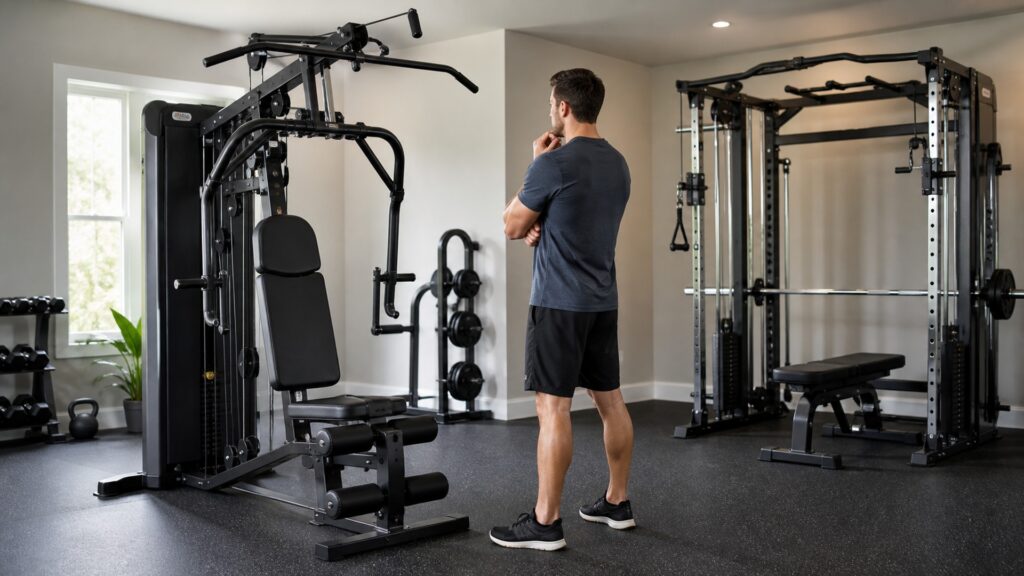
When to Use Home Gym Systems Instead of Cable Machines

Use home gym systems instead of cable machines when the workout needs broader station coverage rather than cable-focused resistance. A home gym system can combine press arms, pulldowns, rows, leg stations, benches, and other built-in exercise areas in one setup.

A cable machine is better when the main need is adjustable pulley resistance from different angles. A home gym system is better when the user wants a more complete all-in-one strength station and is willing to accept some limits in cable flexibility.

By: Review Streets Research Lab
Updated: September 25, 2026
Explainer · 8-12 min read
home gym systems explainer hero image for Review Streets
What You'll Learn

When A Home Gym System Is The Better Fit

A practical way to choose broader station coverage over cable-focused training.

  • When built-in stations matter more than cable angles
  • Why home gym systems can simplify full-body sessions
  • Where cable machines still win for adjustable resistance
  • How space and station comfort change the choice
  • What to check before buying the broader setup

Tip: Start with the exercises that define the routine. Equipment value comes from supporting those movements safely and repeatedly.

Definitions

Key Concepts Behind Home Gym Systems Instead of Cable Machines

These concepts clarify the practical differences between home strength setups.

Home Gym System

A home gym system combines several training stations or functions into one home setup.

  • Example: a multi-gym with press arms, pulldown, row, and leg station
  • Check: review which stations will be used weekly
  • Limit: some stations may be less flexible than dedicated equipment

Cable Machine

A cable machine uses pulleys, cables, and attachments to create adjustable resistance angles.

  • Example: a functional trainer used for rows, curls, pressdowns, and core work
  • Check: test pulley height and cable smoothness
  • Limit: it may not include broader stations

Station Coverage

Station coverage is the range of built-in exercise areas a system provides.

  • Example: press, pull, leg, and cable stations in one frame
  • Check: separate useful stations from unused extras
  • Limit: more stations can add bulk

Cable Flexibility

Cable flexibility is the ability to change pulley angle, attachment, and body position for different exercises.

  • Example: moving from high pressdowns to low cable rows
  • Check: compare the cable work the user actually needs
  • Limit: broader systems may offer fewer cable positions

Full-Body Convenience

Full-body convenience is the ability to train several movement types in one setup without assembling separate stations.

  • Example: moving from chest press to pulldown to leg extension
  • Check: walk through a normal workout
  • Limit: convenience is useful only if the stations fit

Routine Fit

Routine fit is how well the equipment matches the user's repeated workouts.

  • Example: choosing the system because most sessions use its built-in stations
  • Check: map weekly exercises to the machine
  • Limit: goals can outgrow the system

Tip: The better choice is the one that supports the user's repeated workouts with the clearest setup and fewest compromises.

Best Fit

Choose The System When You Need More Than Cables

A home gym system makes sense when the user wants several built-in stations rather than one cable-focused tool. It can reduce the need to buy separate pieces.

  • Check press, pull, and leg stations.
  • Review comfort and adjustment at each station.
  • Avoid paying for stations that will sit unused.

The system wins when its broader coverage matches the routine.

Cable Advantage

Use Cable Machines When Angles Are The Point

Cable machines are stronger when the workout depends on adjustable lines of pull, attachment variety, and accessory movements from several angles.

  • Choose cables for rows, pressdowns, flyes, and rotations.
  • Check pulley range and frame clearance.
  • Use a cable machine when cable work is the main need.

Cable flexibility is valuable when angle changes drive the workout.

Convenience

All-In-One Stations Can Simplify Training

Some users train more consistently when the machine provides clear station choices. A home gym system can make a simple full-body routine easier to start.

  • Walk through a complete session.
  • Check load changes and seat settings.
  • Keep common transitions simple.

Convenience matters when it leads to repeated use.

Tradeoff

Broader Coverage Can Reduce Flexibility

A home gym system may cover more categories while giving less freedom within each one. Fixed arms, station paths, and limited cable positions can shape the movement.

  • Test key movements before buying.
  • Check whether station paths fit the user.
  • Compare broad coverage with movement quality.

More coverage should not come at the cost of awkward exercise quality.

Decision

Choose The Tool That Solves The Bigger Gap

If the user lacks several training stations, the home gym system may be the better purchase. If the user mainly lacks adjustable cable resistance, the cable machine is cleaner.

  • List missing exercises.
  • Match each gap to the equipment's strength.
  • Choose the simpler option that covers the weekly plan.

The right choice follows the missing training function.

Quick Reality Check

Where Home Gym Systems Beat Cable Machines And Where They Do Not

The choice depends on broad station coverage versus cable flexibility.

Home Gym Systems Win When

The user wants several built-in stations in one setup.

Full-body convenience matters more than adjustable cable angles.

Cable Machines Win When

The routine depends on pulley height, cable angle, and attachment-based movements.

The user already has other equipment and needs cable capability.

Common Myths

Misconceptions About Home Gym Systems Versus Cable Machines

A broader setup is not automatically the better setup.

Home gym systems always do more

They do more only when their stations match the routine.

Cable machines are only accessories

Cable machines can be central when cable work is the program's main need.

All-in-one means no compromises

All-in-one designs still have station paths, load limits, and space needs.

More stations mean better value

Unused stations add bulk without improving training.

Tip: Judge equipment by the workout it makes more repeatable, not by how complete it sounds.

FAQ

Frequently Asked Questions About Home Gym Systems And Cable Machines

Short answers for comparing home gym equipment.

When should I choose a home gym system?

Choose it when several built-in stations will be used regularly.

When is a cable machine better?

Choose the cable machine when adjustable cable resistance is the main need.

Can a home gym system replace a cable machine?

Sometimes, if its cable station is good enough for the user's routine.

Which is better for full-body training?

A home gym system may be better when its stations cover the full routine comfortably.

What is the practical takeaway?

Choose home gym systems for broad station coverage and cable machines for adjustable cable work.

Bottom Line

Home gym systems make more sense than cable machines when broader built-in station coverage is the main need.

Cable machines remain better when adjustable pulley resistance and angle-based accessory work define the routine.

Next Steps

Go Deeper or Compare Your Options

Use these Review Streets paths to compare related categories and practical next decisions.

Cable Machines

Compare cable-focused equipment with broader home gym systems.