
Offset Load
An offset load places the weight away from the hand, changing balance and timing.
- Example: a bell hanging below the handle during a swing
- Check: use it when the offset helps the exercise
- Limit: it can make some lifts harder to learn
Use kettlebells instead of barbells when the workout needs compact equipment, offset loading, swings, loaded carries, or conditioning work that does not require a rack and plates. Kettlebells can fit small spaces and provide useful movement options with less setup.
Barbells still make more sense when the goal is heavy standardized loading, especially for squats, deadlifts, bench presses, and overhead presses. The better choice depends on whether the session needs maximum load or kettlebell-specific movement.
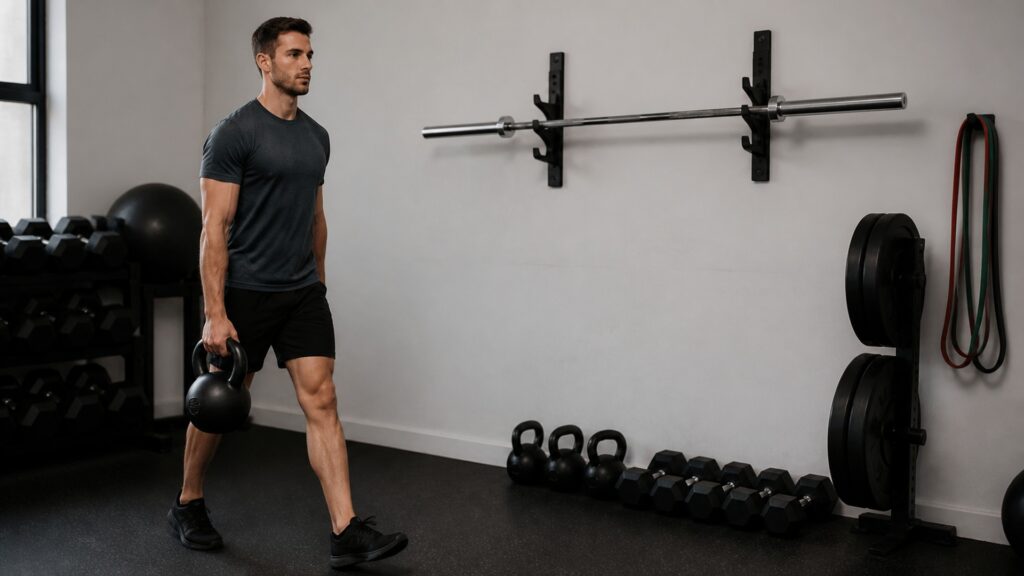
A practical decision path for choosing kettlebells over barbells for compact training, carries, swings, and conditioning.
Tip: Choose kettlebells when movement quality and setup simplicity matter more than maximum load.
These concepts explain when compact offset loading beats long-bar loading.
An offset load places the weight away from the hand, changing balance and timing.
A ballistic movement uses controlled momentum instead of only slow lifting.
Grip security is how reliably the hand controls the handle during work.
Rack position holds the bell near the forearm and torso for squats, presses, and carries.
Load jump is the increase between available kettlebell weights.
Training role is the job the kettlebell has in the workout.
Tip: The right training tool is the one whose resistance and setup match the exercise goal.
Kettlebells need less infrastructure than a barbell, plates, rack, and bench. That makes them useful in apartments, garages, and small training areas.
Lower setup friction can make training more consistent.
Swings, cleans, snatches, and carries use the kettlebell's handle and offset mass. A barbell does not copy those movements well.
Kettlebells win when the shape drives the exercise.
A kettlebell can support demanding circuits without changing plates or stations. That is useful when the goal is work capacity and repeatable movement.
Conditioning is a natural kettlebell role.
Barbells are better for maximum strength progression because they are easier to load heavily and incrementally.
Heavy standardized loading is still the barbell's strength.
The choice is not permanent. A user might choose barbells for heavy lifts and kettlebells for carries, warmups, hinge power, or conditioning.
The right tool depends on the job.
The choice depends on space, load ceiling, and exercise role.
The workout needs compact setup, swings, carries, or conditioning.
Offset loading adds useful grip and trunk-control work.
The workout needs heavy standardized loading.
The user has the rack, plates, space, and safety setup.
The smaller tool is not automatically easier, and the bigger tool is not always better.
They can support strength, carries, and power work.
Barbells are better for heavy loading, not every goal.
They still require grip, timing, and space.
Many programs use both for different jobs.
Tip: Choose the tool that fits the session instead of the one that seems more serious.
Short answers for practical training and equipment decisions.
Choose kettlebells for compact training, swings, carries, conditioning, and offset-load work.
Barbells are better for heavy standardized strength lifts and small load increases.
Yes, when the load and exercise selection fit the goal.
They often fit small spaces better, but heavy strength goals may still need barbells.
Use kettlebells for compact offset movement; use barbells for heavy standardized loading.
Kettlebells are better than barbells when the workout needs compact setup, offset loading, swings, carries, or conditioning.
Barbells remain better when heavy standardized strength progression is the main goal.
Use these Review Streets paths to compare related categories and practical next decisions.
Review the core kettlebell design and training setup.
Explore the kettlebells category.
Compare related strength-training tools.
Choose a retailer
Prices checked regularly. We may earn a commission at no cost to you.