
When to Use Midsize SUVs Instead of Electric SUVs

A gasoline or conventional-hybrid midsize SUV can be the more practical choice when dependable charging is unavailable, frequent journeys leave little flexibility for charging stops, or the electric models you are considering do not meet your seating, cargo, or towing needs. The reason to choose it should be a specific mismatch between an electric vehicle and your routine.

Midsize describes vehicle size; electric describes the powertrain. An SUV can be both. The meaningful choice is therefore between similarly suitable gasoline, conventional-hybrid, plug-in-hybrid, and battery-electric vehicles, rather than between two mutually exclusive SUV categories.

By: Review Streets Research Lab
Updated: September 30, 2026
Explainer · 8-12 min read
midsize suvs explainer hero image for Review Streets
What You'll Learn

When Gasoline or Hybrid Power Fits Better Than Battery Electric

Begin with charging access and actual trips, then compare vehicles that meet the same passenger and cargo needs.

  • Separate body size from powertrain choice.
  • Evaluate where and when charging would happen.
  • Check long journeys and towing against realistic energy needs.
  • Compare costs using your electricity and fuel prices.
  • Recognize when an electric SUV may be the easier option.

Tip: Map a normal week and your most demanding regular trip before choosing a powertrain.

Definitions

Powertrain and Charging Terms Behind the Decision

These distinctions prevent a size comparison from obscuring the real ownership question.

Battery-electric SUV

An SUV propelled by electric motors using energy stored in a rechargeable traction battery, without a gasoline engine.

  • Example: A midsize electric SUV recharges while parked at home.
  • Check: Check charging compatibility, usable range, and the actual cabin layout.
  • Limit: The midsize label alone says nothing about how it charges.

Conventional hybrid

A vehicle combining an engine and electric drive without routine external plug-in charging.

  • Example: A hybrid midsize SUV refuels with gasoline and manages its battery internally.
  • Check: Compare fuel economy and service requirements for the exact model.
  • Limit: It still uses fuel and retains engine-related maintenance.

Plug-in hybrid

A vehicle with an engine and a battery that can be charged externally for electric driving.

  • Example: Short journeys use a charged battery while longer trips can use the engine.
  • Check: Consider how often you would actually plug it in.
  • Limit: Its benefit depends on use; it is not identical to a battery-electric vehicle.

Dependable charging access

A charging arrangement that is compatible, available, and practical at the times you need it.

  • Example: An assigned parking space has suitable charging for overnight use.
  • Check: Confirm permission, equipment, cost, and access before purchase.
  • Limit: A charger visible on a map is not proof of convenient daily availability.

Trip energy allowance

The energy needed for a journey plus a sensible allowance for conditions and reaching another charger.

  • Example: A winter route includes a planned charging stop and a backup location.
  • Check: Use vehicle-specific planning and allow for weather, speed, and load.
  • Limit: A headline range estimate does not guarantee every trip distance.

Charging session time

The time needed to add the energy required for the next leg, including access and connection.

  • Example: A road-trip stop adds sufficient charge to continue with reserve.
  • Check: Check vehicle charging performance and the equipment on the route.
  • Limit: Peak charging power is not maintained throughout every session.

Tip: Choose the charging arrangement and vehicle together; neither can be evaluated in isolation.

Daily access

Choose Gasoline or Hybrid When Charging Would Be a Repeated Burden

A driver with no reliable home or workplace charging may need to make dedicated public-charging visits. That can be manageable, but it should be tested against working hours, local availability, and cost. A gasoline or conventional-hybrid midsize SUV may fit better when those visits would repeatedly disrupt essential travel.

  • Confirm whether your regular parking location permits suitable charging.
  • Inspect the relevant network’s compatibility, hours, and pricing.
  • Consider how the plan works when the preferred charger is unavailable.

For example, an apartment resident relying on a busy charger several miles away faces a different routine from someone who plugs in overnight. Neither situation is captured by the vehicle’s range number.

Long journeys

Check the Routes You Repeat, Not Only the Longest Possible Trip

Frequent travel through areas with inconvenient charging can favor rapid refueling. An electric SUV may still work well where stops align with suitable chargers and your normal breaks. Compare the actual route, including arrival needs at the destination and a backup plan.

  • Check compatible charging locations on the route and at the destination.
  • Allow for weather and operating conditions in the vehicle’s trip planning.
  • Include detours, possible waits, and the energy needed after arrival.

One rare holiday should not automatically outweigh a convenient daily charging routine. Conversely, a difficult journey made every week deserves more weight than an idealized demonstration route.

Towing and capacity

Match the Load Before Comparing Refueling Stops

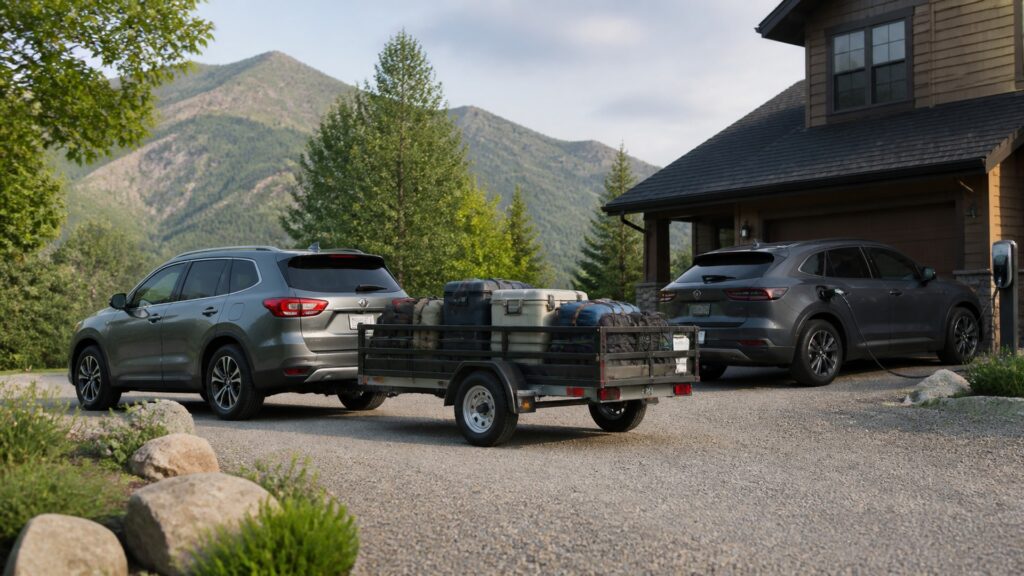
An electric SUV can offer suitable towing capability, but towing also increases energy demand and can change the practicality of the charging route. Gasoline vehicles consume more fuel under towing loads too. Start with verified ratings and then evaluate how each vehicle completes the loaded journey.

  • Check the exact vehicle’s towing, payload, and equipment requirements.
  • Plan with the loaded trailer rather than its empty weight.
  • For charging stops, check whether the layout can accommodate the combination or requires unhitching.

If a midsize electric candidate cannot meet the required seating or load arrangement, compare another suitable vehicle. Do not assume every electric SUV shares that limitation, or that every gasoline midsize meets it.

Cost comparison

Use Your Energy Prices and Your Charging Mix

An EV’s running-cost advantage depends in part on where it charges and what electricity costs there. Public fast charging and home charging can have different prices. Compare the purchase, insurance, tires, required maintenance, and any charging installation with the gasoline or hybrid alternative.

  • Multiply electricity use per distance by the relevant electricity price.
  • Compare fuel use over the same annual distance and driving pattern.
  • Use current quotes rather than assuming a particular incentive or resale value.

A lower energy bill does not automatically establish the lowest total cost. Equally, a charging installation cost should be weighed over the period you expect to use it, rather than treated as a recurring annual expense.

The alternative

Choose Electric When Parked Time Can Supply the Energy

Reliable charging during time the vehicle is already parked can make an electric SUV straightforward to own. A routine that fits comfortably within practical range may need few special charging trips. Quiet electric driving and fewer engine-related maintenance tasks can also be valuable.

  • Check that the electric model meets the same seating and luggage needs.
  • Verify daily charging feasibility before committing.
  • Test whether your demanding regular trips remain practical.

The strongest reason to choose gasoline or hybrid is an unresolved practical constraint. If charging and vehicle fit are already solved, consider the electric SUV on its merits rather than excluding it because it is electric.

Quick Reality Check

When Each Powertrain Has a Practical Advantage

Compare suitable vehicles against the same household requirements.

Gasoline or conventional hybrid can fit better when…

Reliable charging is unavailable and public charging would add repeated inconvenience.

Frequent routes or loaded trips work substantially better with available refueling and the verified vehicle configuration.

Battery electric can fit better when…

Charging occurs conveniently during normal parked time.

The vehicle meets passenger and load needs, and regular trips fit a workable charging plan.

Common Myths

Misconceptions About Midsize and Electric SUVs

Keep size, capability, and energy supply as separate questions.

Midsize SUVs and electric SUVs are opposites

One label describes size and the other propulsion. Many comparisons involve a midsize vehicle on both sides.

No home charger means an EV is impossible

Workplace or public charging can work, but availability, timing, compatibility, and cost must suit the owner’s routine.

The advertised range applies to every journey

Conditions and use affect consumption. Cold weather, higher speeds, and towing can change the trip plan; use vehicle-specific guidance.

A hybrid is the same as an EV without a plug

A conventional hybrid retains an engine and fuel system. A plug-in hybrid is another distinct option whose usefulness depends partly on charging.

Tip: Evaluate the vehicle you can buy and the charging you can actually use.

FAQ

Questions About Choosing a Gasoline, Hybrid, or Electric SUV

Answers that keep the choice tied to real use.

When is a conventional hybrid a sensible compromise?

When its fuel use, space, price, and driving behavior meet your needs and external charging is impractical. It still needs engine-related service.

Should winter rule out an electric SUV?

No. Cold conditions need planning because range and charging behavior can change. Check the model’s guidance and whether your routes still work with an allowance.

Can an electric SUV tow?

Some can, within model-specific limits. Verify the loaded combination and plan charging access and energy demand for that use.

What is the first thing to verify?

Confirm the passenger and cargo requirement, then establish dependable charging access. Those two checks eliminate unsuitable options before detailed cost comparisons.

Bottom Line

Choose a gasoline or conventional-hybrid midsize SUV when it resolves a charging, journey, or vehicle-fit problem that your electric alternatives do not.

An electric SUV can also be midsize. If it meets the same carrying needs and fits a dependable charging routine, it belongs in the comparison.

Next Steps

Go Deeper or Compare Your Options

Use these Review Streets paths to compare related categories and practical next decisions.

Midsize SUVs

Explore midsize models with your passenger, cargo, and ownership requirements in mind.

SUVs

Compare the wider SUV category if another size or configuration may suit the task.

Vehicles

Consider other vehicle types when an SUV does not meet the full travel requirement.

Further reading: DOE: electric-vehicle benefits and considerations; DOE: winter EV operation; DOE: charging station locator; DOE: electric-vehicle maintenance. Use the owner’s manual for the exact vehicle’s instructions and limits.