
Powered Base
Motor, heater, controls, cord, and filter shared by attachments.
- Use: judge core performance
- Variable: airflow and durability
- Tradeoff: One failure disables the system
Use a multi-styler instead of separate tools when one base can complete several repeated steps—such as rough drying, smoothing, volumizing, or curling—with attachments that suit the user's hair length, density, dexterity, and target styles.
Consolidation is not automatically gentler or cheaper. Air-powered attachments still use heat and tension, weak drying can lengthen exposure, and a large kit creates clutter when only one head is used. Compare the complete routine: preparation, attachment changes, total minutes, heat levels, section size, arm strain, cleaning, storage, replacement parts, and whether a conventional dryer or iron still remains necessary.
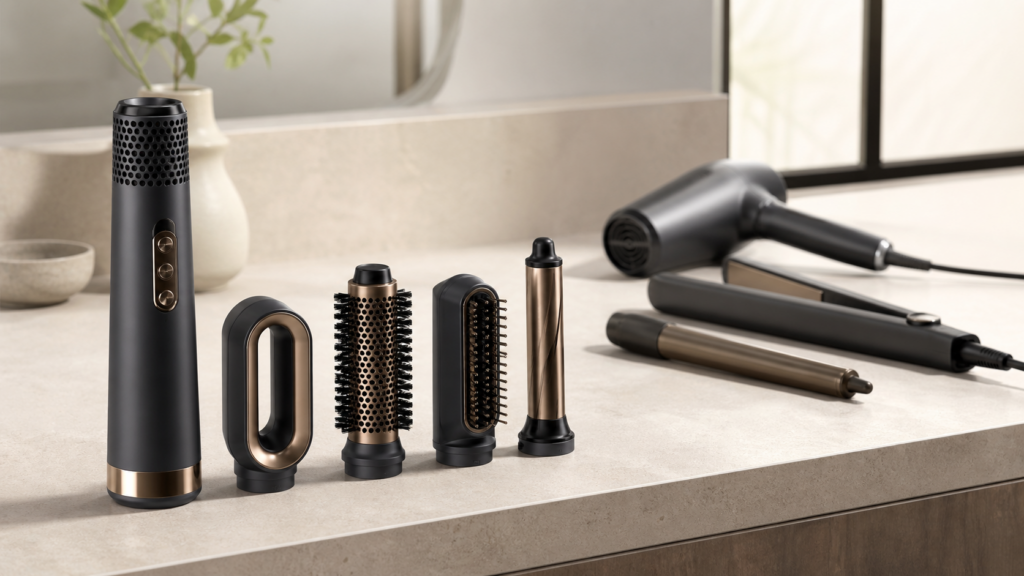
Choose a multi-styler when one powered base and a genuinely used attachment set reduces switching, storage, and total exposure without sacrificing control, drying capacity, or safety.
Tip: Attachment utility beats attachment count.
These when to choose multi-stylers concepts separate mechanism, application, limits, and purchasing consequences.
Motor, heater, controls, cord, and filter shared by attachments.
How often a head performs a distinct needed job.
Reduction in device changes and repeated preparation.
Shape created primarily with heated airflow and tension.
Dependence on one brand's attachment interface and parts.
Loss of several functions when the base fails.
Tip: Use these terms to test when to choose multi-stylers instead of relying on a front-label promise.
List actual weekly styles and map each attachment to one. Duplicate barrels or brushes that remain unused should not justify a larger kit.
Attachment utility beats attachment count.
Airflow, heat, filter, section capacity, and attachment seal determine whether the system saves exposure or extends it.
Consolidation fails when the base bottlenecks every step.
A multi-styler can reduce direct-iron use for some styles, but repeated passes with weak airflow are not free. Count total minutes and corrections.
Air styling is lower-contact, not zero-heat.
Check replacement brushes, barrels, filters, cases, warranty, and future compatibility. A lost attachment or failed base can remove several functions at once.
A system is only as durable as its service path.
A powerful dryer, compact iron, or exact barrel may outperform a generalist system for dense hair, precise roots, travel, professional pacing, or a signature style.
Use the multi-styler only when compromise is acceptable.
Multi-stylers are valuable when system consolidation improves a real routine, not when attachment count becomes the goal.
Several frequently used steps share one stable base and control scheme.
Total time, passes, storage, and tool switching decline.
A compromise attachment may underperform a dedicated tool.
Unused heads and unavailable replacements weaken value.
These claims flatten the variables that determine how when to choose multi-stylers performs in a real routine.
Value comes from frequently used distinct functions. Extra heads add storage and cost, and may duplicate shapes that technique already provides.
Air-powered tools still combine heat, airflow, tension, and repetition. Conservative settings, movement, detangling, and reduced frequency remain important.
Some systems lack strong drying, precise straightening, compact travel, or a specific curl radius. The replacement claim must be tested against the actual routine.
A large case, many heads, cooling space, and accessory storage can occupy more room than two compact dedicated tools. Measure the whole kit.
Brands can change interfaces and discontinue parts. Verify current replacement availability and warranty rather than assuming future compatibility.
Tip: Test the exact when to choose multi-stylers tool, setting, and routine before generalizing from its category.
The remaining decisions about when to choose multi-stylers concern technique, compatibility, safety, upkeep, and value.
Users who repeat several supported styles, value one control scheme, have storage for heads, and can achieve results without repeated corrections are strong candidates.
Only if airflow, heat, nozzle options, filter, and section capacity dry the user's hair efficiently. Compare total time and scalp comfort with a dedicated dryer.
Some reduce direct heated-surface contact, but actual exposure depends on heat, airflow, tension, time, and repetition. Gentleness must be observed, not inferred.
Use every intended head during the return window with normal products and sections. Record time, redos, finish, arm strain, cleaning, and storage.
Filters, brushes, barrels, concentrators, cases, and damaged cords or bases need clear service options. Never improvise incompatible electrical or heated parts.
Choose specialization when one result dominates, power or precision is critical, travel space is tight, or the system requires more time and compromise.
Use a multi-styler when its powered base and genuinely useful attachments consolidate several recurring jobs while lowering switching, storage, or repeated exposure. The system must still deliver adequate airflow, control, and ergonomics.
Keep dedicated tools when they perform the critical task faster, more precisely, or more reliably. Count attachments used, total minutes, serviceability, and system downtime—not the excitement of the unboxing.
These Review Streets paths narrow the next when to choose multi-stylers decision by format, goal, and routine fit.
Compare dryers, irons, wands, multi-stylers, and their buying paths.
Explore airflow, heat control, attachments, ergonomics, and long-term versatility.
Choose a retailer
Prices checked regularly. We may earn a commission at no cost to you.