When to Use No-Code Automation Platforms Instead of Integration Automation Software

When to Use No-Code Automation Platforms Instead of Integration Automation Software is best answered by tracing which category fits the immediate operating need without creating an avoidable gap. Visual Builder establishes the starting condition, while Citizen Developer and Usage Monitor show whether the process can carry a trustworthy result from intake to review. In this article, the practical comparison is with integration automation software.

The useful test is operational rather than promotional: ask a real team to assemble applications and automations through visual configuration, introduce shadow automation, and watch build lead time. Then follow the same case through Environment Boundary and confirm that the final record still supports a clear decision.

By: Review Streets Research Lab
Updated: August 18, 2026
Explainer · 8-12 min read
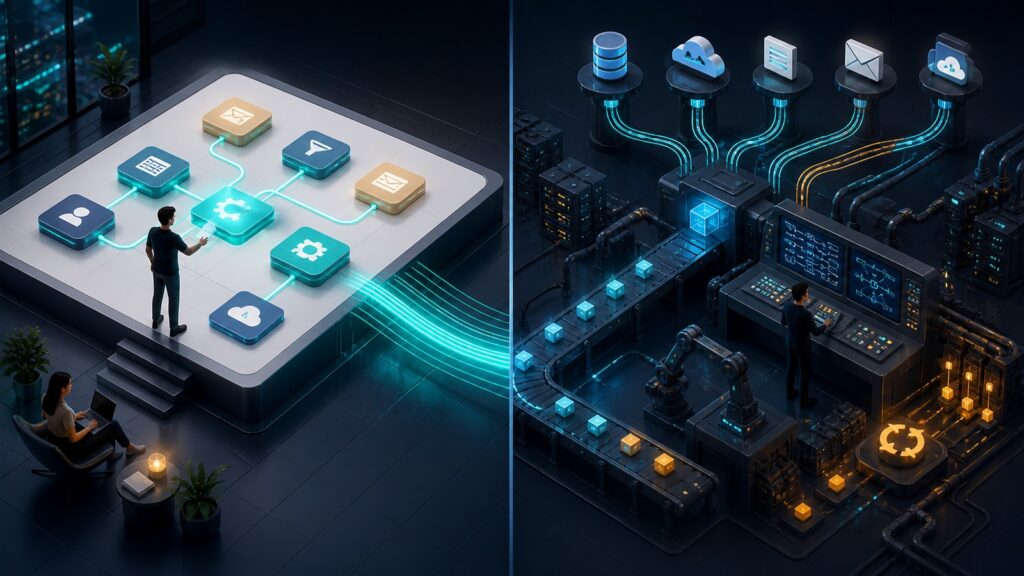
Editorial business scene illustrating no-code automation platforms and integration automation software
What You'll Learn

What to examine when evaluating No-Code Automation Platforms

The sections below use six distinct checkpoints to explain which category fits the immediate operating need without creating an avoidable gap.

  • Establish what enters through Visual Builder and who validates it
  • Follow the handoff from Reusable Component to Citizen Developer
  • Identify the decision controlled by Environment Boundary
  • Simulate shadow automation without losing the original record
  • Use component reuse to judge whether the recovery worked
  • Confirm what Usage Monitor preserves for the next reviewer

Tip: Read the concept as part of a system, then connect it back to the use case.

Definitions

Key Concepts That Define No-Code Automation Platforms and Integration Automation Software

These definitions connect the main idea to the variables, limits, and practical signals readers need to compare options.

Visual Builder: Need to Establish

Visual Builder establishes the first dependable fact in the process. It should assemble applications and automations through visual configuration. For this article's focus on which category fits the immediate operating need without creating an avoidable gap, build lead time is the quickest way to see whether shadow automation is being caught early enough.

  • Show the exact source that feeds Visual Builder and explain why it is authoritative.
  • Create shadow automation before the demonstration begins; do not repair it in advance.
  • Record the starting value for build lead time and the person responsible for responding.

Reusable Component: Fit Question

Work reaches Reusable Component after the initial record exists. Its job is to reuse governed connectors forms rules and templates, without blurring who owns the next decision. Watch component reuse while deliberately introducing fragile visual logic; the behavior of that handoff reveals more than a feature list.

  • Have one operator reuse governed connectors forms rules and templates while another observes the handoff.
  • Delay or interrupt Reusable Component and note which queue, alert, or owner becomes visible.
  • Compare component reuse before and after the interruption instead of relying on impressions.

Citizen Developer: Adoption Handoff

Citizen Developer is the point where the system changes or enriches the working state. A credible design can enable trained business users to build within defined limits and still leave the earlier facts recoverable. If uncontrolled publishing appears, publishing exceptions should expose the problem before downstream teams rely on it.

  • Trace one representative record into, through, and out of Citizen Developer.
  • Change a key value and verify that the earlier state remains explainable.
  • Use publishing exceptions to decide whether the transformation is complete and timely.

Environment Boundary: Tradeoff to Accept

Environment Boundary marks a business boundary, not merely another screen. The platform must separate development testing and production environments under an explicit rule. Test the boundary with abandoned citizen-built solutions, then determine whether supported-solution coverage gives the approver enough context to accept, reject, or reroute the case.

  • Name the role allowed to approve the decision at Environment Boundary.
  • Attempt an out-of-policy action and inspect the denial or escalation path.
  • Require the approver to justify the outcome using retained facts, not memory.

Publishing Gate: Risk to Test

Publishing Gate becomes important when ordinary processing stops being ordinary. It needs to review approve and release changes without unmanaged deployment while preserving the unresolved condition. A buyer should examine how shadow automation is surfaced and whether build lead time changes soon enough for a responsible person to intervene.

  • Stage shadow automation during normal volume and observe how quickly it becomes actionable.
  • Follow the exception until a named person accepts responsibility for it.
  • Verify that correction improves build lead time without hiding the original failure.

Usage Monitor: Reason to Choose

Usage Monitor closes the loop by making the outcome visible to the next participant. It should track adoption failures capacity and unsupported solutions and retain enough history to explain what happened. Use component reuse to confirm recovery from fragile visual logic, then ask a second reviewer to reconstruct the decision independently.

  • Give the completed case to someone who did not participate in the test.
  • Ask that reviewer to explain the sequence, decision, and remaining uncertainty.
  • Accept the result only when component reuse reconciles with the source and destination records.

Tip: Keep the definitions connected; the strongest answer usually comes from the whole system, not one term.

End-to-End Trace

Follow one case from intake to outcome

Begin with Visual Builder and a single representative case. Follow it through Reusable Component and Citizen Developer until Usage Monitor records the result. At every transition, identify what changed, who accepted it, and which source remains authoritative. This trace shows whether no-code automation platforms supports which category fits the immediate operating need without creating an avoidable gap as one connected process or merely presents disconnected features.

  • Select a case that enters through Visual Builder
  • Mark each state change through Citizen Developer
  • Identify the owner at Environment Boundary
  • Reconstruct the outcome from Usage Monitor

The test is complete when Reusable Component remains explainable, shadow automation is visible rather than hidden, and build lead time supports a documented decision.

Ownership Map

Separate system work from human judgment

Assign a named operator to Reusable Component, a decision owner to Environment Boundary, and an exception owner to Publishing Gate. Then ask the team to separate development testing and production environments. If the same person can silently create, approve, and conceal a change, the design has confused convenience with control. The ownership map should make separation and escalation visible without slowing ordinary work unnecessarily.

  • Separate creation rights from approval at Environment Boundary
  • Document who monitors component reuse
  • Route fragile visual logic to a named escalation owner
  • Test coverage during absence, reassignment, and turnover

The test is complete when Citizen Developer remains explainable, fragile visual logic is visible rather than hidden, and component reuse supports a documented decision.

Operational Fit

Test the surrounding handoffs and dependencies

Place no-code automation platforms inside the real operating environment rather than an isolated demo. Connect Visual Builder to its source, exercise Citizen Developer at realistic volume, and pass the result from Usage Monitor to the next team or system. Evaluate the handoff with publishing exceptions, including retries, corrections, and delayed dependencies that polished demonstrations usually omit.

  • Use production-like volume at Citizen Developer
  • Include one delayed upstream dependency
  • Verify retry behavior without duplicate work
  • Reconcile the downstream result using publishing exceptions

The test is complete when Environment Boundary remains explainable, uncontrolled publishing is visible rather than hidden, and publishing exceptions supports a documented decision.

Failure Exercise

Expose how the process behaves under strain

Introduce shadow automation first, then add uncontrolled publishing before the team finishes the initial recovery. Observe what happens at Publishing Gate: the exception should remain visible, assigned, and linked to its original facts. A useful test ends only after normal processing resumes and the team can explain why the correction did not create a second hidden problem.

  • Trigger shadow automation without warning the operator
  • Add uncontrolled publishing during recovery
  • Inspect the queue and history at Publishing Gate
  • Require a clean return to normal processing

The test is complete when Publishing Gate remains explainable, abandoned citizen-built solutions is visible rather than hidden, and supported-solution coverage supports a documented decision.

Decision Evidence

Measure whether the result can be trusted

Use build lead time to establish a baseline, component reuse to monitor the active process, and supported-solution coverage to judge the final outcome. Numbers alone are insufficient; each measure needs a source, owner, review interval, and decision threshold. For when to use no-code automation platforms instead of integration automation software, the strongest evidence connects those measures to a reproducible case rather than an attractive average.

  • Record the baseline for build lead time
  • Define the decision threshold for component reuse
  • Explain any movement in supported-solution coverage
  • Have an independent reviewer repeat the conclusion

The test is complete when Usage Monitor remains explainable, shadow automation is visible rather than hidden, and build lead time supports a documented decision.

Quick Reality Check

What No-Code Automation Platforms can clarify—and what still needs management

The platform can make which category fits the immediate operating need without creating an avoidable gap visible, but it cannot supply sound policy, accountable ownership, or reliable source data on its own.

Evidence of a workable design

Visual Builder has a trusted source, and build lead time is reviewed by a named owner.

Environment Boundary applies an explicit decision rule while preserving the facts behind each approval.

Responsibilities the software does not remove

The platform cannot correct fragile visual logic when the organization has not defined ownership or policy.

A favorable publishing exceptions does not prove the result is useful if the underlying source or decision rule is wrong.

Common Myths

Misconceptions About No-Code Automation Platforms and Integration Automation Software

Common shortcuts and misunderstandings can make the topic seem simpler than it is.

Visual Builder makes the rest of No-Code Automation Platforms automatic

Visual Builder matters, but it does not eliminate shadow automation. Test whether the team can assemble applications and automations through visual configuration, then use build lead time to confirm the correction before ordinary work resumes.

A good component reuse means exceptions no longer need review

Reusable Component matters, but it does not eliminate fragile visual logic. Test whether the team can reuse governed connectors forms rules and templates, then use component reuse to confirm the correction before ordinary work resumes.

Citizen Developer and Environment Boundary can share an undefined owner

Citizen Developer matters, but it does not eliminate uncontrolled publishing. Test whether the team can enable trained business users to build within defined limits, then use publishing exceptions to confirm the correction before ordinary work resumes.

A successful demo proves No-Code Automation Platforms will work at operating scale

Environment Boundary matters, but it does not eliminate abandoned citizen-built solutions. Test whether the team can separate development testing and production environments, then use supported-solution coverage to confirm the correction before ordinary work resumes.

Tip: Treat strong claims as starting points for comparison, not final answers.

FAQ

Frequently Asked Questions About No-Code Automation Platforms and Integration Automation Software

Concise answers to common questions readers may have after the main explanation.

What should buyers test first in No-Code Automation Platforms?

Start with Visual Builder. Ask a representative operator to assemble applications and automations through visual configuration, introduce shadow automation, and record build lead time. The exercise reveals whether the starting record, ownership, and first handoff are dependable.

How should a team evaluate Citizen Developer?

Trace one real case through Citizen Developer while a second person observes. Change an important value, preserve the earlier state, and use publishing exceptions to verify that the transformation remains complete and explainable.

Which failure reveals the most about No-Code Automation Platforms?

Simulate abandoned citizen-built solutions during realistic volume because it challenges both ordinary processing and recovery. Follow the case into Publishing Gate, assign an owner, and confirm that supported-solution coverage improves without erasing the original failure.

What evidence should remain after the demonstration?

Retain the source state, every material change, the responsible roles, the exception reason, and the final approval. A new reviewer should be able to reconstruct Usage Monitor and reach the same conclusion independently.

Bottom Line

No-code automation platforms let governed business builders create applications and automations visually while environments, components, publishing, and support remain controlled.

Before selecting no-code automation platforms, run one continuous case from Visual Builder through Usage Monitor, include shadow automation, and require an independent reviewer to reconcile the outcome using publishing exceptions. In this article, the practical comparison is with integration automation software.

Next Steps

Go Deeper or Compare Your Options

Use these Review Streets paths to connect the explainer to related categories, comparisons, and next decisions.

Quick Summary

No-Code Automation Platforms and Integration Automation Software Explained

  • Visual Builder — establish the trusted starting record
  • Reusable Component — inspect the first operational handoff
  • Citizen Developer — verify how the working state changes
  • Environment Boundary — name the rule and decision owner
  • Publishing Gate — route failures without hiding them
  • Usage Monitor — preserve evidence for independent review