
Pilates training
A practice often built around controlled repetitions, trunk organization, and resistance or apparatus cues.
- Repetition-centered
- Often equipment-guided
- Control is central
Pilates training and yoga practice overlap, but they are not the same decision. Pilates often emphasizes controlled repetitions, trunk control, apparatus setup, and resistance-guided movement. Yoga often emphasizes poses, transitions, breath pacing, mobility, balance, and sometimes stillness or meditation.
Use Pilates when the session goal is structured resistance, repeated control work, or apparatus-guided feedback. Use yoga when the goal is pose practice, flow, mobility emphasis, or a breath-led session rhythm.
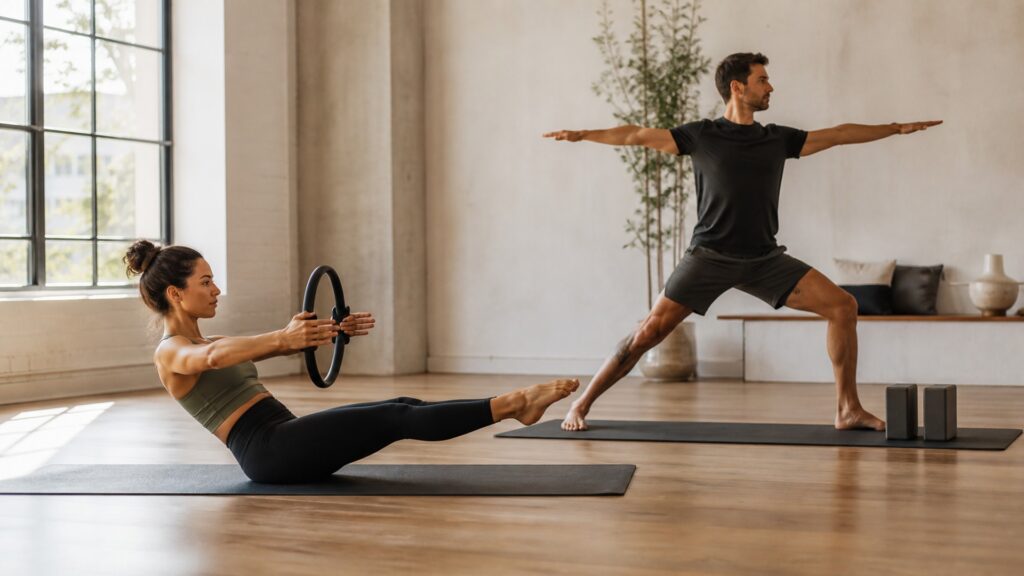
A focused explanation of the signals, movement constraints, tradeoffs, and limits behind Pilates Training vs Yoga Practice.
Tip: For Pilates Training vs Yoga Practice, compare the behavior first; the product or practice label comes second.
These definitions connect the main idea to the variables, limits, and practical signals readers need to compare options.
A practice often built around controlled repetitions, trunk organization, and resistance or apparatus cues.
A practice often organized around poses, transitions, breath pacing, mobility, balance, or stillness.
Repeated movement with consistent range, tempo, and position.
A linked series of poses or transitions.
External support or load that helps or challenges a movement.
An instruction that uses breathing to pace or organize movement.
Tip: If the explanation skips controlled repetition and spring resistance, it is probably too generic.
Pilates is often the better match when the session is built around repeated controlled movement, trunk organization, apparatus feedback, or small changes in resistance and range.
Pilates fits when the lesson is repeated control under a defined setup.
Yoga is often the better match when the goal is a pose sequence, mobility emphasis, balance practice, breath-led pacing, or a class structure that includes stillness.
Yoga fits when the practice rhythm matters as much as the exercise selection.
A mat-only Pilates class and a reformer class can feel very different because springs, straps, and carriage travel change the resistance path. Yoga props usually modify support rather than becoming the main machine.
Equipment can shift Pilates from mat practice to apparatus training.
Pilates and yoga can both involve strength, balance, mobility, breathing, and body awareness. The difference is the organizing logic: repeated control and resistance versus poses, transitions, and practice rhythm.
The practices overlap in benefits but differ in structure.
If the question is how to control a repeated movement against resistance, Pilates may fit better. If the question is how to explore poses, mobility, flow, or breath pacing, yoga may fit better.
The better choice is the one whose structure matches the day.
A useful explanation should clarify the decision without pretending one rule covers every product, body, app, surface, or practice.
It clarifies which class structure and equipment logic fits the session goal.
It gives readers a practical vocabulary for comparing claims without leaning on vague fitness language.
It does not claim one practice is healthier, safer, or better for every person.
The right interpretation can change with fit, setup, instruction, surface, activity type, and the exact product.
Common shortcuts and misunderstandings can make the topic seem simpler than it is.
Pilates has its own movement logic, often built around repetition, trunk control, and resistance. Yoga is not simply an easier version of it.
Many yoga styles include strength, balance, transitions, breath work, and sustained positions, not only passive flexibility.
Mat Pilates exists and can be structured around bodyweight control, small props, and precise repetition.
They can overlap, but class design, equipment, tempo, and instruction change the training effect.
Neither practice guarantees safety. Pain, medical concerns, and individualized limitations need qualified guidance.
Tip: Treat strong claims as starting points for comparison, not final answers.
Concise answers to common questions readers may have after the main explanation.
Choose Pilates when controlled repetitions, trunk organization, apparatus resistance, or precise movement feedback are the main goals.
Choose yoga when pose practice, flow, mobility emphasis, balance, breath pacing, or stillness better match the session.
Yes. Both can involve strength, mobility, breathing, and control, but they usually organize the session differently.
No. Reformers add spring-guided resistance, but mat Pilates can still be a complete practice format.
No blanket claim is appropriate. Pain or rehabilitation questions should be handled with qualified individual guidance.
Use Pilates training when controlled repetition and resistance-guided feedback are the main point.
Use yoga practice when poses, flow, breath pacing, mobility, or stillness define the session. The right choice follows the practice goal.
Use these Review Streets paths to connect the explainer to related categories, comparisons, and next decisions.
Use this hub to compare mats, props, reformers, rings, and balance tools across the broader Yoga and Pilates equipment space.
Use this path when surface grip, cushioning, sweat handling, and floor feel are the next equipment questions.
Use this path when springs, straps, rings, reformers, and resistance-assisted positioning are the next comparison point.
Choose a retailer
Prices checked regularly. We may earn a commission at no cost to you.